A library of padel drills you can run without a coach, sorted by skill, with the number of players each one needs, the level it suits, how to set it up and what to watch for. At the end there's a template for a 45 to 60 minute session and a simple way to tell whether any of it is working.
How to use this library
Each drill starts with who you need (solo, two or four players) and the level it suits. Beginners are still learning the walls and the basic strokes. Improvers can rally, but one or two shots let them down. Intermediate players are comfortable at the net and working on overheads and decisions. Then comes the setup, and the one thing to focus on.
Pick one theme per session, two drills from that section, and a scoring game to finish. Trying to cover volleys, the glass and the serve in one booking tends to leave all three half done.
- Bring at least a dozen older balls. With a tube of three you'll spend the hour picking them up.
- Feed a steady, repeatable ball. Throwing by hand often beats hitting, especially for glass drills.
- Give each drill a number to beat: a rally count, hits out of ten, points to ten. Without one, a drill drifts back into a casual knock.
Several drills come from LTA Padel's coaching pages, and we say so where they do. The rest are standard exercises used across the game, written up in our own words. If a Spanish shot name is new, the padel glossary explains it.
Warm-up drills
A warm-up is a drill in itself: it should raise your heart rate, wake up your feet and find your timing before anything hard happens. Ten minutes is enough. Build the pace gradually and keep it gentle for the first few minutes.
- Mini padel. Two or four players, all levels. Everyone stands inside the service boxes and rallies softly, letting each ball bounce once before playing it. Focus on clean contact and small, quick steps between shots. After a few minutes, take a step back and let the rally lengthen.
- Racket taps. Solo, beginner. Tap the ball straight up off the racket face and count how many you can do in a row, then alternate the two faces on each tap. LTA Padel suggests it for building control. Focus on a relaxed grip and meeting the ball in the middle of the face.
- Back, middle, front. Two or four players, all levels. Rally from the back for three or four minutes, move up to volley for three, then hit a few gentle overheads each and finish with five serves and returns per player. Focus on raising the pace slowly and noticing how the ball comes off the glass today.
Serve and return
The serve is the one shot you control from start to finish, and LTA Padel points out that it's one of the least practised parts of the game. Keep every practice serve legal (bounce behind the line, contact at or below the waist, at least one foot on the ground) so the habit carries into matches. The serve and return guide has the rules and the technique in full.
- Three targets. Solo, beginner. Put a marker in three spots in the service box: near the centre line, tight to the side glass, and where the receiver's body would be. Hit ten serves at each and count the ones that land close, then repeat into the other box. Focus on the same simple routine every time: drop, bounce, swing.
- Serve and arrive. Two players, improver. This one is from LTA Padel. The server places a marker at the net roughly level with the second post on the side fence and about a racket's length from the centre line. Serve, then try to reach the marker before the returner plays their shot. Five attempts each, then swap. Focus on finishing the serve before you run in.
- One serve only. Four players, improver. Play points or games with a single serve per point. Focus on a serve you trust under pressure: most players find their safe serve is better placed than they expected.
- Return to the feet. Two players, improver. The server serves and moves in to volley. The returner tries to land the return low, around the server's feet as they arrive, or lobs if the server gets in too quickly. Focus on a short, compact swing (and the serve must bounce before you return it).
From the back: groundstrokes and the glass
Most defending happens from the back, and these drills build the patience it needs. The forehand and backhand post covers the strokes themselves.
Groundstroke drills
- Ladder rally. Two players, beginner. An LTA Padel drill. Use half the court and rally with a target of two shots, then three, then four. Any mistake sends you back to two. When that's comfortable, put one player at the net and the other at the back. Focus on control: a slower ball that goes in beats a fast one that might.
- Cross-court only. Two players, beginner to improver. Each of you takes one half of the same diagonal and rallies cross-court only, from the back, with a target of twenty in a row. Focus on depth, and on recovering to the middle of your half after every shot.
- Under the net players. Four players, improver. One pair at the net, one at the back. The back pair can only play low balls that would reach the net players below waist height, aimed through the middle or at their feet. Swap after ten points. Focus on keeping the ball low, not fast.
- Decision line. Four players, improver. Another LTA Padel game. Treat the service line as a decision line: a ball that bounces before it is played without the glass, a ball that bounces past it is left to come off the glass. Breaking that rule earns a yellow card, and a second in the same rally loses the point. Focus on judging the bounce early.
Glass drills
Spacing is most of the glass. Stay further from the wall than feels natural and let the ball come out to you. The guide to playing off the glass explains the footwork.
- Throw and catch. Solo or two players, beginner. Stand near the service line, throw the ball so it bounces and hits your back glass, then catch it as it comes out. No racket, so all you're learning is where to stand. Focus on letting the ball drop to waist height before you catch it.
- Back glass feed. Two players, beginner. From LTA Padel. The feeder stands on your side and throws or hits slow, deep balls that bounce past the service line into the glass. Play each rebound softly back to the feeder. At first allow an extra bounce after the glass; then take it away. Feed both sides at random. Focus on a side-on position before the ball reaches the wall.
- Corner balls. Two players, improver. Same setup, but the feeder aims into the corner so the ball comes off the side and back glass (LTA Padel uses this as the harder version). Focus on waiting: the second wall changes the angle, and moving too early leaves you on the wrong side.
- Glass to lob. Two players, intermediate. One player at the net on the far side, the other at the back. The net player volleys deep so the ball reaches the back glass; the back player plays it off the glass as a lob over the net player. Focus on height: a lob from the glass needs time to climb.
Volleys and net play
Volleying is about a short, firm action and depth. For technique, see the volleys and net play guide and the volley post.
- Volley to volley. Two players, beginner. Stand opposite each other at the net, two to three metres back, and keep a soft volley rally going without letting the ball bounce. Count your best together. Focus on a racket held up in front of you and almost no backswing.
- Block wall. Two players, improver. The feeder stands at the back and hits firm balls at the volleyer, who blocks each one back deep. Ten balls, then swap. Focus on a steady racket face: let the pace of the incoming ball do the work.
- Target zones. Two players, improver. Lay towels on the far side, past the service line but well short of the back glass. The volleyer aims for the first bounce to land on or near them. A volley that bounces deep and sits up off the back glass gives the defender time, which is why the target sits short of the wall. Focus on placement over pace.
- Push them back. Four players, improver. From LTA Padel. One pair at the net, one at the back. The back pair start the point, and the net pair must land three volleys past the service line before the point is played out. Only the volleying pair can score; if the back pair win the point, they become the volleying pair. Focus on depth.
- High and low. Two players, intermediate. The feeder mixes balls above the net with balls that dip below it. Low ones get lifted back deep and safe; high ones get punched into a corner. Focus on recognising which ball you've got before you swing.
Overheads: bandeja, víbora and smash
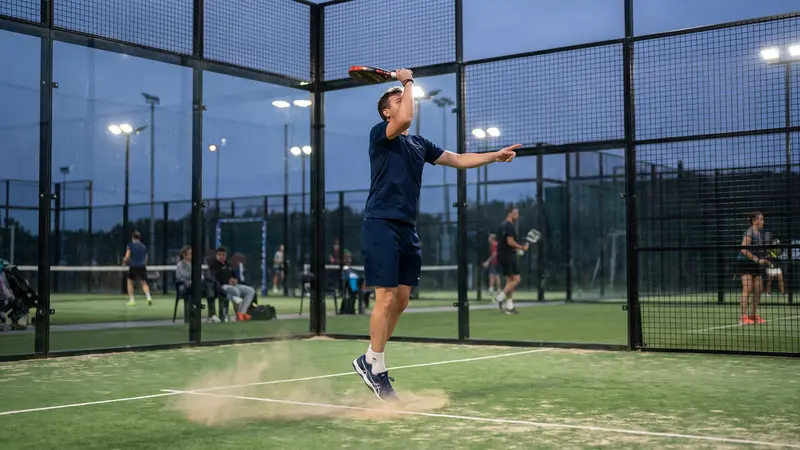
A match gives you a handful of overheads, each with a point riding on it; a drill gives you dozens in a row. The bandeja is the controlled, sliced overhead that keeps you at the net, and the víbora is its more aggressive sidespin cousin. The bandeja and víbora guide covers both, and when to smash.
- Shadow overheads. Solo, beginner. No ball. From the net, turn sideways, side step back three or four steps with your free arm pointing up, swing a slow bandeja, then step back in. Ten times, then the other way round for the víbora. Focus on turning before you move back.
- Lob and recover. Two players, improver. One player lobs from the back; the other starts at the net, moves back, plays a bandeja deep, then returns to the net before the next lob. Score a point for every overhead that lands deep and lets you get back in. Focus on the recovery, even after a poor shot.
- Defend the net. Four players, improver to intermediate. From LTA Padel. The back pair feed a lob. The net pair must land a bandeja beyond the service line, and then the point is live. Swap which pair starts at the net every two points; first to ten wins. Focus on keeping your net position.
- Read the lob. Two players, intermediate. The feeder mixes deep, high lobs with shorter ones. Deep lobs get a bandeja; short ones that land around the service line can be attacked. Call your choice out loud before you hit. Focus on deciding early, and choosing the bandeja whenever you're unsure.
Lob and defence
The lob is how a defending pair takes the net back. A good one is high and deep, landing near the back glass so the net pair have to retreat. Players who lob off balance usually lob short, so the setup matters as much as the swing.
- Lob targets. Solo or two players, beginner. Put markers beyond the service line towards the back of the far court. Self-feed or have a partner feed, and lob for the markers. Focus on getting low and finishing with the racket high.
- Two up, two back. Four players, improver. From LTA Padel. The net pair feed, and the back pair must start every rally with a lob, then the point is played out. Swap ends every two points; first to ten. Focus on following a good lob in to the net as a pair.
- Lob over the backhand. Two players, improver. The net player stands on one side. The lobber aims over the net player's backhand shoulder, which is the harder side to play an overhead from. Focus on direction as well as height.
- Survive and switch. Four players, intermediate. The net pair attack anything high; the back pair may only defend (lobs, low balls, glass returns) until they land a lob deep enough to take the net. Then the roles switch mid-rally. Focus on patience: the defending pair win by waiting for the right ball to lob.
Movement and communication as a pair
Plenty of points are lost in the gap between two players. These drills train moving as a unit and calling the ball. The positioning and tactics guide and the positioning post explain where you should be.
- The rope. Two players, beginner. No ball. Stand side by side at the net about two to three metres apart, as if tied together. One player shuffles left, right, forward or back, and the other mirrors to keep the gap. Thirty seconds, then swap leaders. Focus on short side steps and never crossing your feet.
- Call everything. Four players, all levels. Play normal points, but every ball must be called, "mine" or "yours", before it's hit. An uncalled ball loses the point, even if it's a winner. Focus on calling early and loudly enough to be heard.
- Middle ball rule. Four players, improver. Before you start, agree who takes balls down the middle (often the player with their forehand in the centre). The feeder sends only middle balls. Any ball both players go for, or neither touches, is a point to the feeders. Focus on trusting the rule you agreed.
- Back together. Four players, intermediate. The back pair lob every few balls. When a lob goes over, both net players retreat together, and when the overhead or defence is done, both move forward together. Count the times one player is left at the net alone. Focus on watching your partner as well as the ball.
- Yellow card, red card. Four players (or two on half court), all levels. An LTA Padel game. Play normal games, but your pair's first error in a game is a yellow card and a second loses the game. It rewards keeping the ball in, which decides a lot of club matches.
Building a session and measuring progress
A 45 to 60 minute session
Many bookings are an hour, and you lose a few minutes of that to changing shoes and chatting. Pick one theme, take two drills from that section, and finish with a game that puts the same skill under pressure.
| Block | Minutes | What to do |
|---|---|---|
| Warm-up | 8 to 10 | Mini padel, then back, middle, front |
| Main drill | 12 to 15 | The easier drill from your theme, swapping roles every few minutes |
| Harder drill | 12 to 15 | The next drill up, or the same one with a target |
| Pressure game | 10 to 15 | A scoring game using the theme, such as push them back or defend the net |
| Note it down | 2 to 5 | Write your numbers before you leave |
For a 45-minute slot, cut the harder drill. If a drill is going badly, stay with it longer and drop the next one.
On repetition: the same ball over and over improves a shot quickly within the session, while mixed balls feel messier but, in lab studies, help skills stick. A 2024 review in Frontiers in Psychology found that difference much smaller in real sport settings. So groove the shot with simple feeds, then mix it up and finish with points.
How to measure progress
Feeling better is hard to judge from one week to the next. Numbers are easier. Keep a note on your phone and record the same few after every session:
- Best ladder rally, volley-to-volley count or glass rally.
- Serves on target out of thirty, and first serves in out of twenty.
- Overheads that land deep and let you recover, out of ten.
- Scores from the pressure games, such as defend the net to ten.
Re-test every few weeks under the same conditions: same drill, same feeder if you can, same number of balls. A phone propped against the fence shows things you can't feel, such as how close you stand to the glass or how late you split step.
In matches, count one thing. Unforced errors are a good one, or how many times your pair got to the net. Match results depend on the opponents, so they're a poor measure of your own progress.
If your numbers stall for a month on the same shot, more drilling probably won't fix it. That's when an hour with a coach pays off, and it helps to know what a padel lesson involves before you book. For more match practice, the court finder shows venues near you.
Questions players ask
Can I practise padel on my own?
Yes. Serves, racket taps, throw-and-catch on the back glass, rallying against your own glass and shadow overheads all work alone. You'll need other people for volleys at pace, reading opponents and moving as a pair.
How many balls do I need for drills?
At least a dozen, and more is better. Older balls that have lost some pressure are fine for drills, and they save new ones for matches.
How long should a padel practice session be?
Forty-five to sixty minutes covers a warm-up, two drills on one theme and a pressure game. Twenty focused minutes of solo serving is also worthwhile.
Should I drill or just play matches?
Both. Matches teach decisions and partnership, while drills give you the repetitions on one shot that a match never will. If you only get one session a week, spend the first part on a single drill and play points for the rest.
What is the best drill for beginners?
The LTA ladder rally on half a court, followed by the back glass feed. Together they build consistency and the skill beginners find hardest, which is the glass.
Find a court near you
Over 700 UK venues with opening hours, facilities, nearest stations and booking links.
Open the court finderSources
- ltapadel.org.uk/play/padel-training-tips/
- ltapadel.org.uk/play/padel-tips-and-techniques/serve/
- ltapadel.org.uk/play/padel-tips-and-techniques/volleys/
- ltapadel.org.uk/play/padel-tips-and-techniques/lobs/
- ltapadel.org.uk/play/padel-tips-and-techniques/overheads-bandeja-and-the-smash/
- ltapadel.org.uk/play/padel-tips-and-techniques/how-to-play-off-the-back-glass-in-padel
- ltapadel.org.uk/play/padel-tips-and-techniques/forehands-and-backhands/
- ltapadel.org.uk/play/how-to-get-started-playing-padel/skills-for-beginners/
- thepadelschool.com/drill-book
- thepadelschool.com/padel-tips/training-padel-volleys
- thepadelschool.com/padel-tips/the-padel-lob
- thepadelschool.com/padel-tips/the-padel-serve
- thepadelschool.com/resources/blog/padel-tips-how-to-warm-up-with-your-padel-partner
- totalpadel.com/lc/how-to/how-to-improve-faster-in-padel.html
- pmc.ncbi.nlm.nih.gov/articles/PMC11349744/