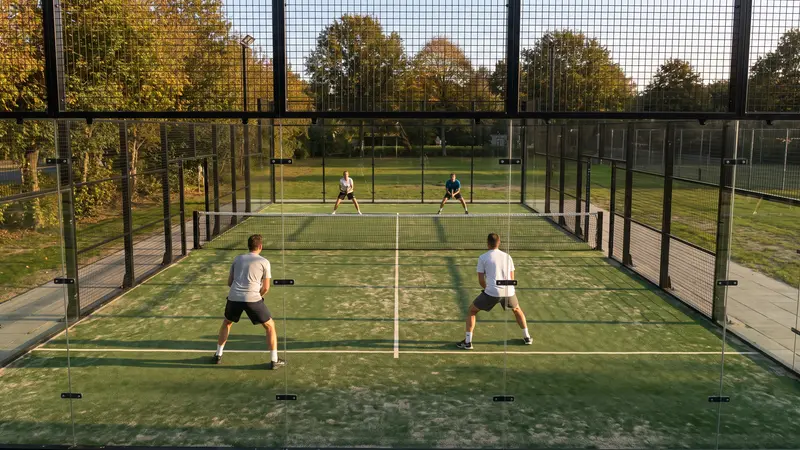
The walls are what make padel padel. Learning to let the ball come off the glass, rather than lunging at it, is the skill that separates newer players from improvers. This guide takes you through each kind of rebound and how to move for it.
Why the glass is your friend
In tennis, a ball that gets past you is usually a lost point. In padel, once the ball has bounced on your side it can hit your back or side glass and you can still play it, as long as it has not bounced twice on the floor. The full rules on walls are in our padel rules and scoring guide.
That gives you time. A deep ball that would rush you if you hit it straight away often comes off the glass slower and at a comfortable height. The key is patience: let the ball come to you.
The back glass
This is the rebound you will see most. The ball bounces, hits the back wall and comes back towards the net.
- Turn early. Turn your shoulders side-on and take the racket back as soon as you see the ball is going deep.
- Move back with the ball. As it heads for the glass, take a small step or two back so you are not crowded.
- Move forward to hit. As the ball comes off the wall, step forward and meet it in front of your body. This lets you use your whole body rather than just your wrist.
- Give yourself space. Stand far enough from the wall that you are not jammed. A metre or so from the glass is a reasonable starting point, adjusting to the pace of the ball.
The commonest mistake is staying too close to the wall and hitting the ball when it is already behind you. That leads to scooped, weak shots.
Reading the rebound
- A hard, flat ball comes off the glass fast and travels further back towards the net. Give it more room.
- A soft, looping ball drops close to the glass. Move in towards it.
- Slice makes the ball stay low after the bounce and off the wall. Topspin makes it kick up and forward.
Once the ball is off the wall, the height decides your shot. Waist height or higher is a chance to attack or play a firm drive. Knee height or lower is a defensive ball: lift it safely, usually as a lob.
The side glass
A ball that bounces and hits the side wall changes direction across the court rather than coming back towards you. The trick is to turn so your shoulders face the side wall, let the ball come off it, and hit it as it moves away from the glass.
Do not chase the ball into the wall. Stay a little away from it, wait for the rebound and then move with it. If you are unsure where it will go, take an extra moment to watch the bounce off the glass before committing.
Double walls
A double wall (doble pared) is when the ball hits two walls after bouncing, usually back then side, or side then back. It looks chaotic at first but follows predictable angles.
- Back then side: the ball comes off the back glass, then the side glass pushes it into the middle of the court. Move towards the centre and wait.
- Side then back: the ball comes off the side glass and then the back glass pushes it towards the net. Stay back and let it travel forward.
The common advice for beginners is to stay patient, keep the racket face slightly open and let the ball finish its path before hitting. Most double-wall balls end up slower than they started.
Corners and the contrapared
Balls deep in the corner are the hardest to read because they can hit both walls in quick succession. Keep your distance, watch the ball closely and wait. Often the best you can do is a safe lob back cross-court.
When you really cannot get to a ball before it passes you, there is a last-resort option: the contrapared. This means hitting the ball into your own back or side wall so it rebounds over the net. It is legal off the glass (hitting your own mesh fence loses the point), but the ball usually comes back soft and high, so it is purely a rescue shot. Use it to stay in the point, not to win it. Look up this and other wall terms in our padel glossary.
Attacking off the glass
When a ball comes off the back glass high, you can attack it. A firm drive at the feet of the net players, or an overhead known as a bajada, can turn defence into attack. These are medium to advanced shots, so build your basic wall play first. Our volley and net play guide explains how the bajada helps you win back the net.
Footwork and patience
- Keep your feet moving with small steps. Big strides make fine adjustments impossible.
- Turn sideways first, then move. Turning late is the root of most wall mistakes.
- Hit the ball as it moves away from the glass, not as it hits it.
- If in doubt, lob. A high, deep lob from the back of the court is never a bad answer.
Drills
Wall play is easiest to learn with a feeder and a basket of balls. Courts vary a little in how lively the glass is, so practise at the venue you play most; our court finder lists UK venues.
- Catch it first. A partner throws balls so they bounce and hit the back glass. Catch the ball with your hand as it comes off the wall, without moving your racket. It trains your eyes and feet before you add a swing.
- Back glass to lob. The feeder sends deep balls. Let each one come off the back glass and play a lob cross-court. Count how many land beyond the opponents' service line.
- Step back, step in. As each ball heads for the glass, say "back" as you step back and "in" as you step forward to hit. Saying it out loud fixes the timing.
- Side glass drives. The feeder aims at your side glass. Let the ball come off the wall and drive it low down the line.
- Double-wall reading. The feeder throws balls into the corner. Before you hit, call "middle" or "forward" to predict where the ball will go, then play it.
Our padel drills and practice library has more glass drills, including ones you can do on your own with a few balls.
Questions players ask
Can I hit the ball before it reaches the back glass?
Yes. After the bounce you can hit it straight away or let it come off the glass. Letting it come off the wall usually gives you more time.
How far from the back wall should I stand?
Far enough that the ball has room to come off the glass in front of you. A metre or so is a sensible start, then adjust to the pace of the ball.
Is it legal to hit the ball into my own wall?
Yes. Hitting the ball into your own wall so it goes back over the net (a contrapared) is legal. It is usually a defensive rescue shot.
What happens if the ball hits the mesh fence?
After a bounce on your side, a ball that hits the mesh is still in play, though it can rebound unpredictably. Players usually avoid waiting for mesh rebounds.
Does my racket make playing off the glass easier?
A control-focused racket with a forgiving sweet spot can help newer players. See how to choose a padel racket or try the racket match quiz.
Find a court near you
Over 700 UK venues with opening hours, facilities, nearest stations and booking links.
Open the court finder