The bandeja and the víbora are the two overheads that make padel different from tennis. This guide explains what each one is for, how to hit them, when to use which, and why the full smash is usually the wrong choice at club level.
Why padel has special overheads
In tennis, a lob that you reach is usually a chance to smash for a winner. In padel, a hard smash that bounces deep often hits the back glass and comes back to your opponents at a comfortable height. Meanwhile you are out of position.
The LTA calls the bandeja the antidote to the lob. Its main job is not to win the point but to keep you at the net. The víbora is its more aggressive cousin. Both are hit with slice so the ball stays low and does not sit up off the glass.
The bandeja
Bandeja means "tray" in Spanish, and the racket position looks like you are holding a tray or plate above your shoulder. It is the most common overhead in padel.
What it is for
Use it when you are lobbed and cannot hit a clean winner. A good bandeja takes pace off the ball, lands deep, and gives you and your partner time to get back to the net or stay there.
How to hit it
- Turn side-on as soon as you see the lob, so your shoulders face the side wall.
- Raise the racket early, above and slightly behind your head, with the face open. Point your free hand at the ball to help you track it.
- Let the ball drop to around eye height. Hitting it at the top of your reach is a smash habit and costs you control.
- Swing high to low and slightly across the ball, cutting under and behind it for slice.
- Finish across your body, with your arm wrapping round like a scarf (the LTA's description), not down by your knees as in a tennis smash.
Aim for medium pace and good depth. Good targets are deep cross-court towards the corner, or the side glass on the far side so the ball dies off the wall.
The víbora
Víbora means "viper". It looks similar to the bandeja, but it is faster, with more sidespin, and is meant to put the opponents under real pressure.
What it is for
Use the víbora when the lob is a little shorter or easier and you want to attack without the risk of a flat smash. The aim is to send the ball into the side glass so it skids low and fast, making it hard to return.
How to hit it
- Take an extra step back so you get behind the ball and can hit it in front of you.
- Contact the ball slightly lower and further to the side than a bandeja, and hit the outside of the ball rather than underneath it. That is where the sidespin comes from.
- Use a faster arm and let your wrist and forearm brush across the ball.
- Aim at the side glass, often towards the corner on the opponents' side.
Coaches often stress that a well-struck víbora at moderate speed is more effective than one hit as hard as possible. Spin and placement do the damage.
Footwork for both shots
Most overhead mistakes are footwork mistakes. If you do not get behind the ball, no amount of arm technique will save it.
- Turn sideways first, then move back with side steps or crossover steps. Avoid backpedalling facing the net, which is slow and unbalanced.
- Keep moving your feet in small adjustments until the last moment.
- After the shot, move forward straight away to rejoin your partner at the net.
When to use which
| Situation | Shot |
|---|---|
| Good, deep lob that pushes you back | Bandeja (or let it bounce and play off the glass) |
| Medium lob you reach comfortably | Bandeja or víbora |
| Shorter lob and you are well balanced | Víbora |
| Very short, high ball near the net | Flat smash, aimed to bounce away from the glass or into a gap |
| Lob you cannot reach cleanly | Let it go and play it after the bounce, off the back glass if needed |
The smash, and por tres or por cuatro
The flat smash is the shot to finish a point when the ball is short and you are close to the net. Hit it with pace into an open space or at the opponents' feet. If you smash from deep in the court, expect the ball to come back off the glass.
At advanced level, players use the smash to send the ball out of the court entirely. A por tres (x3) bounces and leaves over the side wall; a por cuatro (x4) bounces and leaves over the back wall and its mesh, 4 metres in total. These take a lot of power, timing and topspin or a steep downward angle, and opponents may chase them outside on courts where out-of-court play is allowed. They are fun to watch, but for most club players the bandeja wins more points. See the padel glossary for these and other terms.
Common mistakes
- Hitting a bandeja like a tennis smash. Too hard and too flat, so the ball comes back off the glass.
- Letting the ball drop too low. It ends up behind you and you lose control.
- Staying back after the shot. The point of the bandeja is to keep the net, so move forward.
- Not turning side-on. Facing the net makes it almost impossible to get the swing path right.
- Going for the víbora on every lob. Save it for balls you are well set for.
Drills
Overheads put strain on the shoulder and elbow, so warm up properly and keep sessions short to start with. A racket that suits your level helps too; try our racket match quiz or read how to choose a padel racket.
- Shadow swings. Without a ball, turn side-on, raise the racket and swing high to low across your body. Ten slow reps before every session.
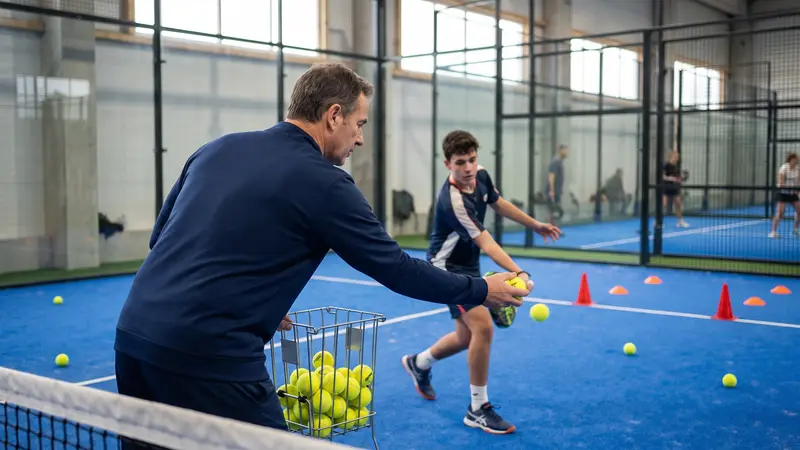
- Fed bandejas. A feeder at the net throws or hits gentle lobs. Hit bandejas cross-court to a target in the deep corner, then step forward to the net after each one.
- Back and forward. Start at the net, move back for a lob, hit a bandeja, recover to the net and touch it with your racket. Repeat for ten balls.
- Víbora to the glass. Mark a target on the side glass near the far corner. The feeder sends slightly shorter lobs and you aim víboras at the target.
- Call the shot. The feeder mixes deep and short lobs. As the ball comes, call "bandeja", "víbora" or "bounce" out loud, then play that shot.
For more overhead drills, and how to fit them into a 45 to 60 minute session, see our padel drills and practice library.
Questions players ask
What is the difference between a bandeja and a víbora?
Both are sliced overheads. The bandeja is about control and keeping the net. The víbora is faster, with more sidespin, and aims to skid low off the side glass.
Why not just smash every lob?
A hard smash often bounces off the back glass and comes back as an easy ball, while you are out of position. The bandeja keeps you in control.
Where should I hit the bandeja?
Deep, usually cross-court towards the corner or into the side glass, at medium pace.
What does x3 mean in padel?
It is short for por tres, a smash that bounces and leaves the court over the side wall. An x4 (por cuatro) leaves over the back wall.
How long does it take to learn the bandeja?
It varies a lot from player to player. Regular practice with a coach is the quickest route, and many UK venues run group sessions; use our court finder to find one near you.
Find a court near you
Over 700 UK venues with opening hours, facilities, nearest stations and booking links.
Open the court finderSources
- ltapadel.org.uk/play/padel-tips-and-techniques/overheads-bandeja-and-the-smash/
- thepadelschool.com/padel-tips/the-vibora-technique
- thepadelschool.com/padel-tips/improve-your-vibora-with-these-tips
- thepadelschool.com/padel-tips/how-to-hit-a-bandeja-without-any-risk
- padel.fyi/terms/por-cuatro/
- padelfip.com/wp-content/uploads/2025/12/FIP_Rules-of-Padel.pdf