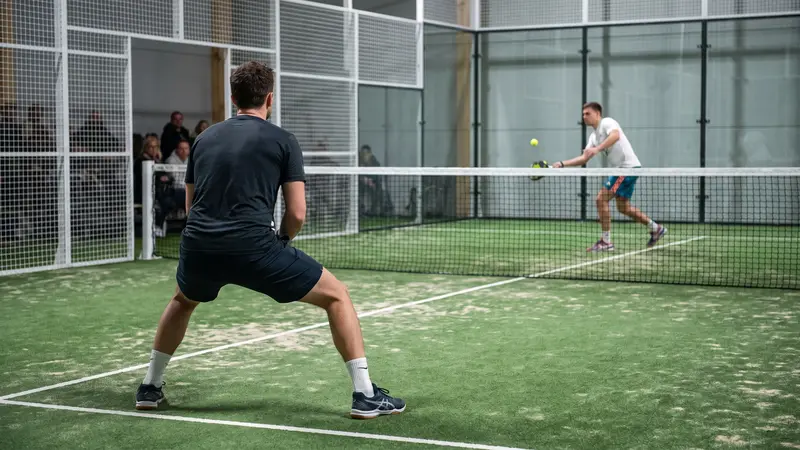
Padel is a game of position. The pair who controls the net usually wins the point, and the pair who moves together usually wins the match. This guide explains where to stand, how to swap from defence to attack, and how to split the work with your partner.
The big idea: fight for the net
The LTA's coaching content says it plainly: the odds of winning a point are much higher when you are at the net. From there you can volley into space, cut off angles and force the other pair to defend.
So every rally is really a battle over who gets to the net and who gets pushed back. Most tactics in padel, from the serve to the lob, are ways to win that battle.
Attack and defence positions
Attacking: both at the net
When you attack, both players stand roughly two to three metres from the net, side by side. Racket up, ready to volley. Being too close makes you easy to lob; being too far back leaves space at your feet.
Defending: both at the back
When you defend, both players stand behind the service line, usually around a metre or two in front of the back glass. This gives you room to let balls come off the wall. Your job here is not to win the point outright but to get back to the net.
Avoid one up, one back
Tennis doubles often has one player at the net and one at the back. In padel that leaves a big diagonal gap, and a good pair will hit straight through it. Both up or both back is the rule. Equally, avoid standing around the service line for long: balls tend to land at your feet there.
| Position | Where | Main aim |
|---|---|---|
| Attack | Both 2 to 3 m from the net | Volley deep or into space, keep the net, finish short balls |
| Defence | Both behind the service line, a metre or two off the back glass | Play safe, use the walls, lob to win back the net |
Moving as a pair
Picture a rope a few metres long tied between you and your partner. When one moves, the other follows.
- Side to side: when the ball goes wide to one side, both of you shift that way so the middle stays covered.
- Forward and back: go up together and back together. If your partner is lobbed and runs back, you go back too.
- The middle: agree who takes balls down the centre. A common rule is that the player with their forehand in the middle takes them.
The lob: the key tactical shot
The LTA calls the lob the most important shot in padel, and for good reason. When your opponents hold the net, a good lob is the main way to send them back and take the net yourselves.
Aim for the ball to land beyond the service line but before the back glass. Cross-court lobs give you more court to work with, so they are safer. A high, deep lob also gives you time to move forward while the other pair turns and chases.
When you lob well and see the opponents turn their backs, move up to the net together. If they get to the ball with a strong overhead, be ready to drop back again.
The low ball at their feet
The other way to win the net is the chiquita: a soft, low ball aimed at the feet of the net players so they have to volley upwards. That gives you a higher, easier ball and a chance to move forward. Our padel glossary covers this and other Spanish terms.
Left and right side roles
In pairs, one player usually stays on the right side and one on the left for the whole match. The roles are often described like this, assuming both players are right-handed.
The right side (drive)
The right-side player's backhand covers the middle of the court. They tend to play a lot of balls from the back, including many lobs and backhands. Their usual role is consistency: keep the ball in play, build the point and set up chances for their partner.
The left side (revés)
For a right-hander on the left, the forehand is in the middle of the court. That means many lobs down the centre and overheads fall to them, so they often play more bandejas, víboras and smashes. The left-side player is usually the one who finishes points.
These are general patterns, not fixed rules. A left-hander changes the picture, and many club pairs simply play the side they feel comfortable on. Try both and see which suits you. In mixed pairs, give the left to whoever has the better overhead, a point our women's padel guide makes in its section on mixed doubles. For the overheads that come with the left side, read our bandeja and víbora guide.
Communication
Good pairs talk all the time, in short words:
- "Mine" or "yours" for balls down the middle and lobs.
- "Up" when it is time to move to the net together.
- "Back" when you are both retreating.
- "Bounce" to tell your partner to let a lob go past and play it off the glass.
Between points, a quick word about the plan for the next one helps more than a long chat at the change of ends. Keep it positive. A partner who feels blamed makes more mistakes, not fewer.
A simple game plan for beginners
- Serve deep, then move to the net with your partner.
- When you are at the net, volley deep and to the middle or into the side glass. Do not go for winners from low balls.
- When you are lobbed, use a bandeja or let the ball come off the glass. Do not smash from deep.
- When you are at the back, lob high and deep, cross-court where you can, then move forward.
- Keep the ball in play. At club level, more points are lost through mistakes than won through winners.
Drills
All of these need four players. If you need a court, our court finder lists venues across the UK.
- Lob to take the net. One pair starts at the net, the other at the back. The back pair can only lob. When a lob lands deep, they move up and the net pair must defend. Play to 10.
- Rope walk. Partners hold a towel between them at the net and shadow the ball as a feeder moves it side to side. It builds the habit of moving together.
- Middle calls. A feeder hits balls down the centre. The pair must call "mine" or "yours" before every ball. Any ball without a call counts as lost.
- Swap sides. Play a set with each player on their usual side, then swap. Notice which shots each side asks of you.
Our padel drills and practice library has more movement and communication drills, including versions for two players and a plan for a full session.
Questions players ask
Should both players be at the net at the same time?
Yes, when you are attacking. Both up or both back is the basic rule, because one up and one back leaves a large gap.
Which side should the better player play?
Often the left, because the left-side player (if right-handed) has the forehand in the middle and takes more overheads. It depends on the pair, so try both.
Why is the lob so important in padel?
It is the main way to push a pair away from the net and take the net yourselves. A deep lob also gives you time to move forward.
Where should I stand when defending?
Behind the service line, a metre or two off the back glass, so the ball has room to come off the wall.
Does my racket choice affect tactics?
Control-focused rackets suit consistent, defensive play, while power rackets suit players who finish more points. See how to choose a padel racket or the racket match quiz.
Find a court near you
Over 700 UK venues with opening hours, facilities, nearest stations and booking links.
Open the court finder