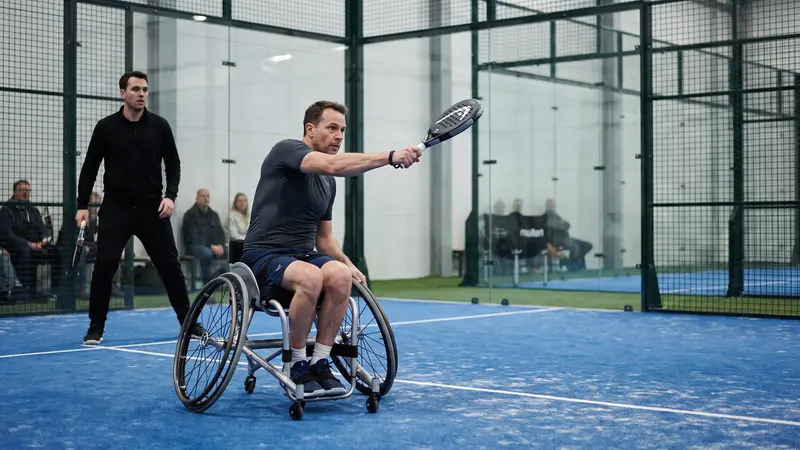
Padel is one of the easier racket sports to get going in, and plenty of women's first game ends with them booking the next one. This guide covers where women's padel stands in Britain, how to find a first session that suits you, the kit questions that come down to size and strength, mixed doubles, the competitive pathway and the professional game.
Where women's padel stands in Britain
The LTA, which governs padel as well as tennis, put the number of people playing in Britain at 860,000 in 2025, double the year before. Women are a minority of them. When the Press Association reported the LTA's figures in March 2026, only 30 per cent of players were female.
So the honest picture is a sport growing fast, with a gap the governing body is trying to close. The LTA's She Rallies plan aims to make tennis and padel gender balanced, and part of that is encouraging venues to run women-only and girls-only sessions.
In September 2026 the LTA and Empower Padel, a community set up in 2024 to help women start, stay in or return to sport through padel, launched a pilot that trains women as Padel Activators to bring new players from their own communities onto court.
The padel in the UK guide has the wider numbers on courts, venues and growth.
Why women take to it
Nobody has a survey that settles this, but the people running women's sessions keep pointing to the same few things:
- It's always doubles. Four people on a small, enclosed court means you're never far from your partner or your opponents, and there's time to talk between points.
- Rallies come early. The ball is slower than in tennis, the racket has no strings to mistime, and the walls keep the ball in play. One organiser of women's clinics described players who had never tried a racket sport rallying within minutes.
- It doesn't demand years of lessons first. Empower Padel's founder has made the point that tennis and golf ask for a lot of coaching before they're fun, where padel lets you enjoy a game early and get better from there.
None of that is specific to women, of course. It's why padel suits most beginners. Coaches who run women's sessions add one more point: confidence, not ability, is what keeps many women off court, and a sociable game you can enjoy from the first hour takes some of that pressure away.
Getting started: sessions, socials and coaching
You can start the way anyone does: book a court with three friends, hire rackets at the desk and have a go. Our first padel session post covers what to wear, bring and pay. Many women prefer a more structured first step, though, and more venues now offer one.
Women-only sessions
These go by different names: ladies' socials, women's beginner clinics, women's Americanos, daytime ladies' leagues. Most are listed in the venue's booking app or on its website, and the LTA's She Rallies work means more venues are adding them. They're a good fit if you'd rather learn without feeling watched, want to meet regular partners, or are coming back to sport after a long gap.
When you look at a session listing, check:
- The level. Sessions are usually labelled with a range on the 0 to 7 scale that clubs and Playtomic use. If you've never played, look for "beginner", "intro" or "0 to 1.5". The numbers are explained in padel levels and social formats.
- Whether there's a coach. A coached session teaches you the basics while you play. An unhosted social just matches you with other players.
- Whether rackets are included or for hire. Most venues hire them for a few pounds.
- The time. Off-peak daytime sessions usually cost less than evenings.
Choosing a coach
Lessons speed things up, especially the grip and the habit of letting the ball come off the glass. Some women prefer a female coach to start with. That's a reasonable thing to ask for when you book, though availability varies a lot by venue.
Whoever you pick, the LTA advises looking for a coach with LTA Accreditation, which means a recognised qualification, safeguarding and first aid training, and a criminal record check. Our padel lessons post covers what a first lesson looks like and what it costs.
Finding people to play with
Regular partners are what keep people playing. Women's socials are one of the easiest places to find them, and venue WhatsApp groups, club ladders and booking-app match listings are the others. Finding padel partners goes through each route. To find venues near you, start with the court finder, then look at each club's timetable for women's sessions.
Kit: what genuinely differs
There's no such thing as a women's padel racket in the rules. The same limits apply to everyone, and many rackets badged as "women's" models are lighter versions of an existing racket in a different colour. What matters is your strength, your swing speed and the size of your hand. Those vary a lot among women and among men.
Racket weight and balance
Most adult padel rackets weigh somewhere between about 340 and 375 g. A lighter racket is quicker at the net, easier to swing late in a long session and puts less load through the elbow and shoulder. A heavier one is more stable when a hard ball hits it and gives more power for less effort, but only if you can swing it freely for two hours.
| If you are | Start around | Why |
|---|---|---|
| New to racket sports, or lighter build | 340 to 355 g, low or even balance | Easy to manoeuvre, kinder to the arm |
| Coming from tennis or squash with a solid swing | 350 to 365 g, even balance | Enough stability without slowing you down |
| Strong, experienced and attacking | 360 g and up, any balance | More weight behind smashes and volleys |
Balance is where the weight sits. A low (handle-heavy) balance feels lighter in the hand than the scale says, and a high (head-heavy) balance feels heavier. If you're unsure between two weights, go lighter: you can add weight with tape later, but you can't take it off. The racket guide goes further into shape, core and face materials.
Core and face
A soft core and a fibreglass face send the ball off the racket with less effort, which helps anyone who doesn't swing fast yet. A hard core and a stiff carbon face reward a fast swing with control, but feel dead and jarring at slow speeds. Plenty of strong women players use stiff rackets. Plenty of men would play better with soft ones.
Grip size
Padel handles mostly come in one fairly standard size, and you adjust the thickness with overgrips. A quick check: hold the racket normally. Your middle finger and thumb should just about meet without squeezing, leaving a small gap your little finger could slot into. If your fingers wrap round and dig into your palm, the handle is too thin for you. If they're nowhere near meeting, it's too thick.
Smaller hands usually suit a single thin overgrip, or the original grip and no overgrip at all. Larger hands can add a second. A grip that doesn't fit makes you squeeze harder, and that tension travels up to the wrist and elbow. The shoes, balls and grips guide covers overgrips in more detail.
Clothing, sports bras and shoes
Wear what you'd wear for tennis or the gym: breathable, stretchy and easy to move in. Padel involves lots of short sprints, sudden stops and the odd jump for an overhead, so a sports bra with enough support for running is a sensible choice. Skirts, shorts and leggings are all normal on court. Pockets or a ball clip help, because you'll often hold the second ball when serving.
Shoes matter more than clothes. Use padel shoes with a herringbone or omni sole that grips the sandy turf, and pick them by fit, not by colourway. Our padel shoes post explains sole types.
Mixed doubles and playing with men
Mixed Americanos, mixed club nights and mixed sections in leagues are all common. The game is the same, with one extra rule from the FIP Rules of Padel: on a deciding point (golden point or Star Point), the player receiving must be the same sex as the server, and the receiving pair still can't swap sides to arrange it. The rules and scoring guide explains deciding points if they're new to you.
Two habits are worth questioning in mixed play:
- Sending the man to the left by default. The left side usually takes more overheads through the middle, so it should go to whoever has the better overhead and movement. Sometimes that's the woman.
- Sending every ball to the woman. Hitting at the weaker opponent is normal doubles tactics. Deciding that's automatically the woman is just an assumption. If you're the one being targeted, stay patient, keep the ball low and in play, and let them make the mistake trying to force it.
Agree sides and who takes the middle before you start. Most mixed-pair arguments come from not having that chat. The positioning and tactics guide covers the left and right sides properly.
Competing: the women's pathway in the UK
The LTA runs padel competition in Britain, and runs women's events at every level of it. You need a free LTA Advantage membership to enter.
Graded tournaments and rankings
LTA padel tournaments come in five grades:
- Grade 5, Local Tour: for players new to competition. First come, first served, often on one court, with a compass draw so every pair plays at least three matches.
- Grade 4, County Tour: different venues and opponents; entry is based on your LTA Padel ranking.
- Grade 3, Regional Tour: the next step up.
- Grades 2 and 1, LTA Padel British Tour: the highest level of domestic competition, with entry decided by ranking.
Results earn ranking points, and your LTA Padel ranking is calculated from your best six results in the previous 52 weeks. That's a ranking based on tournament results, not a skill rating, so it's separate from the level number in your booking app.
Teams, seniors and juniors
The LTA Cupra Padel National League is the biggest team competition in Britain, with separate men's and women's competitions split into three divisions and a national finals. Any LTA-registered venue can enter teams of five players.
For players over 35, the seniors tour has age groups for women from 35+ upwards. Girls can start on the LTA Padel Youth Tour, and the LTA has run national junior girls' camps as part of its She Rallies work.
National teams
At the top, the LTA picks GB women's teams for international events such as the FIP Euro Padel Cup and the World Championships. Players are spotted through LTA Grade 1 to 3 events and coach recommendations, invited to national training camps, and selected from there.
There are senior women's teams in age groups from 35 upwards, and a youth pathway that started in 2024. In September 2026 the GB women's team qualified for the FIP World Cup for the first time since 2021.
Following the women's professional game
GB international Hansie Ruddick has described the women's game as longer, more tactical rallies built on moving opponents out of position, with less of the lob-then-smash pattern of the men's. That makes it arguably the better one to learn from if you play at club level.
The top professional tour is Premier Padel, run with the FIP, and it holds women's and men's draws at its events. Below it sits the FIP Tour, where many British players compete. FIP-sanctioned events count towards the world rankings; LTA events count towards the British ones.
To watch:
- Premier Padel and FIP Tour matches are streamed on the official YouTube channels, often free.
- The LTA Padel National Championships, Britain's top domestic event, are streamed on YouTube too (the 2026 edition was in Bristol from 1 to 4 October).
- The LTA's British players page lists the current GB rankings. As of October 2026 it named Aimee Gibson as the women's British No. 1.
Rankings at the top change week to week, so check the FIP and LTA sites for the current order.
Health: pregnancy, after birth and the pelvic floor
This section is short on purpose. Anything specific to you belongs with your GP, midwife or a physiotherapist, and they should be your first stop with any pain or symptoms.
Playing while pregnant
NHS guidance is that pregnant women should aim for the same 150 minutes a week of moderate activity as other adults, with two strengthening sessions. It also says not to start a new vigorous activity in pregnancy, and to avoid sports where there's a risk of falling or of a knock to the bump.
Padel has sprints, sudden turns and a hard ball at close range, so if you already play, talk to your midwife about whether and how to carry on. If you haven't started yet, pregnancy isn't the time to take it up. Tell any coach you're pregnant, and stop if you feel too hot, uncomfortable or unwell.
Coming back after having a baby
The NHS postnatal check is at around 6 to 8 weeks, and it's a good point to ask about returning to sport. NHS advice is to build up gradually and avoid high-impact exercise at first.
Return-to-exercise guidance from NHS trusts typically starts with walking and pelvic floor work, moves to low-impact exercise, and holds off running, jumping and similar high-intensity exercise until around 12 weeks and only once you can hop, jog and jump without heaviness, leaking or pain. Padel falls into that higher-impact group. If you had a difficult birth or a caesarean, or anything doesn't feel right, ask your GP to refer you to a women's health physiotherapist.
Pelvic floor
Leaking a little when you run, jump or land is a common problem, and pregnancy and birth make it more likely by weakening the pelvic floor muscles. It's also treatable.
The NHS and the Chartered Society of Physiotherapy both recommend pelvic floor exercises as the first treatment, done several times a day for at least three months. If you're unsure you're doing them right, or nothing improves, a specialist physiotherapist can assess you, and your GP can refer you. Don't treat it as something to put up with.
For the general fitness side, is padel good exercise? covers what the research says.
Questions players ask
How many women play padel in the UK?
The LTA counted 860,000 padel players in Britain in 2025, and LTA figures reported in March 2026 put women at about 30 per cent of players.
Do I need a women's padel racket?
No. Choose by weight, balance and grip size to suit your strength and hand. Many players new to racket sports do well with a racket of about 340 to 355 g with a low or even balance and a soft core.
How do I find women-only padel sessions near me?
Look at each venue's booking app or website for ladies' socials, women's clinics or women's Americanos, and ask at the desk. The LTA is encouraging venues to run more of these.
Is there a special rule for mixed padel?
Yes, one. On a deciding point the receiver must be the same sex as the server, and the receiving pair cannot swap sides to arrange it.
Can women play in LTA padel tournaments as beginners?
Yes. Grade 5 Local Tour events are designed for players new to competition, and you only need a free LTA Advantage membership to enter.
Can I play padel while pregnant?
Speak to your midwife first. NHS guidance advises against starting a new vigorous sport in pregnancy and against sports with a risk of falls or knocks to the bump.
Find a court near you
Over 700 UK venues with opening hours, facilities, nearest stations and booking links.
Open the court finderSources
- ltapadel.org.uk/news/2026/march/860000-players-lta-unveils-latest-figures-on-growth-of-padel-in-britain/
- aol.com/articles/why-change-needed-boost-uk-000300233.html
- ltapadel.org.uk/news/2026/september/empower-padel-and-lta-launch-nationwide-programme-to-accelerate-the-growth-of-womens-padel/
- thepadelpaper.com/tordoff-launches-set-padel-to-boost-female-participation/
- thepadelpaper.com/women-padel-nicky-horn-blog/
- lta.org.uk/about-us/safeguarding/choosing-a-coach/
- padelshop.com/en-fr/blogs/padel-tips/how-does-grip-thicknesses-impact-my-padel-game
- padelfip.com/wp-content/uploads/2025/12/FIP_Rules-of-Padel.pdf
- ltapadel.org.uk/compete/how-to-start-competing/
- ltapadel.org.uk/compete/competitions/local-county-regional-and-national-padel-competitions/
- ltapadel.org.uk/compete/lta-padel-rankings/
- ltapadel.org.uk/compete/competitions/lta-padel-national-league/
- ltapadel.org.uk/compete/competitions/lta-padel-british-tour/
- ltapadel.org.uk/compete/national-teams/
- thepadelpaper.com/fip-world-cup-european-qualifier-2026-great-britain/
- padelfip.com/2025/03/premier-padel-makes-further-improvements-to-worlds-official-professional-tour-following-player-feedback-at-ranking-committee-meetings-with-players-and-the-international-padel-federation/
- ltapadel.org.uk/fan-zone/watch-padel-online/
- thepadelpaper.com/paris-was-magnifique-but-british-star-hansie-ruddick-asks-why-was-there-no-womens-tournament/
- ltapadel.org.uk/fan-zone/british-padel-players/
- nhs.uk/pregnancy/keeping-well/exercise/
- nhs.uk/baby/support-and-services/your-post-pregnancy-body/
- mft.nhs.uk/app/uploads/sites/4/2022/08/Returning-to-exercise-postnatal-period.pdf
- nhs.uk/conditions/urinary-incontinence/treatment/
- csp.org.uk/conditions/incontinence/exercise-advice-incontinence