Plenty of people play padel for years without a single lesson. They book a court with friends, borrow a racket and have a brilliant time from the first rally, and nobody checks for a certificate at the door.
A better question is whether an hour with a coach will make the next hundred hours more fun. For most people, booked at the right moments, we think it will. Below are the formats, rough UK prices, what a first session looks like and how to pick a coach worth paying.
Why bother with a coach at all?
Padel is easy to start and surprisingly hard to get good at. The early wins come quickly because the walls keep the ball alive. The habits that hold people back come quickly too: a frying-pan grip, swinging like a tennis player, backing away from the glass, rushing the net alone.
None of those feel like problems in your first few weeks. They start to matter when you play people slightly better than you, and by then they’re grooved in. A coach spots them in minutes, and fixing a grip in week two is far easier than fixing it in month eight.
The other reason is plain enjoyment. A good session gives you more ball contact in an hour than a match does, and you leave knowing what to practise. If you’ve ever come off court unsure why you lost, that’s the gap a lesson fills.
The formats you’ll be offered
Most UK venues offer some mix of the following, and the court finder links to each venue’s own pages so you can see who runs what near you. Names differ between clubs, but the shape is usually the same.
| Format | Players with the coach | Rough cost per person, per hour | Good for |
|---|---|---|---|
| Taster or intro session | Usually four to eight | Often free or cheap; check the venue | Trying the game with a racket lent to you |
| Group course or weekly drills | Four per court | Varies by venue and course length | Learning the basics and meeting people at your level |
| Semi-private | Two or three | Around £15 to £25 | You and a regular partner working on the same things |
| Private | One | Around £35 to £45 outside London, more in central London | A specific problem you want fixed |
Those figures come from price lists we’ve looked at, and they move a lot with location and peak times. Check one thing before you book: whether the court is included. At many venues it is, so the coach’s rate covers the hire. Where it isn’t, add the court cost and split it between however many of you are on it.
A common setup is that a private lesson can take one or two extra people for a small top-up each. If you have a friend at the same level, that’s often the best-value hour in padel.
What happens in a first lesson
An introductory session is built for people who have never held a padel racket, so don’t worry about being behind. You’ll usually be lent a racket and balls. Wear padel or tennis shoes if you have them, since some venues turn away running shoes, and bring water and clothes you can move in. The first session checklist has the full list.
The content varies by coach, but a first hour tends to cover:
- How to hold the racket, usually the continental grip.
- A ready position, and a short, compact swing for forehands and backhands.
- Letting the ball bounce and come off the back glass before you hit it.
- A first go at volleys near the net.
- The underarm serve and the basic rules.
- A short game at the end, so it all joins up.
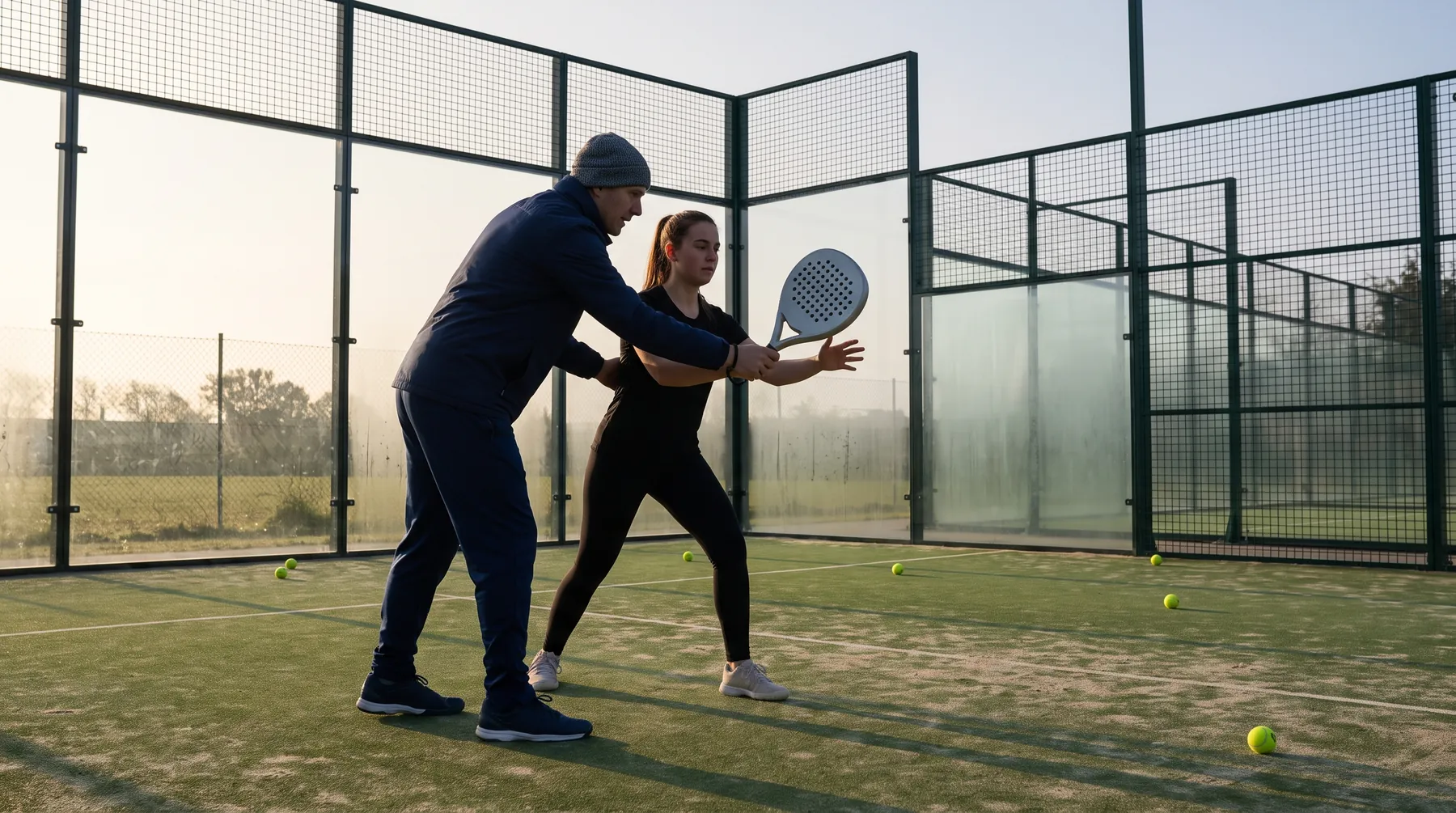
Expect the coach to feed lots of balls by hand or racket early on, then build towards rallies. If you leave tired and slightly confused about the glass, that’s normal. The glass makes sense around the third or fourth session for most people.
Group or private?
For a beginner, we’d start with a group. You learn how the court works, where to stand and how to move with a partner, and none of that can be practised properly with one person and a coach. You’ll also meet people of a similar level, which solves the other big beginner problem of finding someone to play with.
Private lessons earn their keep later, once you know what’s going wrong. Maybe your backhand falls apart under pressure, or every ball off the back glass goes into the net. An hour where the coach watches only you can sort that out quickly.
Lots of players end up doing both: a weekly group session for match practice, plus the odd private hour aimed at one weakness. The private hour gives you something to work on, and the group session is where you find out whether it’s stuck.
Before any lesson, tell the coach one thing you want to leave with. “My serve keeps going long” gets you a far more useful hour than “just general stuff”.
How to choose a coach
Padel is growing so fast that coaching quality varies a lot. Some coaches are padel specialists, some are tennis coaches who have added padel, and some are simply good players. Here’s what we’d check.
Start with accreditation. The LTA’s coach accreditation means the coach holds a recognised qualification, is insured, and has an up-to-date criminal record check, first aid and safeguarding training. You can search for accredited coaches on the LTA find a coach page.
Look at the qualification too. The LTA Padel Instructor course is the main padel-specific one in Britain, a five-day course aimed at people leading group sessions. Coaches who came through Spain or Argentina may hold qualifications from there instead, which is fine. Just ask.
Then ask some practical questions:
- Do you mainly coach padel, or tennis as well?
- What level are most of your players?
- Is the court included, and are rackets and balls provided?
- What’s your cancellation policy?
After one session, you’ll know more than any profile can tell you. A good coach keeps you hitting balls and gives you one or two corrections at a time, not ten.
When lessons pay off most
If you only book a handful, these are the moments we’d spend them on:
- In your first month, to get the grip, ready position and movement right before habits set.
- When you stop improving. Many club players stall around the intermediate level, where good habits and positioning matter more than any single shot.
- Before your first league or tournament, to work on serve, return and the shots that win points under pressure.
- After an elbow or shoulder niggle, because technique is often part of the cause, and a coach can see it.
Getting your money’s worth
A lesson is only as good as what you do between them, and even one game a week can be turned into practice. Play at least once in the week after, and try the thing you worked on, even if it costs you a few points. Jot down the one or two corrections you were given as soon as you get off court; they fade fast.
Knowing your rough level on the 0 to 7 scale helps the coach put you in the right group. And if the week after a lesson comes round with nobody to play with, a social or an open match will do; there are more ideas in finding people to play with.
So, are they worth it?
For most people, yes, in small doses at the right time. A taster or a short group course early on will make the game more enjoyable faster than anything you can buy. After that, book lessons when you have a problem you can name, not out of habit.
If you’ve never played at all, a taster is the easiest first step there is: the venue lends you everything, a coach explains the walls, and you find out in an hour whether padel’s for you. The beginner’s guide is a good read the night before, so the rules aren’t all new on the day.
Next on the blog: a ten-minute padel warm-up you can do on court before the first ball.