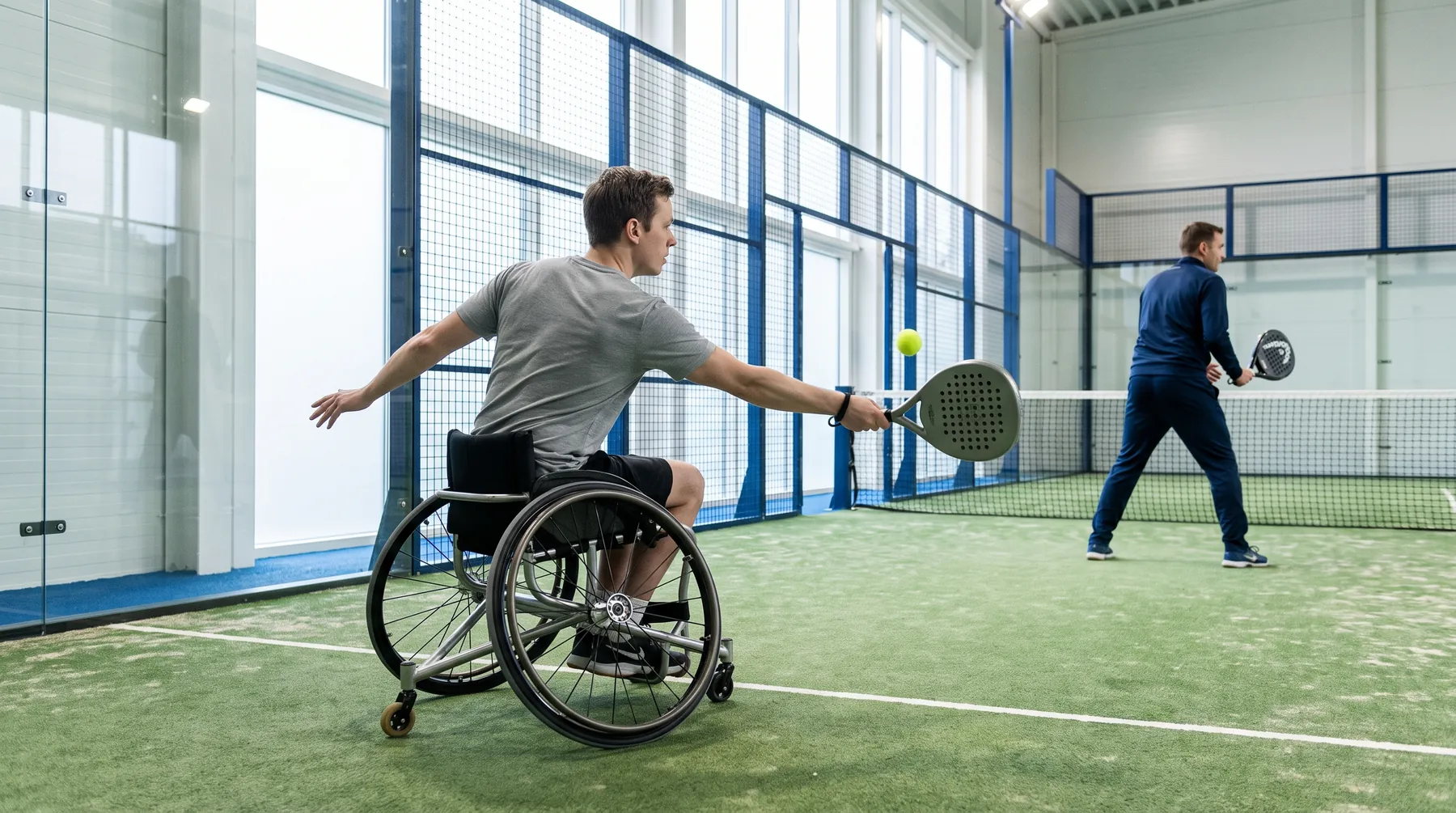
The biggest change in wheelchair padel fits in one sentence: the ball is allowed to bounce twice. Nearly everything else follows from that, and the court, the racket, the ball and the scoring are the same ones you’d use in any other game.
There are a few smaller changes, mostly around the serve and the chair itself. None of them takes long to learn, and once you know them you can play with other wheelchair users or in a mixed four with standing players.
Where the rules come from
The International Padel Federation (FIP) writes the Rules of Padel, but its rulebook doesn’t have a wheelchair section. The LTA, which runs padel in Britain, confirms the two-bounce rule on its disability padel page without publishing a full set of wheelchair rules.
The fullest published version we’ve found comes from Spain. The FEDDF, the Spanish federation for sport for people with physical disabilities, has run wheelchair padel since 2016. Its adapted rulebook starts from the FIP rules and marks every change for wheelchair players. The rules below come from that rulebook, and anything not mentioned works as normal.
Competitions set out their own format, so read the entry details before you play one. For a friendly game, agree the adaptations with the other three players while you warm up, the same way you’d settle golden point or advantage.
Two bounces, and what follows
A wheelchair player can let the ball bounce twice and has to hit it before the third bounce. That counts in rallies and on the return of serve. The FEDDF points out that top players often prefer to take the ball after one bounce anyway, but the second is always there if you need it.
The rule
In the FEDDF’s adapted version of the FIP rules, wherever standing padel says “before the second bounce”, wheelchair padel says “before the third”. A serve that lands in the box and then hits the mesh before its third bounce is a fault. A serve that clips the net, lands in the box and doesn’t reach the mesh before its third bounce is a let.
The point of the extra bounce is time. Pushing a chair across 10 metres of sandy turf takes longer than running it, and the second bounce evens that out.
Serving from a chair
The serve keeps its basic shape: underarm, bounced first, diagonal into the opposite box, with two attempts, exactly as in the standing serve. The wheelchair changes are about position and height.
- At the start of the serve, the front wheel or wheels must be behind the service line, and they can’t touch it or the imaginary extension of the centre line.
- The ball is struck below the shoulders, not at or below the waist.
- You can’t serve on the move or turn the chair to change position, though slight movements of the wheels are fine.
- If bouncing the ball by hand is difficult, you can bounce it with the racket.
Before the first point, tell your opponents which serve rules you’re using. A standing player who has never seen a wheelchair serve might call a shoulder-height serve a fault without knowing it’s allowed.
The chair counts as part of you
In standing padel, you lose the point if the ball touches you or your partner after one of you has hit it. In the adapted rules, the wheelchair is treated as part of the player’s body, so the ball touching your chair after your side’s shot loses the point too.
The rulebook also expects the player to stay in contact with the chair all the time. Straps or belts at the waist and the feet are compulsory, and you can’t brake or push off with a foot on the floor, or lift off the seat to reach a high ball.
A couple of practical rules round this off. Pairs can skip changing ends if neither side minds the sun, wind or light, which saves a lot of manoeuvring. The racket stays on its wrist cord, and a wheelchair player can’t switch it to the other hand to play a shot.
Playing with standing players
Padel’s doubles format makes mixed fours easy. The wheelchair player takes two bounces and everyone else plays to one. That’s the basis of the Inclusive Padel Tour (IPT), an international amateur circuit in which every pair has one disabled and one non-disabled player.
The IPT’s rules go a little further, because its disabled category includes prosthesis users and players with an obvious motor limitation as well as wheelchair users. They get two bounces too, except where the impairment is in the upper body or the player has a below-knee prosthesis.
The tour’s first UK stop was at Padel Maidenhead in 2025, and The Padel Paper reports that a UK series is due to start in Nottingham on 26 September 2026.
For a social game, the rule is simpler still: ask the player what they need, agree it, and get on with the match. Good court etiquette covers the rest.
How to start
A sports wheelchair is built to fit its owner, which makes it expensive, so don’t buy anything before you’ve played. These steps get you on court first.
- Look for an Open Court venue. The LTA’s Open Court programme, jointly funded by Sport England, runs disability padel sessions at venues across Britain. Its disability padel page is the place to start.
- Ring the venue. Ask about level access, the width of the court doors, accessible changing, and whether it has sports chairs to borrow. Some do: the LTA says Padel Maidenhead keeps four for visitors to use free.
- Book a session with a coach. A coach can set up the adaptations and show you how the chair and the glass work together.
- Bring a friend. Padel is a doubles game, and a regular partner makes it much easier to keep going.
What to wear, bring and expect to pay is the same as for any first padel session, whether you play standing or seated.
For the full picture, including other impairments, what makes a venue accessible and the competition pathway, read our guide to adaptive and wheelchair padel.
Next on the blogThe forehand and backhand from the back of the court