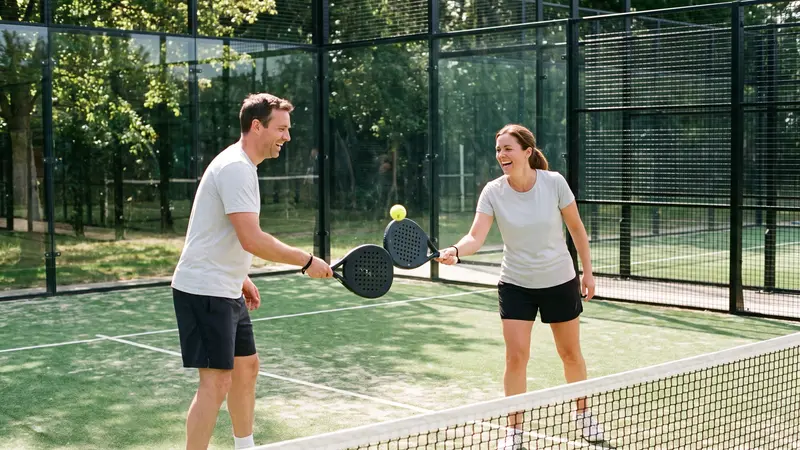
The rules of padel in plain English, based on the current FIP Rules of Padel (the version applying from 1 January 2026), with the key numbers in one table and answers to the arguments that come up most on court.
The court and net
A padel court is 20 metres long and 10 metres wide, measured inside the walls. A net divides it in half, and on each side a service line runs parallel to the net, 6.95 metres from it. A centre service line splits the area between the net and the service line into two service boxes.
The net is 88 cm high at the centre and 92 cm at the posts. The court is fully enclosed. Each end has 3 metres of wall (often glass) topped by 1 metre of mesh fencing, and the sides combine glass panels near each end with mesh fencing elsewhere.
| What | Official figure |
|---|---|
| Court size (inside) | 20 m long by 10 m wide |
| Net height | 88 cm at the centre, 92 cm at the posts |
| Service line distance from net | 6.95 m |
| End enclosure height | 4 m (3 m wall plus 1 m mesh) |
| Ball diameter | 6.35 to 6.77 cm |
| Ball weight | 56.0 to 59.4 g |
| Racket length (maximum) | 45.5 cm |
| Racket width (maximum) | 26 cm |
| Racket thickness (maximum) | 38 mm |
| Serves per point | 2 |
| Games to win a set | 6, by two clear games (tie-break at 6-6) |
| Tie-break | First to 7 points, by two clear points |
| Time between points (competition) | 20 seconds maximum |
| Change of ends break (competition) | 90 seconds maximum |
The serve
Every point starts with a serve, and you get two attempts.
- Stand behind the service line, between the centre line and the side wall, and stay there until you have hit the ball. Your feet must not touch the service line or the centre line.
- Bounce the ball once on the ground behind the service line, then hit it.
- Strike the ball at or below waist height, with at least one foot on the ground. This is an underarm serve, not an overhead one.
- Serve diagonally over the net into the opponent's service box. The lines count as in.
Each game starts with a serve from the right-hand side, then the server alternates sides after every point. The receiver must let the serve bounce before returning it.
Service faults
A serve is a fault if:
- you break any of the serve rules above (a foot fault, hitting above the waist, not bouncing the ball);
- you swing and miss;
- it lands outside the correct service box;
- it hits you or your partner;
- it bounces in the box and then hits the mesh fencing before bouncing again;
- it bounces in the box and goes straight out through a door, on a court where play outside the court is not allowed.
Two faults in a row lose the point. A serve that bounces in the box and then hits the glass is fine, and the receiver plays it.
Lets
A serve is replayed if it clips the net or posts and lands in the correct box without then hitting the mesh, or if it was served before the receiver was ready. A let on a second serve only replays the second serve.
A whole point is replayed if the ball splits, something from outside lands on court, or play is interrupted by something unconnected to the players. If you want a let, call it straight away, because playing on means you lose the right to it.
Using the walls and glass
The golden rule: the ball must bounce on your opponents' side of the court before it touches any wall or fence on their side.
After that bounce, the ball can hit the back glass, the side glass or the mesh and stay in play. The opponents can play it before or after it comes off the walls, as long as it has not bounced twice.
On your own side, you can use your own walls to get the ball back. Hitting the ball into your own back or side wall so it rebounds over the net is legal, and it is a recognised shot called the contrapared. What you cannot do is hit your own mesh fencing, or let the ball bounce on your own side before it crosses.
What is in and what is out
Your shot is good if it:
- lands in your opponents' court, including the lines and the corner where wall meets floor;
- bounces in their court and then hits any wall or the mesh;
- bounces in their court and then leaves the court entirely, for example over the walls;
- clips the net and still lands in their court.
Your shot loses the point if it:
- hits their walls, glass or mesh before bouncing (it is "out", just as in tennis);
- hits the net and then goes directly into their walls or fence;
- hits your own mesh fence or bounces on your own side;
- bounces twice before you return it.
If the ball bounces in your opponents' court and gets stuck in the mesh, goes through a hole in it, or lodges on top of the wall, you win the point.
Other ways to lose a point
- Touching the net, the posts or your opponents' court with your body, racket or clothing while the ball is in play.
- Hitting the ball before it has crossed the net to your side.
- Hitting the ball twice, or both partners hitting it.
- The ball touching you or your partner (anywhere other than the racket) after you hit it, or being hit by your opponents' shot before it bounces.
- Hitting the ball with a racket you are not holding, for example by throwing it.
Scoring
Padel uses tennis scoring. Points go 15, 30, 40 and game. Six games win a set, with a two-game margin, and at 6-6 you play a tie-break. Matches are usually best of three sets.
Deuce and advantage
At 40-40 the score is deuce. Under traditional advantage scoring, the next point gives one pair the advantage, and they need one more point to win the game. Lose it and it goes back to deuce.
Golden point
With golden point (punto de oro), there is no advantage. At 40-40 one deciding point is played, and whoever wins it takes the game. The receiving pair chooses which of them receives that point. In mixed doubles, the player receiving must be the same sex as the server.
Golden point is very common in social play, leagues and club tournaments because it keeps matches moving.
Star point
Star point is a newer format. The FIP added it to the Rules of Padel in November 2025, and from 2026 it has been used on the Premier Padel and FIP pro tours. At deuce you play advantage as normal, but only up to twice. If the score returns to deuce a third time, a single deciding point (the star point) is played, with the receiving pair choosing who receives.
Tie-break
At 6-6 a tie-break decides the set. Points are counted 1, 2, 3 and so on, and the first pair to 7 with a two-point lead wins the set 7-6. The player due to serve takes the first point from the right. After that, each player serves two points in turn, keeping the normal order. Some formats replace the third set with a super tie-break to 10 points, again by two clear points.
Changing ends
Pairs swap ends after the first game, the third game and every odd game after that (1, 3, 5 and so on). In a tie-break you change ends after every six points. In competition, there is no rest at the change after the first game of each set or during a tie-break, and up to 90 seconds at the other changes.
Common disputes
- "It hit the glass first." If the ball touched the wall or mesh before bouncing on the receiver's side, it is out. If you genuinely cannot tell, the fair thing in a friendly game is to replay the point.
- "You touched the net." Any touch of the net while the ball is in play loses the point, even after you have hit a winner.
- The ball hitting a player. If your opponents' shot hits you before bouncing, you lose the point. It does not matter whether the ball was heading out.
- Out-of-court play. Running outside through the doors is only allowed on courts built for it. If you are unsure, ask the venue, and agree before you start.
Wheelchair padel uses an adapted version of these rules, most notably letting a wheelchair player take two bounces. Our guide to adaptive and wheelchair padel explains the changes, including how inclusive pairs of a disabled and a non-disabled player share a court.
Our padel glossary explains the shots and terms, and the beginner's guide covers kit and booking. When you are ready to play, use the court finder.
Questions players ask
Can you serve overarm in padel?
No. The ball must be bounced and then hit at or below waist height, so the serve is always underarm.
Can I volley the serve?
No. The receiver must let the serve bounce first. If the serve hits the receiver or their partner before bouncing, the serving pair wins the point.
Is golden point the official rule?
The FIP rules allow three methods: traditional advantage, star point and golden point. Organisers choose which one applies, and golden point is the usual choice in UK social and club play.
Do the lines count as in?
Yes. A serve or shot that lands on a line is good.
Find a court near you
Over 700 UK venues with opening hours, facilities, nearest stations and booking links.
Open the court finder