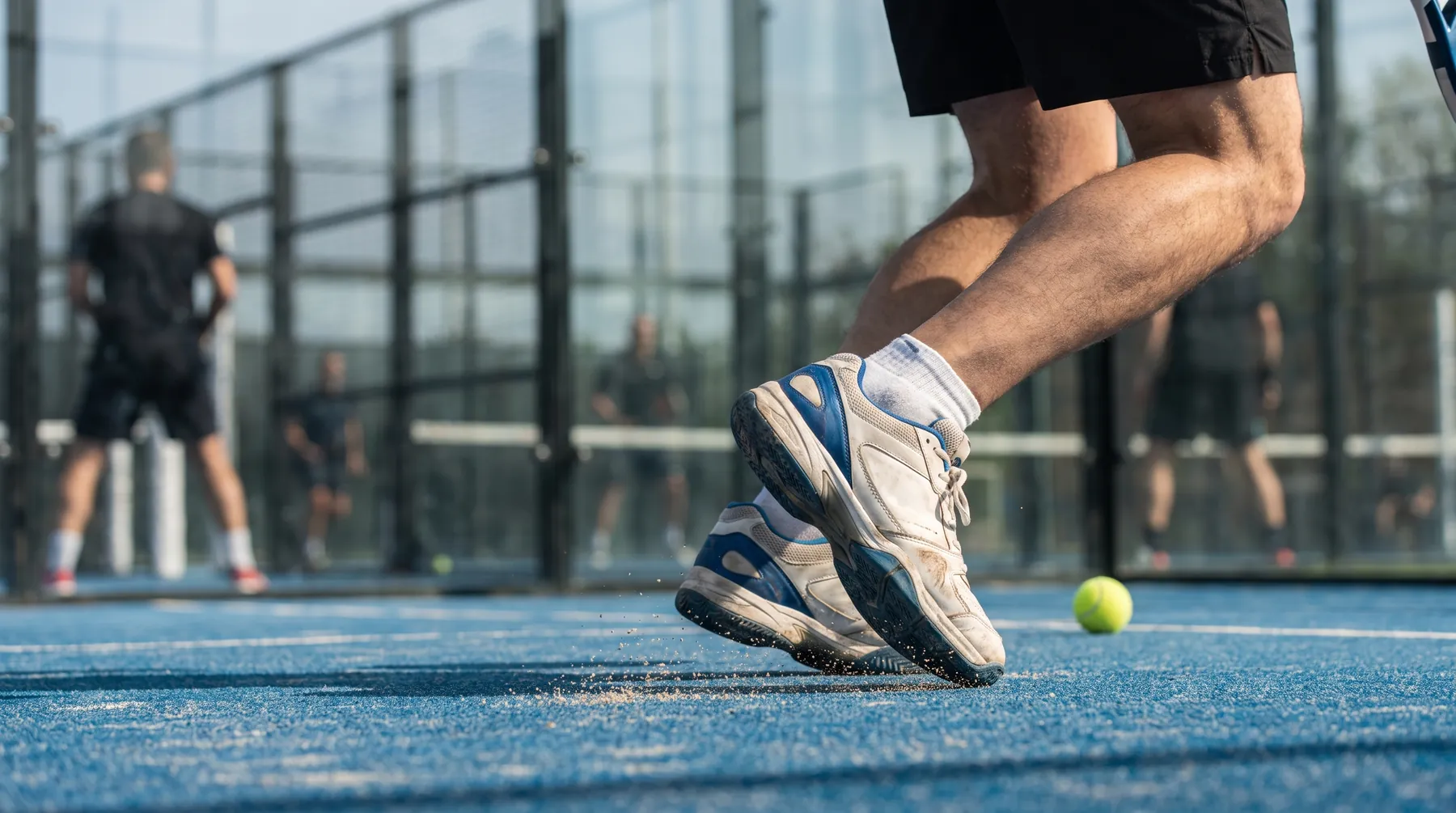
If you can only spend money on one piece of padel kit in your first few months, we’d pick shoes over a racket. It sounds odd until you see a beginner in running trainers try to stop and turn on sandy turf. Padel is all short sprints and sudden changes of direction in a small space, and your shoes decide how well you can do that without slipping or turning an ankle.
So here’s what makes a padel shoe different, how to match the sole to the courts you play on, and how to tell when a pair is finished.
Why running shoes are a bad idea
Running shoes are built to go forwards. They have soft, tall heels and very little support at the sides, because a runner rarely moves sideways. On a padel court you’re moving sideways and backwards all the time, and a soft, high shoe lets your foot roll over the edge of the sole when you push off. That’s how ankles get sprained.
Their soles don’t help either. Road running treads aren’t made for artificial grass with sand on it, so you get less grip when you plant your foot and less control when you need to slow down.
Tennis shoes are a much better stopgap, and they’re what we suggest for your first padel session if you don’t own court shoes yet. They’re built for sideways movement, and plenty of people play their first months of padel in them. Padel shoes are still the better buy once you’re playing regularly, because the soles suit the surface and the uppers are built for the way padel wears them out.
What’s underfoot
Most UK padel courts are artificial grass with sand brushed into it, indoors or out. How much sand there is varies a lot. Older courts and busy outdoor ones can be quite sandy, which makes them slippery. Many newer courts use a carpet that needs less sand, and those grip more.
That difference is why padel shoes come with different soles. A sole that grips well on a sandy court can feel almost sticky on a low-sand one, and a sole made for low-sand carpet can slide about on a sandy court. Precision can wait at the start, but take a look at the courts you play on most.
The three main sole patterns
Brands use their own names, but almost every padel sole falls into one of these groups:
| Sole pattern | What it looks like | Best on | Watch out for |
|---|---|---|---|
| Herringbone (sometimes called clay or fishbone) | Rows of zigzag grooves | Sandy courts, where it bites through the loose sand | Can grip too hard on low-sand carpet |
| Omni | Lots of small rubber pimples | Low-sand carpet and newer courts | Less grip on a very sandy court |
| Hybrid | Herringbone round the edge, pimples in the middle | A mix of courts | A compromise, so not the best at either extreme |
If you play at different venues or you’re not sure what their courts are like, a hybrid sole is the safe first choice. If you play almost all your padel at one club, ask the staff or the regulars what they wear. They’ll know whether the courts are sandy.
What else to look for
Once you’ve picked a sole, a few other features make a difference.
- The upper should hold your foot over the sole when you push off sideways. Squeeze the sides of the shoe: if they fold easily, it won’t do much for your ankles.
- Padel involves lots of small impacts for an hour or more, and your knees and calves feel it. If you play often or you’re on the heavier side, look for more cushioning under the heel.
- When you stretch for a low volley, your back foot often drags along the turf. Without extra rubber or a tough cap at the toe, the front of the shoe wears through first.
- Indoor courts get warm, so a mesh upper that lets air through helps.
Weight matters less than the marketing suggests. A slightly heavier shoe that holds your foot well is a better choice for most club players than a featherweight one that doesn’t.
Getting the fit right
Try shoes on if you possibly can. Brands differ a lot in width, so if one brand always pinches, try another before going up a size. Most ranges also come in women’s versions, and those can suit narrower feet whatever you normally buy.
- Go later in the day. Feet swell as the day goes on, so an afternoon fitting is closer to how they’ll feel mid-match.
- Bring your playing socks. A thick sports sock fills more of the shoe than you’d expect.
- Check the toe and heel. You want about a thumb’s width beyond your longest toe, and a heel that doesn’t lift when you walk.
- Move sideways. Do a few side steps and a quick stop, if the shop will let you. If your foot slides about inside the shoe, it’ll be worse on court.
When to replace them
There’s no single date on a padel shoe. How long a pair lasts depends on how often you play, how you move, and the surface. As a rough guide, if you’re playing two or three times a week, expect somewhere between six and twelve months. Play once a week and they’ll last longer. Outdoor courts and players who slide a lot wear them out faster.
Look for these signs instead of counting months:
- The tread under the ball of your foot has worn smooth, and you’ve started to slip when you push off.
- The toe has worn through, or you can see the midsole showing through the rubber.
- The midsole has deep creases and feels flat, and your knees, shins or feet ache after games when they didn’t before.
- The upper has stretched so your foot moves around inside.
Keep your padel shoes for padel. Wearing them on pavements wears down the tread and drags grit onto the court. Change into them at the venue, and knock the sand out after each game.
How much to spend
The model the professionals wear isn’t the one to copy. Tournament shoes are built for players who slide into shots several times a week, and they’re stiffer as a result. A mid-range padel shoe from any of the main brands, with a sole that suits your courts, is plenty for most club players. Fit matters more than price: a comfortable shoe at the cheaper end beats an expensive one that pinches.
If the budget only stretches to one thing this month, put it here and keep borrowing a racket; choosing your first racket can wait a few weeks. Shoes, balls and grips also share a page in our kit guide, and clothing has its own section in the guide to etiquette and what to wear.
Next on the blogPadel balls: pressure, lifespan and why tennis balls don’t work