Your first padel racket should be a bit boring. That’s harder to stick to than it sounds, because the moment you go looking online you’re reading about 18K carbon, EVA densities and balance points, and the exciting-looking rackets are nearly always the wrong ones for a beginner.
Most of that detail matters less than it looks, at least for now. A first racket needs to do one thing well: make the ball easy to hit cleanly while you learn. Only a handful of choices affect that, and they’re below.
Do you need your own racket yet?
Not straight away. Most venues hire rackets for a few pounds, and playing with whatever’s in the rack for your first handful of sessions is no bad thing. You’ll get a feel for what you like before you spend anything.
The point to buy is when you’re playing most weeks and the hire rackets start to bother you: worn grips, dead feel, or a different racket every time so you never settle. If a friend has a racket you like, ask to borrow it for a game. That tells you more than any product page.
Shape matters most
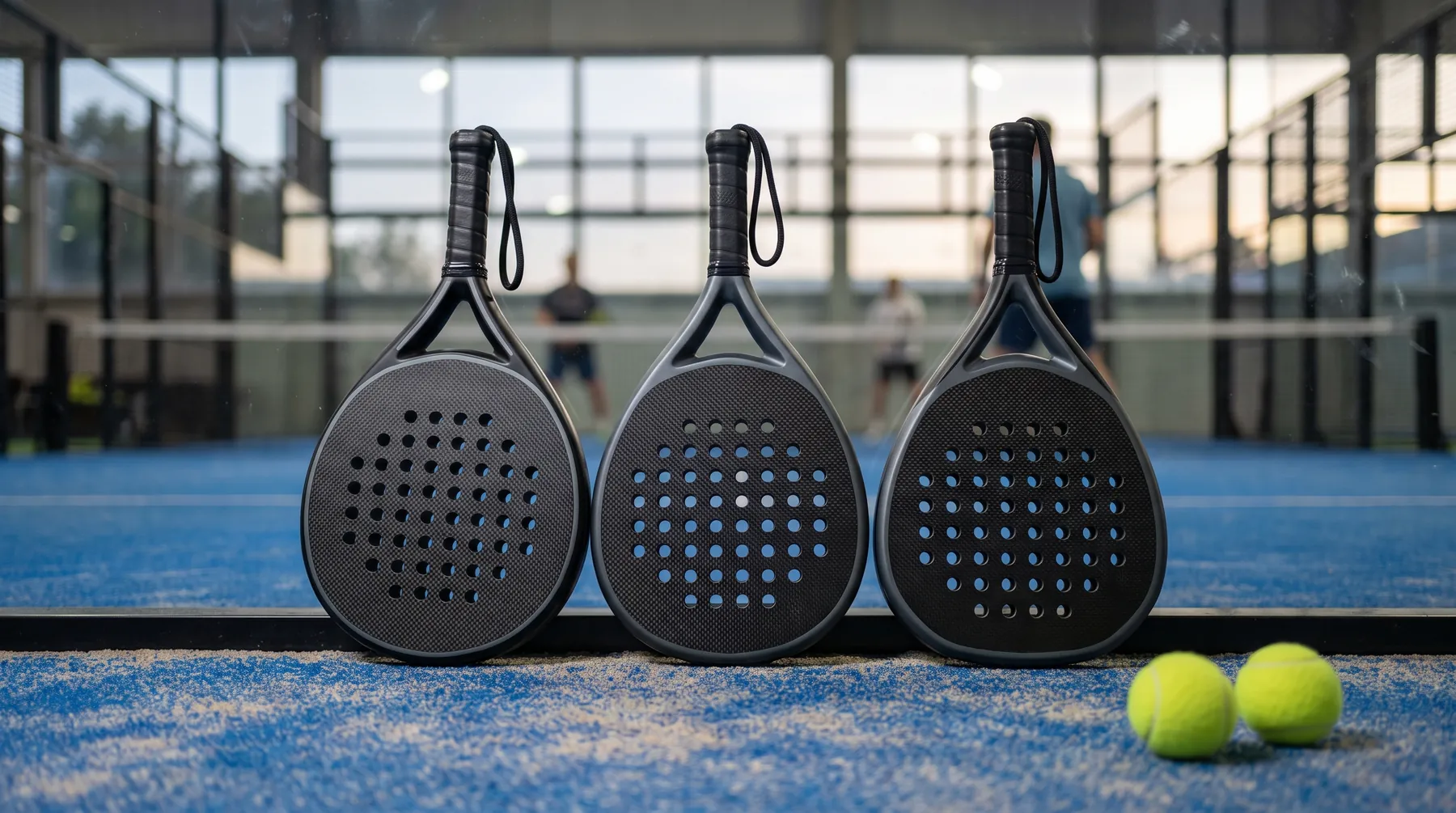
A padel racket comes in one of three broad shapes, and the shape decides where the sweet spot sits, which is the part of the face where a hit feels solid and the ball goes where you aimed it.
| Shape | Sweet spot | Weight sits | Feels like |
|---|---|---|---|
| Round | Large, in the middle of the face | Towards the handle | Forgiving and easy to steer |
| Teardrop | Medium, a little higher up | Around the middle | A mix of control and punch |
| Diamond | Small, up near the tip | Towards the head | Powerful on a clean hit, harsh on a miss |
For a first racket, we’d go round. While you’re learning, plenty of your hits will land away from the centre of the face, and a round racket shrugs those off far better than a diamond. A teardrop is fine too if you’ve come from tennis or squash and your timing is already decent (though tennis players have a few habits to lose first, as padel for tennis players explains).
Don’t think of round as a beginner’s shape you’ll grow out of. Some professionals play with round rackets, because control wins more padel points than raw pace. The diamond suits players who spend a lot of time smashing at the net, and it puts more load on your arm.
Weight and balance
Most adult rackets weigh somewhere between 340 and 375g. That doesn’t sound like much of a spread, but you’ll notice 20g after an hour of volleys.
A lighter racket is quicker to get into position, which helps at the net where the ball arrives fast. A heavier one is more stable on impact and adds a bit of free power to your overheads, but it tires your forearm sooner.
For most beginners, the lighter end of the range (roughly 340 to 360g) is the comfortable place to start. Stronger players coming from other racket sports often get on fine with something a little heavier. The kit section of our women’s padel guide has a simple table matching weight to build and experience, and it applies to anyone.
Balance is where that weight sits along the racket. A head-heavy racket swings with more momentum; a handle-heavy one feels nimble in your hand. Shape and balance usually go together, so a round racket tends to have a low balance and a diamond a high one. Pick round and you’ve largely made the balance choice already.
Soft or hard: the face and the core
Inside a padel racket there’s a foam core, covered on both sides by a face made from fibreglass, carbon fibre or a blend. Brands describe these in different ways and there’s no shared scale, which is why spec sheets are so hard to compare. This is the version we go by:
- Fibreglass faces are softer and more forgiving, and they’re kinder to elbows.
- Carbon faces are stiffer and more precise, and they reward a fast, confident swing.
- A soft core gives you easy power when you’re not swinging hard, and absorbs more vibration.
- A hard core gives control, and gives power back to players who hit the ball hard.
For a first racket, softer is usually better: a fibreglass or mixed face with a soft core. You’ll get more depth on gentle shots, and less jarring through your forearm on the ones you mistime. Hard, high-carbon rackets make more sense once you’re swinging through the ball with good technique, which takes most people a fair while.
If you’ve had elbow trouble
Padel elbow is common, and the racket plays a part. If you’ve had tennis elbow before, or your forearm already aches after a game, look for a racket that’s round, soft and on the lighter side, with the weight towards the handle. Avoid anything heavy at the head.
A racket can only help so much, though. Late preparation and hitting off the edge of the face put strain on your arm whatever you’re holding. If you’re already in pain, get it looked at by a physio before you buy anything, because a new racket won’t fix an injury that’s already there.
Grip size and the wrist cord
Padel handles vary less than tennis handles, and most people adjust the thickness with overgrips, the thin tacky tape wrapped over the base grip (the guide to shoes, balls and grips covers how many to add). A handle that’s too thin makes you squeeze harder to stop it turning, which is more work for your forearm. If you can’t decide between two sizes, go for the thinner handle and build it up.
Every padel racket comes with a cord at the bottom of the handle. Under the FIP rules you have to wear it round your wrist. It feels fussy for the first few games, but a solid racket slipping out of a sweaty hand on a smash is a real hazard to your partner, so get in the habit from day one.
How much to spend
We’re not going to quote prices here, because they move around and vary a lot between shops. A few principles hold up, though.
The flagship models at the top of each brand’s range are built for advanced players. They’re usually stiff, often diamond-shaped, and they’ll make the game harder for you, not easier. At the other end, the very cheapest rackets tend to use low-grade foam that goes dead quickly. The middle of a brand’s range, where the round, soft, control-focused models sit, is where most first rackets belong.
Check last season’s models too. Racket ranges change every year, often with a new paint job and small tweaks, and the outgoing version usually drops in price.
A quick checklist for your first racket: round or teardrop shape, around 340 to 360g, low or even balance, a soft feel, and a grip you can hold without squeezing. If you can try it on court before you buy, even better. Ask your club whether they keep demo rackets.
When to upgrade
You’ll know it’s time when the racket starts holding you back, which is a different thing from being bored of it. Usually that means you’re hitting cleanly most of the time and want more from your overheads or your volleys. That’s the point to look at a teardrop, a firmer face or a little more weight, and it’s a choice you’ll make far better with a year of padel behind you.
Until then, the cheapest upgrade is a fresh overgrip. If you’d like a shortlist anyway, our racket finder asks how you play and narrows the field, and the full guide to how to choose a padel racket goes deeper into materials and specs than we have here.
Next on the blogHow to practise padel when you only play once or twice a week