A lot of padel racket advice quietly assumes a fast swing, a large hand and enough strength to make a stiff, heavy racket work. If that doesn’t describe you, some of the usual recommendations point the wrong way.
This one is for players who are lighter or smaller in build, have smaller hands, or are new to racket sports and still building swing speed. Plenty of women and teenagers fit that, so do many older players coming back to sport, and so do a fair number of men. What you’re after is a racket you can swing freely for a full session without your arm paying for it.
Why the usual advice doesn’t fit
A racket gives you power in two ways. Either it’s heavy and stiff, and the speed of your swing does the work, or it’s softer and lighter, and the racket helps the ball off the face. Rackets built for strong, fast swingers feel dead and jarring if you can’t swing them hard, and their weight makes you late on the ball at the net.
There’s no women’s version in the rules either. FIP limits on length, width and thickness apply to everyone, and many rackets sold as “women’s” or “lady” models are lighter versions of an existing racket in a different colour. Judge each racket on its specs, not the badge.
Weight: start lighter than you think
Adult padel rackets usually weigh between about 340 and 375 g. Retailers tend to call anything under about 355 g light. For a lighter or newer player, that’s the band to look in.
| Your build and game | Weight to look for | Balance |
|---|---|---|
| New to racket sports, light build | 340 to 350 g | Low or even |
| Some racket sport behind you, average build | 345 to 360 g | Even |
| Teenager still growing | Junior or light adult model | Low or even |
A few grams sound trivial, but you swing the racket hundreds of times in an hour, and a lot of those are fast reactions at the net. Lighter means you get the racket into position sooner and your shoulder and elbow do less work by the end of the night.
Overgrips add a few grams each, so allow for them. Weight also varies by a few grams between units of the same model, so check the range on the listing.
If you’re stuck between two weights, take the lighter one. You can add a strip of lead tape to the frame later if you want more weight. There’s no way to take it off.
Balance: where the weight sits
Balance tells you whether the weight is nearer the handle (low balance), in the middle (even) or towards the tip (high balance). It changes how heavy a racket feels far more than a few grams on the scale.
A head-heavy racket swings like a hammer: lots of momentum on a smash, but slow to bring round on a fast ball at the net.
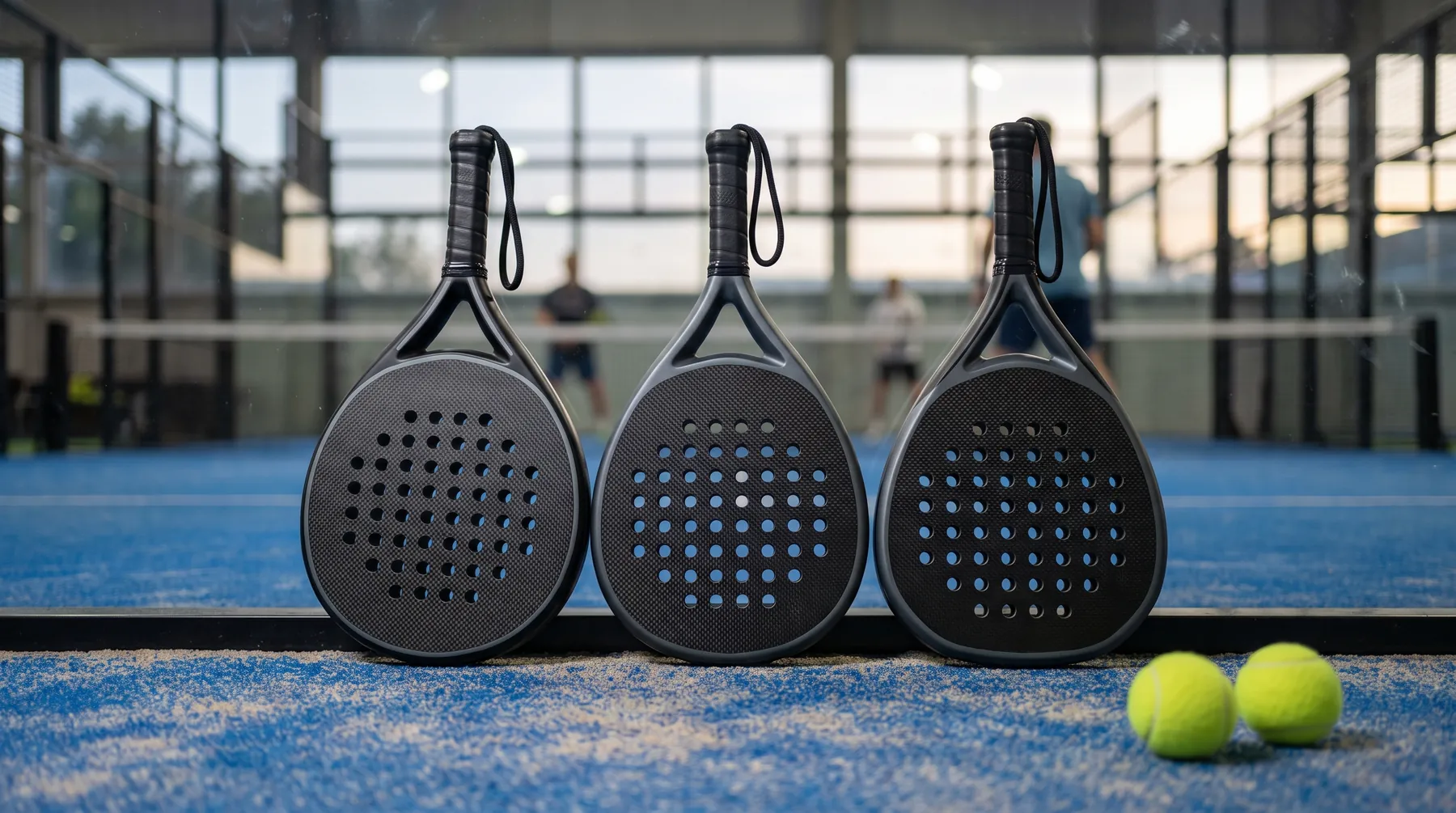
A low-balance racket feels light and quick in the hand even at the same weight. For lighter players, low or even balance is the safer choice. It usually comes with a round shape, which also has the biggest sweet spot. Our guide to choosing a padel racket explains round, teardrop and diamond shapes in detail.
Softness: let the racket do some of the work
Two things decide how hard or soft a racket feels: the core and the face.
- Core. Soft EVA or foam cores give a little on impact and send the ball out easily at slower swing speeds. Hard EVA rewards a fast, full swing with control but feels dull if you can’t provide that speed.
- Face. Fibreglass faces flex more, adding ball output and comfort. Carbon faces are stiffer and more precise, and the higher the carbon number (3K, 12K, 18K), the stiffer they tend to get.
For a lighter player, a soft core with a fibreglass or 3K carbon face is the combination to look for. It’s also kinder to the elbow, because a stiff racket passes more vibration into your forearm, and the elbow is the most commonly injured single body part in padel.
Soft doesn’t mean weak, either. A soft racket simply means you don’t need a big swing to get the ball deep, which frees you to concentrate on placement.
Grip size: often the most overlooked part
Padel handles mostly come in one fairly standard size, and you fine-tune the thickness with overgrips. On smaller hands, a handle built up with two overgrips can be too fat. You end up squeezing harder to hold it steady, and that tension runs straight up into the wrist and elbow.
- Hold it as you would to play. Use the continental grip, the one you’d use for a volley. How to hold a padel racket shows it if you’re unsure.
- Check your fingers. Your middle finger and thumb should just about meet without you squeezing.
- Look for the gap. There should be a small space your little finger could slot into. No space means the handle is too thin; a big gap means it’s too thick.
- Adjust with overgrips. Too thick: take one off, or swap to a thinner overgrip. Too thin: add one.
If a hire racket felt chunky, count the overgrips wrapped on it before you rule out that model. With one fewer it may fit you well. The shoes, balls and grips guide covers overgrip types and when to change them.
Juniors and teenagers
Children and smaller teenagers usually start with a junior racket, which is lighter (roughly 250 to 330 g) and often shorter. Once a teenager is close to adult height, a light adult racket with a low balance and soft core is the usual next step. Growing players outpace their rackets quickly, so we wouldn’t spend a lot on one.
Try before you buy
Specs only tell you so much. The best test is an hour on court. Many venues hire rackets, and some run demo days where you can try several back to back.
If you can, play the same drill with two or three rackets: a set of volleys at the net, then some balls off the back glass. The one that’s easiest to get into position will usually feel best by the end of the session, too.
Our racket finder asks about your game and narrows the field if you’d like a shortlist to try. And if you’re about to buy your very first one, choosing your first padel racket covers price and what you can skip.
Looking for somewhere to try it out? Our guide to women’s padel in the UK explains how to find women’s clinics and socials near you.
Next on the blogIs padel good exercise? Fitness and health benefits