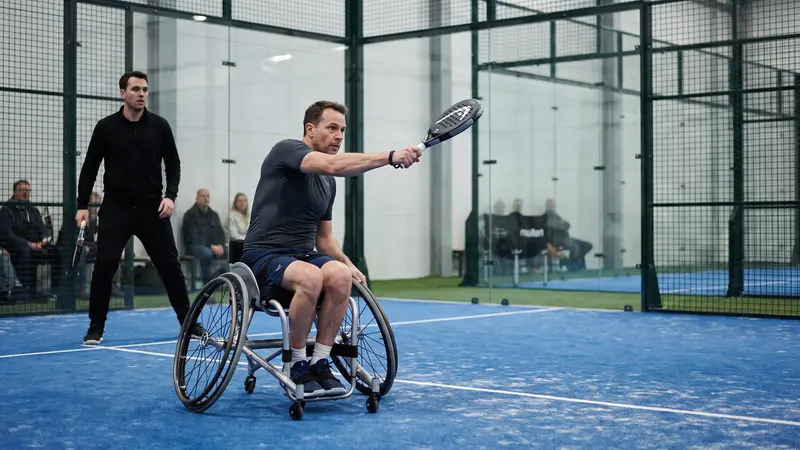
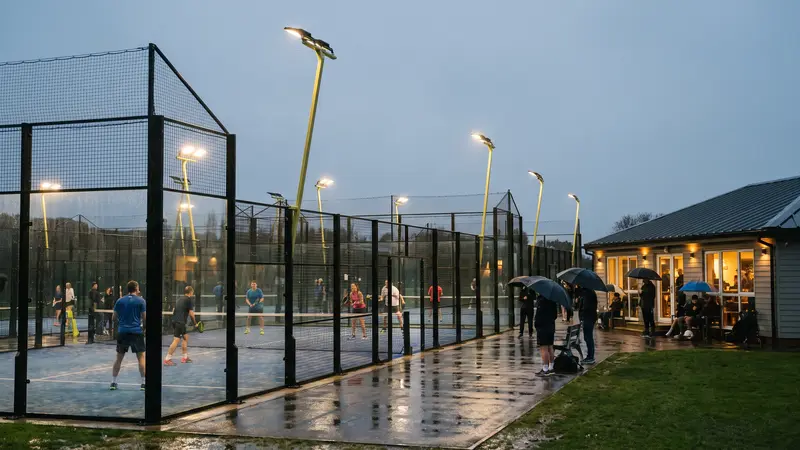
A padel court looks simple: a rectangle of turf inside glass and mesh. Getting one built in the UK is harder, because the four-metre walls, the floodlights and the sound of the ball all go through the planning system. This guide covers what a court needs, what usually needs permission in each part of the UK, why noise causes so many disputes, and what the LTA says it all costs.
We aren't planners or lawyers. Rules differ between England, Wales, Scotland and Northern Ireland, and they change, so treat this as a map of the questions to ask and check every answer with your local planning authority before you spend money.
How much space a court needs
The playing area is fixed at 20 metres by 10 metres, measured inside the walls. The structure around it takes a little more. The LTA's 2025 construction guidance note gives a minimum outside footprint of 20.8m by 10.8m for one outdoor court, which allows for a 400mm concrete ring beam around the edge. If you build more than one court, leave a 1.5m gap between them.
Height matters as much as floor area. The LTA asks for at least 6m of clear space above the whole court so lights and lobs have room, and recommends 8m for new facilities. The end walls are 4m high (3m of glass or solid wall with 1m of mesh above), and most UK courts have stepped side walls, where the glass drops from 3m to 2m near each end and mesh fills the middle.
| What | LTA guidance |
|---|---|
| Playing area | 20m x 10m inside the walls |
| Footprint, one outdoor court | At least 20.8m x 10.8m |
| Gap between courts | 1.5m |
| Clear height over the court | 6m minimum, 8m recommended for new builds |
| End wall height | 4m (3m wall plus 1m mesh) |
| Net post to enclosure | At least 1.2m, for sports wheelchair access |
The out-of-court area, a clear zone beyond the side doors for chasing balls out of the court, only needs considering where elite tournaments are planned, according to the LTA. Most club and garden courts leave it out.
Don't forget access for the build itself: excavators, concrete and large glass panels all need a way in. The LTA suggests measuring your site with an online map tool or a tape before anything else.
Outdoor, canopy or indoor
An open-air court is the cheapest option, but British weather takes a bite out of the year. The LTA's operator guidance notes that covered courts are used more consistently, while open courts see players drop away in winter. That is one reason the LTA's loan scheme now prioritises covered courts as UK padel keeps growing.
A canopy is a separate structure on its own foundations, with its legs outside the court. The LTA's minimum heights are 6m at the edges and 8m over the net line, whichever way the roof spans. That makes a canopy far taller than the court itself, so it is usually the most visible part of any scheme and the part planners look at hardest.
- Planning permission will be needed for a canopy or indoor structure, according to the LTA.
- Building control sign-off is needed for fully enclosed buildings and may be needed for canopies.
- Rainwater off a canopy can't always go straight into drains or soakaways, so some areas need extra drainage storage (the LTA calls it attenuation).
- Steelwork should be hot-dip galvanised, membranes designed to last at least 15 years and frames 20.
Indoor padel in an existing building is a different planning route again. A law firm's 2026 review of padel planning notes that indoor courts fall in Use Class E(d) in England, so a building already in that class may not need permission for a change of use. Conditions on the original permission can still restrict it, so check before you sign a lease.
Planning permission across the UK
The LTA's position is plain: building a padel court counts as development and needs formal planning consent from the local authority, whether it goes on a green field or on top of an old tennis court. Its court data sheet names the reasons. The 3m and 4m walls need consent, and so do floodlight posts and fittings. Contractors usually leave planning out of their quotes, so it falls to whoever owns the project.
Courts in a garden
Homeowners have some building rights without applying (permitted development), and people sometimes assume a court fits inside them. The height limits make that unlikely. In England, the Planning Portal's guidance on outbuildings covers enclosures including tennis courts, with a maximum height of 3m (2.5m within 2m of a boundary). A padel court's 4m end walls go over both.
The rules for fences and walls tell the same story in every part of the UK. Government guidance for England, Wales and Scotland, and council guidance in Northern Ireland, puts the limit for a garden fence or wall at 2m, or 1m next to a road. A padel enclosure stands 3m to 4m high. Listed buildings, conservation areas, national parks and homes where permitted development rights have been removed all make permission more certain still.
What usually needs consent
- The court itself: the walls, mesh and any perimeter fence.
- Floodlights, including (on the LTA's reading) swapping old lamps for LEDs.
- Canopies and buildings, which may also need building control.
- Longer hours or a change of use, where an existing permission limits them.
- A new site access or changes to ground levels.
Some designations raise the bar. On Green Belt land, outdoor sport can be an exception to the usual restrictions, but councils have refused schemes where a domed roof or canopies made the courts look like buildings. One London borough refused a canopied scheme in 2025, then approved courts on the same site without the canopies.
In England, the LTA flags that courts on greenfield land must deliver a 10% gain in biodiversity. Some small sites are exempt and the exemptions were due to change in 2026, so check the current rules.
How an application usually runs
The LTA's planning note suggests starting with research: talk to existing users, consult neighbours early, check for flood zones, rights of way, buried services and distances to houses. Then ask the council for a pre-application meeting, where the officer can say which reports they'll want (noise, lighting, ecology, traffic, heritage). In England, the Planning Portal is where most applications are made and fees are listed.
The LTA says a validated application is normally decided within 12 weeks, and a permission lasts three years from the decision. Any conditions attached have to be discharged before work starts. If you're unsure whether something needs permission at all, a lawful development certificate from the council gives you a formal answer, which is far cheaper than an enforcement notice.
Noise: the usual sticking point
Padel noise doesn't sound like tennis. A solid racket hitting a pressurised ball gives a sharp crack, the ball then smacks off glass, and players call and shout between shots. Acoustic consultants describe it as impulsive: short, loud, irregular bangs over a quieter background. Neighbours tend to notice those far more than a steady hum at the same average level, which helps explain the complaints.
The LTA's guidance gives two rules of thumb. Its planning note says a neighbouring property within 30m could mean sound reduction measures are needed. Its 2025 construction note says that with a house within 50m, noise and light surveys by specialist consultants are likely to be required. It also recommends talking to neighbours before and during the application.
Noise impact assessments
A noise impact assessment measures the existing sound around the site, predicts what the courts will add at the nearest homes, and compares the two against guidance. No UK standard is written for padel yet. Consultants writing in The Padel Paper say assessments usually start from BS 8233 (sound in and around buildings), and that a UK steering group on padel noise has formed.
Their warning is that weak reports quote one average figure and never deal with the individual ball strikes, which are what neighbours hear. Mitigation, where it's needed, usually means some mix of distance, screens or barriers, and shorter hours. Councils commonly attach conditions on hours of use, lighting and screening, so model your bookings on the hours you're likely to get, not the hours you'd like.
Real decisions worth reading
- Bury, 2026: a planning inspector dismissed an appeal for four canopied courts at a cricket and tennis club in Whitefield (appeal APP/T4210/W/25/3360490, 16 March 2026). No noise assessment had been submitted, and the inspector said the effect on neighbours had to be understood before permission, not left to a condition. Parking, lighting, heritage and trees also counted against it.
- Bromsgrove, 2026: the district council served a noise abatement notice on a sports club in March 2025 over "explosive and unpredictable" padel noise. The club cut its hours and appealed, but magistrates upheld the nuisance finding in June 2026 and ordered it to pay £48,500 in costs.
- Harrogate, 2025: North Yorkshire Council refused retrospective permission for two outdoor courts at a health club because the noise assessment didn't account for their impact, then served an enforcement notice. The operator stopped using the courts and appealed the order to remove them.
- Hammersmith and Fulham, 2019: an application was refused because the enclosures were a discordant feature and the courts sat close to homes.
The Bromsgrove case shows that planning permission doesn't protect you from a nuisance complaint. Under government guidance, if a council finds that noise unreasonably and substantially interferes with someone's enjoyment of their home, it must serve an abatement notice, and that applies to private gardens as much as to clubs.
Floodlights and the neighbours
The LTA's floodlighting guidance says lights add about 35% more playing time to an outdoor court between November and April. They bring their own planning questions.
The LTA's minimum for recreational play and regional events is an average of 300 lux at ground level, rising to 500 lux for national and international competition. Fittings must sit at least 6m above the court, either on extended posts that form part of the frame or on separate columns outside it.
What planners care about is the light that escapes: glare into windows, spill onto gardens and glow into the night sky. The LTA asks lighting designers to show the tilt angles of every fitting, and says planning applications should include data that follows the Institution of Lighting Professionals' guidance on reducing obtrusive light. Low tilt angles, shields and louvres all help.
Wildlife can matter too. In the Bury appeal, the lighting assessment didn't account for all four courts together, and the inspector was concerned about bats using the trees along the site edge. Councils often attach conditions on when the lights can be on. The LTA puts LED running costs at about £1 per court per hour.
Ground works and the court itself
Most of the engineering sits underground. The posts bolt to a reinforced concrete ring beam, and the court base inside it is free-draining crushed stone under porous asphalt, with a drain running out through the beam. The LTA wants a UK-qualified structural engineer to design the beam, base and drainage for each site, allowing for local ground conditions and wind loads, backed by professional indemnity insurance.
The LTA's data sheet treats courts simply fixed to an existing slab as temporary event courts, unsuitable for permanent outdoor use. Trees need thinking about early too: the Bury inspector criticised the lack of a tree survey for tall structures beside mature trees.
Court types and materials
- Walls: toughened glass, 12mm outdoors and 10mm indoors, each panel kitemarked. Brick or rendered blockwork is allowed if the bounce is even.
- Layout: stepped side walls are the most common UK version. "Panoramic" courts use framed glass ends without intermediate posts.
- Steel: galvanised and then zinc-plated, because the LTA says UK corrosion rates are much higher than on the Continent.
- Surface: sand-dressed synthetic turf in one colour. The LTA's tender specification prefers monofilament yarn.
- Warranty: at least 10 years from the installer, though manufacturers' warranties usually exclude structural failure of the enclosure.
The LTA's advice is to get three quotes from members of the Sports and Play Construction Association (SAPCA) and visit a court each contractor has already built. Its tender template assumes one main contractor builds everything, so there's a single warranty for the whole job.
What it costs, and LTA funding
The most useful published figures come from the LTA's 2025 construction guidance note, based on projects delivered in 2025. They exclude VAT and professional fees, and the LTA stresses that site conditions move the final price.
| Courts | Court with lights | Ring beam, base and drainage | Total |
|---|---|---|---|
| 1 | £36,000 | £35,000 | £71,000 |
| 2 | £70,000 | £78,000 | £148,000 |
| 3 | £100,000 | £110,000 | £210,000 |
| 4 | £128,000 | £140,000 | £268,000 |
Canopies are where the published numbers disagree. The 2025 guidance note PDF puts a canopy over one court at £95,000 including its foundations, while the LTA Padel construction web page (checked October 2026) gives £75,000. The LTA's loan scheme page uses rough costs of £75,000 per floodlit court and £130,000 per covered court. Treat any of these as a starting point and get quotes.
None of these include planning fees, consultants' reports, an upgraded electricity supply or building control.
The LTA Facility Loan Scheme
Clubs in England, Scotland and Wales can apply to the LTA's Facility Loan Scheme, funded by the LTA Tennis Foundation. In October 2026 its page lists these terms for outdoor and covered padel:
- Up to 50% of the project cost, repaid over up to five years.
- A fixed 5% interest rate, with a possible 50% reduction in more deprived areas. (Older articles describe the loans as interest-free; check the current terms.)
- Applicants must be properly constituted and not for profit, with security of tenure. Individuals and companies limited by shares can't apply, and projects in Northern Ireland aren't covered.
- Venues must offer online booking for non-members and community programmes, and register with the LTA when the project is finished.
- It doesn't fund work already done, land, clubhouses, or new organisations without two years of accounts.
The LTA also recommends gate access systems, which let non-members book, pay and get in with a code, and can switch the lights on for the booked hour, so a club can run pay-and-play padel without staff on site.
Converting a tennis court
An existing tennis court is the most common starting point for clubs. The LTA says two or three padel courts can fit in the space of one tennis court, and the site may already have access, power and a history as a sports ground.
It still needs planning permission, and the conversion isn't just a matter of laying turf. The LTA's data sheet asks for a detailed survey of the existing court's levels and base first, with the new ring beam set above the highest point of the old surface. Old floodlight columns and buried cables may clash with the new layout, or may be reusable.
Losing a tennis court can become a planning issue in itself. National planning policy in England protects existing sports land unless it's surplus, replaced, or swapped for a better sports use, and Sport England is often consulted. In the Bury case, the inspector accepted that padel on disused former tennis courts was a better sports use. The scheme failed on other grounds.
Looking after a court
The contractor should hand over an operation and maintenance manual, and the LTA warns that skipping the maintenance it describes can void the warranty. Its general checklist runs like this:
- Weekly: clear leaves and debris, brush the turf to spread the sand evenly, check the drains, look over the glass for chips, and check the net and posts.
- Every six to twelve months: inspect and tighten every bolt and fixing on the frame and glass, replacing any that are corroded.
- Seasonally: remove loose objects that could blow into the glass, and clear snow and ice carefully.
- Always: keep a log of inspections and repairs, and tell the contractor quickly about any damage.
For budgeting, the LTA recommends a sinking fund of £1,500 per court per year to cover the surface, lamps and columns, and expects the surface to need replacing around every five years, depending on use. The glass, structure and any canopy need their own allowance.
If you'd rather play than build, the court finder lists venues across the UK, and our booking guide covers prices and apps. New to the game itself? Start with what padel is and the rules and scoring.
Questions players ask
Do I need planning permission for a padel court in my garden?
Almost certainly. The end walls are 4m high, which is above the height that householder permitted development allows for garden enclosures in England and above the 2m limit for fences and walls across the UK. Check with your council, which can confirm in writing.
How close to houses can a padel court be?
There is no fixed UK distance. LTA guidance says a home within 30m could mean sound reduction is needed, and within 50m noise and light surveys are likely. Councils decide case by case on the evidence.
How much does a padel court cost in the UK?
The LTA's 2025 figures put one outdoor court with lights, base and drainage at about £71,000 before VAT and fees. A canopy adds roughly £75,000 to £95,000, depending on which LTA publication you use.
Can I get an LTA loan for a court at home?
No. The Facility Loan Scheme only lends to properly constituted not-for-profit organisations with community access, not to individuals or companies limited by shares.
Can neighbours complain once a court has planning permission?
Yes. Permission does not stop a council finding a statutory noise nuisance, and in 2026 magistrates upheld a council's nuisance notice against a club's padel courts.
Find a court near you
Over 700 UK venues with opening hours, facilities, nearest stations and booking links.
Open the court finderSources
- lta.org.uk/4a230f/siteassets/padel/lta-padel-court-construction-guidance-note-2025.pdf
- ltapadel.org.uk/roles-venues/venues/padel-construction/
- lta.org.uk/4ad2a4/siteassets/play/padel/file/lta-padel-court-guidance.pdf
- lta.org.uk/4ad13d/siteassets/about-lta/file/planning-guidance.pdf
- lta.org.uk/4ad167/siteassets/about-lta/file/floodlighting-guidance.pdf
- ltapadel.org.uk/roles-venues/venues/padel-operation/
- lta.org.uk/roles-and-venues/venues/tennis-facility-funding-advice/facility-loan-scheme/
- ltapadel.org.uk/roles-venues/venues/padel-facilities/
- planningportal.co.uk/permission/common-projects/outbuildings/planning-permission
- planningportal.co.uk/permission/common-projects/fences-gates-and-garden-walls/planning-permission
- gov.wales/planning-permission-fences-gates-and-garden-walls
- mygov.scot/build-fence-wall-house
- antrimandnewtownabbey.gov.uk/getmedia/2c7fa16f-ae30-4d32-b032-ac052b5018a5/Your-Home-and-Planning-Permission-Document-2023-Cll-Mark-Cooper.pdf.aspx
- gov.uk/guidance/noise-nuisances-how-councils-deal-with-complaints
- councildecisions.bury.gov.uk/documents/s49406/Agenda%20Item%2062.pdf
- bromsgrove.gov.uk/news/posts/court-upholds-nuisance-finding-over-local-padel-noise/
- localgovernmentlawyer.co.uk/planning/401-planning-news/100883-magistrates-court-upholds-nuisance-finding-over-explosive-noises-from-padel-courts
- thestrayferret.co.uk/stories/david-lloyd-appeals-harrogate-padel-court-enforcement-notice
- freeths.co.uk/insights-events/legal-articles/2026/planning-for-more-padel-observations/
- thepadelpaper.com/all-about-padel-noise-impact-assessments/
- thepadelpaper.com/all-the-information-you-could-need-about-padel-planning-guidance-and-standards/