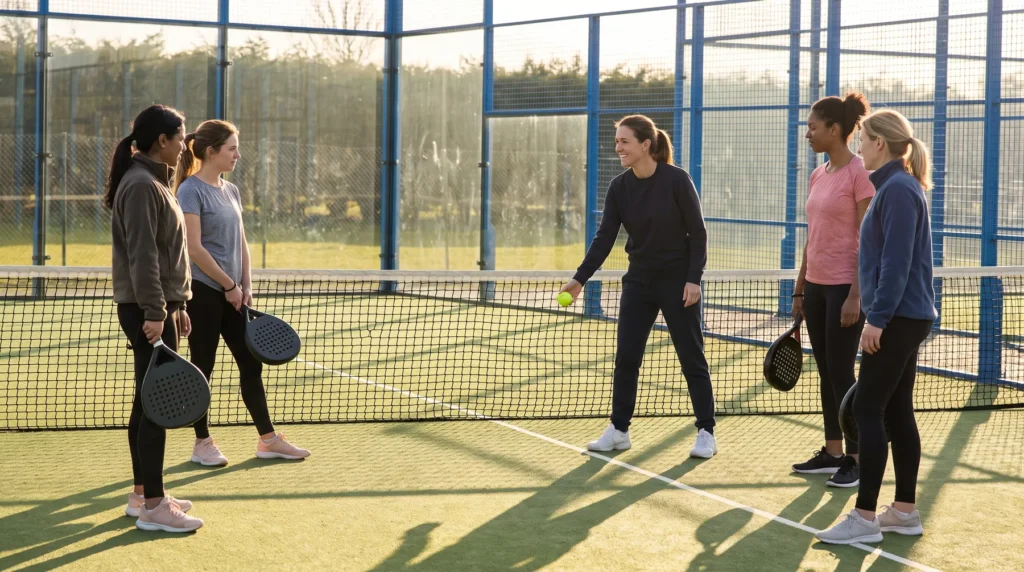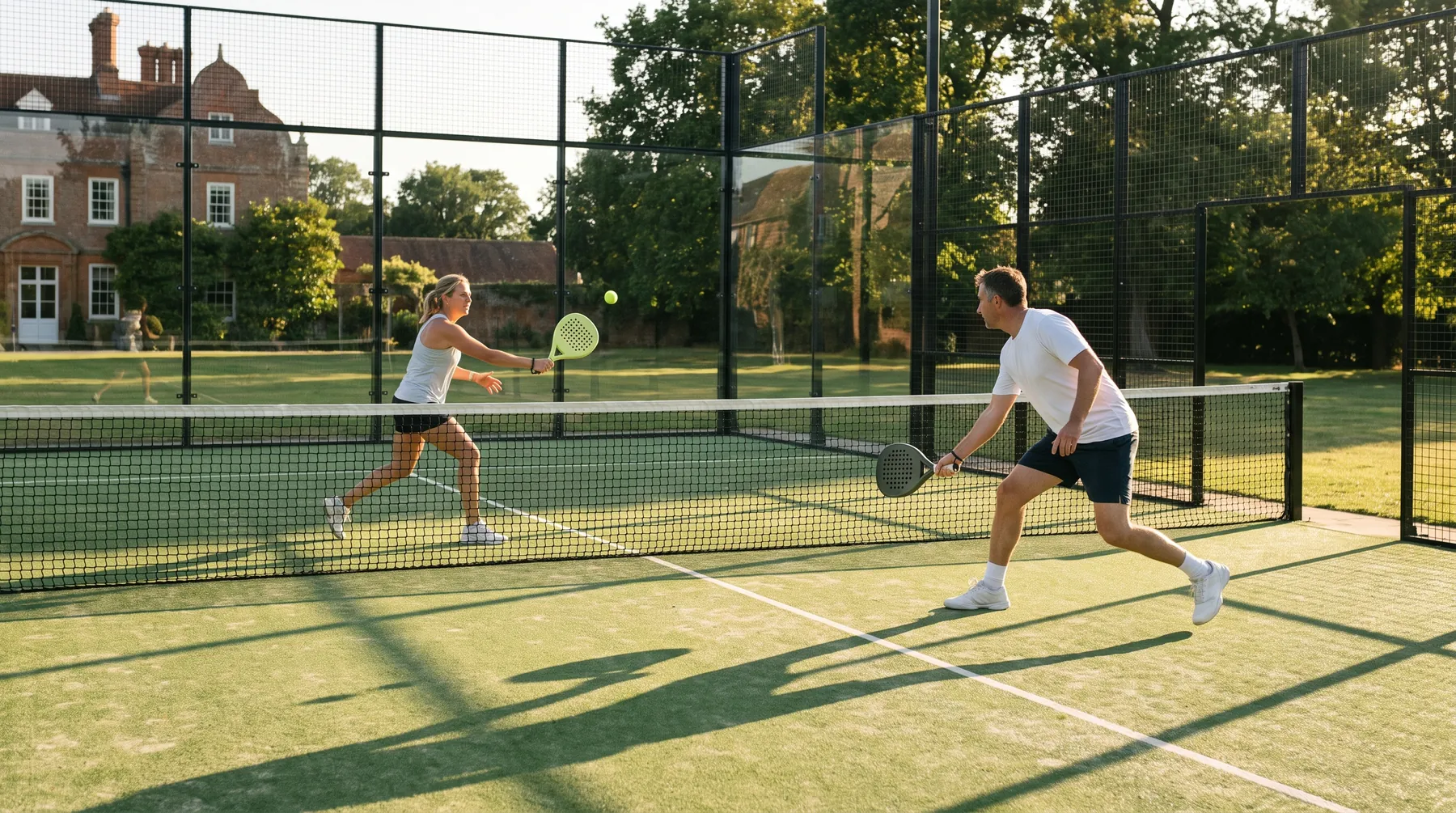
Play padel a few times and the thought arrives on its own: what if the court were at the bottom of the garden? No booking app, no peak-time prices, just a walk across the lawn.
It can be done. But a padel court is a big, tall, noisy structure, and it sits squarely inside the planning system. Here’s what you’d be taking on, in the order it usually matters.
Will it fit?
The playing area is 20 metres by 10 metres inside the walls. Once you add the concrete ring beam that holds the frame, the LTA’s construction guidance puts the smallest outdoor footprint at 20.8m by 10.8m. That’s a flat rectangle roughly the length of two buses parked end to end, before you allow any space around it.
Then look up. The LTA asks for at least 6m of clear height over the whole court, so overhanging branches and nearby power lines are a problem. The builders also need a way in for diggers, concrete and large glass panels, which rules out a lot of terraced gardens on access alone.
Before you call anyone, measure it. The LTA suggests using the distance tool on an online map or a long tape on site. If a 21m by 11m rectangle doesn’t fit with room to spare, planning permission is the least of your worries.
Do you need planning permission?
Almost certainly yes, wherever you live in the UK. The LTA treats every padel court as development needing formal consent, and says the 3m and 4m walls and any floodlights all need permission.
Homeowners do have some rights to build without applying, known as permitted development. In England, the Planning Portal’s outbuilding rules cover garden enclosures, including tennis courts, but cap their height at 3m, or 2.5m within 2m of a boundary. A padel court’s end walls are 4m high.
Garden fences and walls are limited to 2m (1m next to a road) under the rules for England, Wales, Scotland and Northern Ireland, and a padel enclosure stands 3m to 4m high.
Living in a conservation area, a national park or a listed building makes it more certain still. So does a planning condition or Article 4 direction that has removed your permitted development rights, which you can check with the council.
None of this is legal advice. Rules differ between the four nations and between councils, and they change. Ask your local planning authority before you commit to anything, and in England read the Planning Portal’s guidance for your project. If you’re unsure whether permission is needed, the council can issue a lawful development certificate that settles it formally.
The neighbours will hear it
This is the part people underestimate. Padel is loud in a particular way: the crack of a solid racket on the ball, the thump of the ball off glass, and players calling to each other. Acoustic consultants describe it as impulsive noise, sudden and irregular, and it carries over garden fences far more noticeably than the average volume suggests.
The LTA’s guidance says a home within 30m of a court could mean noise reduction measures are needed, and within 50m noise and light surveys by specialist consultants are likely. In most gardens, the neighbours are well inside 50m. Expect your council to ask for a noise impact assessment, and possibly to limit the hours the court can be used.
Permission isn’t the end of it either. Government guidance says councils must act if noise unreasonably and substantially interferes with someone’s enjoyment of their home, and that covers noise from gardens. In June 2026, magistrates upheld a council’s noise nuisance notice against padel courts at a sports club in Worcestershire, even though the club had cut its playing hours. A private court can face the same process.
Talking to the neighbours early is the single most useful thing you can do. The LTA recommends it for clubs, and it matters even more when the neighbours are over the fence.
What about lights?
Without lights, a British outdoor court is a summer-evening and weekend thing. Floodlights fix that, but they need planning permission of their own. The LTA’s minimum for recreational play is an average of 300 lux at court level, with the fittings at least 6m up.
Planners will want to see how much light spills into neighbouring gardens and windows, usually through a lighting design that shows the angle of every fitting. Councils often add conditions on when the lights can be on. If your nearest neighbour’s bedroom faces the court, that’s likely to be the hardest conversation of the whole project.
What it costs
The best published figures come from the LTA’s 2025 construction guidance note, based on projects delivered in 2025 and excluding VAT and fees:
- One outdoor court with lights: about £36,000.
- The ring beam, base and drainage underneath it: about £35,000.
- Total for one court: about £71,000.
- A canopy on top: roughly £75,000 to £95,000 more, depending on which LTA publication you read.
On top of that come planning fees, a structural engineer for the foundations, and reports for noise, lighting and possibly trees or wildlife. The LTA also suggests setting aside £1,500 a year per court for resurfacing and lights, and expects the turf to need replacing around every five years.
Funding help is aimed at community venues. The LTA’s Facility Loan Scheme lends only to properly constituted not-for-profit organisations, not to individuals, so a private garden court is self-funded.
If you still want to go ahead
- Measure the site. Check the footprint, the clear height and access for machinery.
- Talk to the neighbours. Find out early whether noise or light will be a problem for them.
- Ask the council. Use the pre-application advice service if your council offers one, and ask which reports it will want.
- Get specialists in. A structural engineer for the base, an acoustic consultant for noise, and a lighting designer if you want lights.
- Get three quotes. The LTA recommends members of the Sports and Play Construction Association, and visiting a court each one has built.
Our full guide to building a padel court in the UK goes further into each of these, with the rules for each nation, real planning decisions, court materials and converting an old tennis court.
For most people, the honest answer is that a garden court costs about the same as a decent car, needs neighbours who are on board, and takes months of paperwork before the first ball. If that’s not you, your nearest public courts are probably closer than you think, and our booking guide covers how to get on them without the peak-time pain.
New to the game and wondering why anyone would want their own court? Start with what padel is and how it’s played.
Next on the blogPadel levels, socials, Americano and Mexicano explained