In padel the serve is not a weapon for aces. It is the way you start the point on your terms and get to the net. This guide covers where to aim, how to use spin, how to return well, and the drills that make both feel automatic.
A quick recap of the legal serve
You serve from behind the service line, between the centre line and the side wall, with your feet off both lines. Bounce the ball behind the service line, then hit it underarm at or below waist height with at least one foot on the ground. It must travel diagonally into the opposite service box. You get two attempts.
A serve that bounces in the box and then hits the back or side glass is good. One that bounces in the box and hits the mesh fence first is a fault. The full detail, including lets, is in our padel rules and scoring guide.
What the serve is really for
The pair at the net wins most points in padel, and the serve is your free pass to get there. The LTA's own serve advice puts placement over power, and that is the right mindset. A steady, well-placed serve that lets you follow it in to the net is worth far more than a fast one you miss half the time.
So the aim for every first serve is simple: land it deep, make the return awkward, and move forward behind it. Your partner should already be at the net, a step or two from it, ready to pounce on a weak return.
Where to aim: glass, T and body
There are three main targets. Mixing them up stops the receiver settling into a rhythm.
The side glass
Aim deep and wide so the ball bounces near the back of the box and runs into the side glass. The receiver has to deal with a ball that changes direction off the wall, and the return is usually a block rather than an attack. This is the most common serve at club level, and a good one to make your default.
The T
Aim at the point where the service line meets the centre line. The ball heads towards the back glass in the middle of the court, which tends to jam the receiver and take away the wide angle. It is a good surprise serve, especially against a player who has crept wide to cover the glass.
The body
A serve aimed straight at the receiver's hip cramps their swing. It works best against players who like to take a big step and swing freely. Use it now and then rather than every time.
| Target | What it does | Best used |
|---|---|---|
| Side glass | Pulls the receiver wide and makes them play off the wall | As your everyday serve |
| T (centre) | Takes away the angle and jams the receiver | As a change-up, or against a receiver standing wide |
| Body | Cramps the swing | Occasionally, against big swingers |
Adding spin
Most good club players serve with slice (backspin with a little sidespin). Hit slightly under and across the back of the ball with an open racket face. A sliced serve stays low after the bounce and skids off the glass, which gives the receiver less time and less height to attack.
A flatter or topspin serve bounces higher and kicks off the back glass. It can be useful as a change, but a high bounce also gives the receiver an easier ball, so use it sparingly. Whatever spin you use, keep the contact below waist height and the bounce low.
The return: lob or low?
When you receive, the server is coming forward to join their partner at the net. Your return decides whether they get there comfortably. You have two main options.
The lob return
A high, deep lob over the net player, ideally landing beyond the service line and before the back glass, pushes the serving pair back and gives you time to move forward yourself. Coaches often suggest the lob when the serve is a good one down the T, because a fast return from an awkward position tends to come back at you before you have recovered.
The low return
A low, soft return aimed at the feet of the incoming server forces them to volley upwards. This is called a chiquita in Spanish padel terms (see our padel glossary). When the serve is tough and wide into the glass, keep it simple: block the ball low and back towards the server rather than going for anything ambitious.
Choosing between them
- Good serve into the glass: block it back low and safe.
- Good serve down the T: lob to buy time.
- Easy, central serve: be bolder. Go low to the server's feet, or lob straight away and take the net.
Avoid the tennis habit of hitting the return hard and flat at the net player. At padel net distance they will often volley it straight back into the space you have left.
Common faults
- Serving above the waist. Tennis players often let the contact creep up. Bend your knees and let the ball drop.
- Serving too short. A short serve sits up in the middle of the box and is easy to attack.
- Standing still after serving. The serve is the start of your run to the net, not the end of the shot.
- Foot faults. Stepping on the service line or centre line is a fault, so set your feet before you bounce the ball.
- Receiving too close to the glass. Give yourself a metre or so of space so you can let the ball come off the wall if you need to.
- Swinging big on the return. Short, compact strokes give you control. Placement matters more than pace.
Drills
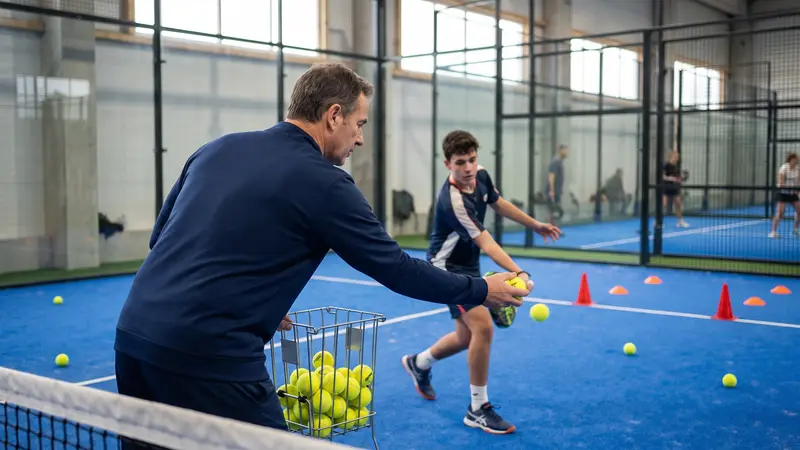
All of these work with two to four players and a basket of balls. If you have not booked a court yet, use our court finder to find one near you.
- Target serves. Put a towel or a cone in the deep corner of each service box, near the side glass. Serve ten balls to each side and count how many land within a racket length of the target. Then move the target to the T.
- Serve and step. Serve, then take three quick steps towards the net and stop in a ready position. Repeat until moving forward becomes automatic.
- Return choices. A feeder serves a mix of glass and T serves. The receiver lobs every T serve and blocks every glass serve low. Swap after ten balls.
- Lob depth. Receivers aim lob returns to land between the service line and the back glass. Score one point for each lob that lands in that zone.
- Serve, return, first volley. Play out only the first three shots of the point: serve, return, then the server's first volley. It trains the transition to the net without needing full rallies.
Serving is the one shot you can practise alone, and our padel drills and practice library has a solo serving drill alongside more partner drills, plus a plan for a full session.
Questions players ask
Can I serve overarm in padel?
No. The serve must be underarm, hit at or below waist height after the ball has bounced behind the service line.
Is it a fault if the serve hits the side glass?
No, as long as it bounces in the correct service box first. If it bounces in the box and then hits the mesh fence, it is a fault.
Should I serve hard?
Not usually. A deep, low, well-placed serve that you land almost every time is more effective than a fast one, because the point is to reach the net safely.
Where should my partner stand when I serve?
At the net on the other side of the court, roughly a step or two back from it, ready to volley the return.
Do I have to let the serve bounce before returning it?
Yes. The receiver must let the serve bounce. After the bounce you can play it straight away or let it come off the glass first.
Does my racket affect my serve?
A little. Control-focused round rackets tend to make placement easier for newer players. Our racket guide and the racket match quiz can help you choose.
Find a court near you
Over 700 UK venues with opening hours, facilities, nearest stations and booking links.
Open the court finder