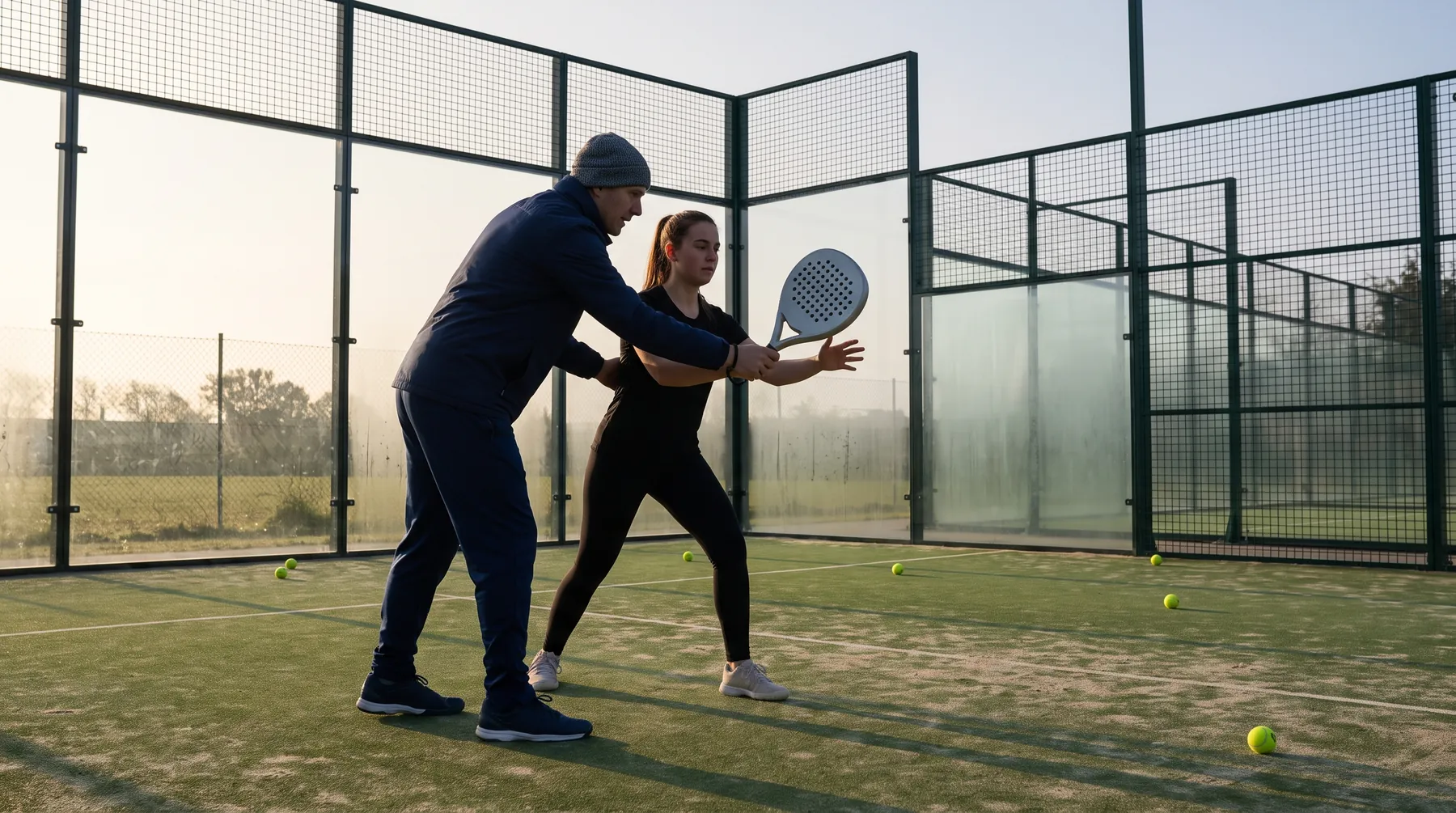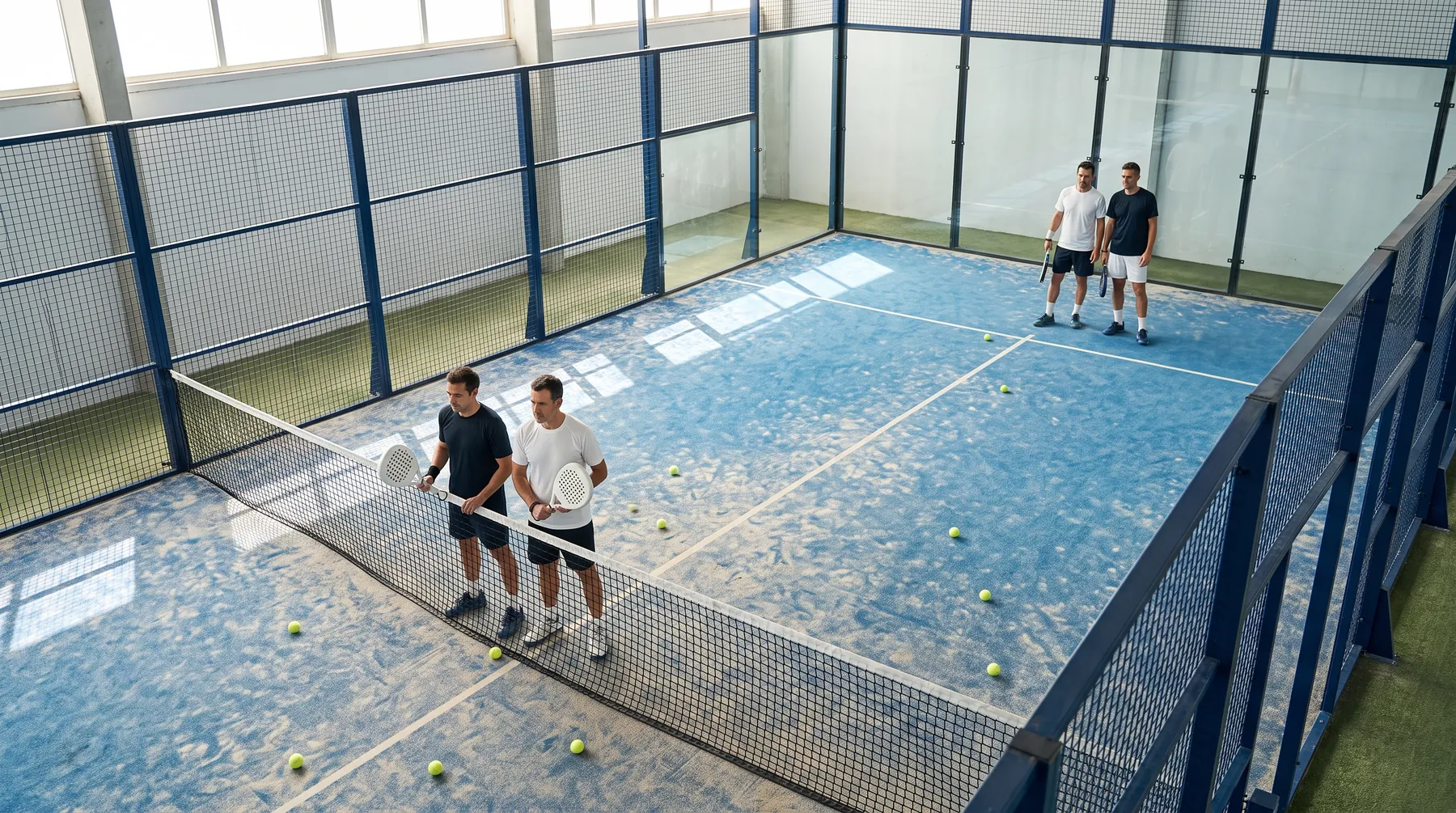
When a new player loses a point, the shot often isn’t the real problem. Where they were standing when the ball arrived usually is. Get your position right and the ball keeps landing in places you can reach. Get it wrong and the ball lands at your feet or sails over your head before you’ve even swung.
Positioning is a decision, though, so it doesn’t take hours of practice to groove like a stroke does. That makes it the quickest thing in padel to improve.
Two places to be, and one to avoid
A padel court has two good places to stand. One is at the back, defending, where you can let the ball come off the glass. The other is at the net, attacking, where you volley the ball before it bounces.
Pairs who hold the net usually win the point, so most of the game is a tug of war over who gets to stand there. The positioning and tactics guide goes deeper into that fight; here we’ll stick to where your feet should be.
Between the back and the net sits a strip of court known as no man’s land. The Padel School defines it as the area from one step behind the service line forward to about the second post of the side fence.
Stand there while an opponent is hitting and you get the worst of both worlds. You’re too far back to volley comfortably and too far forward to let the ball reach the glass, so a ball at your feet or over your head leaves you stuck.
You’ll cross no man’s land all the time on your way to the net. The trick is not to stop in it.
Your defensive spot at the back
When the other pair have the net, both of you should be back. A good starting point is a step or two behind the service line, which leaves a metre or two between you and the back glass. The exact distance depends on how hard the ball is coming. Against a big hitter, drop a little deeper.
From there you can take a short ball before it bounces twice, or let a deep one go through and play it off the glass once it rebounds.
Two signs tell you you’ve got it wrong. Pinned flat against the back wall with no room to swing means you’re too deep. Lobs landing behind you before you can turn means you’re too far forward.
Your attacking spot at the net
When you’ve won the net, don’t stand right on top of it. It feels aggressive, but one decent lob and you’re in trouble. A better home base is roughly two to three metres from the net. From there you can still volley down at the opponents’ feet, and you can reach a lob with a few steps back.
Think of it as a base to return to after every shot, not a fixed spot. If the opponents are under pressure and pop the ball up, step in and finish it. If you see one of them shaping to lob, take a half-step back before they hit. The volley and net play guide covers what to do with the ball once you’re there.
Move together, always
This is the rule that matters most. You and your partner move as a unit. If one of you goes to the net, the other goes too. If one of you is lobbed and has to run back, the other drops back as well.
It helps to picture a short rope tied between you. When your partner moves, you move the same way by about the same distance. One up and one back leaves a huge diagonal gap through the middle of your half, and that gap is the easiest target on the court.
The same idea works sideways. When the ball goes wide to your partner’s side, slide a little towards the middle so the gap between you stays closed. That leaves the far sideline more open, but a sharp cross-court shot into that space is hard to hit, and it’s a trade worth making.
At the end of each point, glance at where your partner is standing compared with you. If you’re not level, one of you has drifted. Agree who’ll adjust, and fix it before the next serve.
Where to stand at the start of a point
Every point starts with one pair at the net and one at the back, because of how the serve works. Here’s a simple set-up for beginners:
| Situation | Where you stand |
|---|---|
| You’re serving | Behind the service line on your side, then move forward to join your partner at the net after the serve |
| Your partner is serving | At the net on your side, at your attacking spot |
| You’re receiving | About a step behind the service line, a couple of steps in from the side glass |
| Your partner is receiving | Level with them at the back on your own side, ready to move up together |
The serving side starts with the advantage, because they get to the net first. The receiving side’s job is to win it back. If you’re unsure where the server is allowed to stand, the serve rules spell it out.
When to move forward
The net has to be earned. If you charge forward behind a weak shot, the next ball lands at your feet halfway there. Move up behind a shot that buys you time:
- A lob that clears the net player and pushes them back towards their glass.
- A low groundstroke that drops at the feet of the net pair and forces them to volley upwards.
- A deep return that keeps the server back.
Go forward in stages, not one sprint. Hit, take a few quick steps, then make a small split step as the opponent swings so you can move in either direction. If their reply is weak, keep coming. If they lob, you’re balanced enough to turn and go back together.
Who takes the ball down the middle
Balls through the centre cause more mix-ups than anything else at club level. Either both of you go for it and clash rackets, or both leave it and watch it go through. The rules don’t settle it for you.
The rule
There’s no turn-taking in padel. Under the FIP Rules of Padel either partner can play any ball, but only one of you may hit it. If both of you touch it, your pair loses the point.
So agree a default before you start. For two right-handers, the player on the left usually takes middle balls, because they’ll be on that player’s forehand. After that, the player moving towards the ball has priority, and whoever calls “mine” first gets it. Talk to each other on every shared ball, even if it’s just one word.
Mistakes to look out for
- Following your own shot halfway to the net and stopping there to watch it.
- Standing so close to the net that every lob beats you.
- Backing right up against the glass, which leaves you no room to swing.
- Going forward alone while your partner stays back.
- Staying in the same spot after hitting, when you should be moving back to your base.
Pick one and watch for it for a whole session. The first one is the hardest to catch, because you won’t feel yourself stopping. Ask your partner to shout “keep going” every time you pull up short of the net, and see how many shouts it takes before you stop needing them.
Next on the blogThe padel volley: blocking, punching and footwork at the net