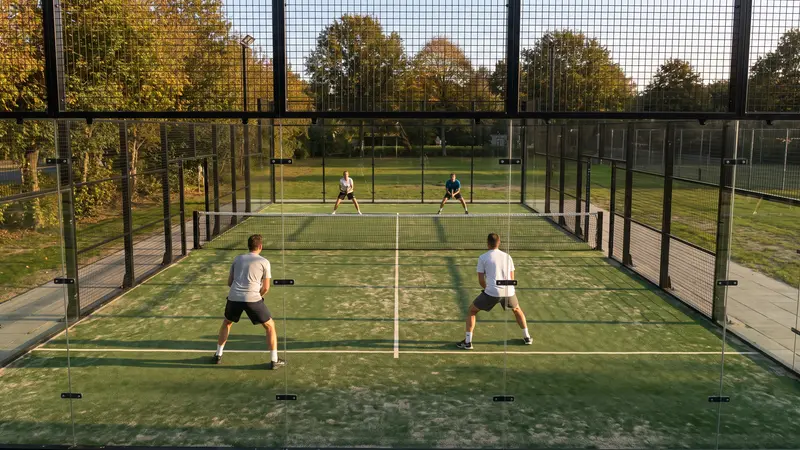
Most points in padel are won by the pair at the net, so a solid volley is the skill that moves you up a level fastest. This guide covers the grip, the ready position, the main volley types and how to share the net with your partner.
The continental grip
Use the continental grip for every volley, forehand and backhand. Hold the racket as if you were about to knock in a nail with the edge of the frame. The V between your thumb and first finger sits along the top edge of the handle.
The big advantage is that you never have to change grip at the net, where there is no time to. It also opens the racket face slightly, which makes it easy to add a little slice and keep the ball low. If you have come from tennis with a strong forehand grip, this will feel odd at first. Stick with it.
The ready position
Stand roughly two to three metres from the net, not right on top of it. Too close and any decent lob goes over you; too far back and the ball drops at your feet.
- Feet a little wider than shoulder width, knees softly bent, weight on the balls of your feet.
- Racket up in front of you at about chest height, head pointing up, so it is already near where you will hit the ball.
- Elbows away from your ribs, so you can move the racket to either side quickly.
- Eyes on the opponent who is about to hit, not on the ball after it leaves your racket.
The LTA's volley advice makes the same point: keep the racket at the height you expect to make contact, and above net height where you can. Less travel means quicker reactions.
Block or punch: the main volley types
A padel volley is a short, compact movement. There is very little backswing. Step towards the ball with the opposite foot where you have time, and meet the ball in front of your body.
The block volley
Use this when the ball is coming at you fast. Hold the racket firmly, keep the face steady and let the pace of the ball do the work. Your job is simply to get it back deep and low. Do not try to add power to a fast ball.
The punch volley
When the ball is slower and above net height, you can add a short, firm push forward through the ball, with a touch of slice. Aim deep, ideally towards the back glass or the side glass near the back, so the opponents have to play from deep in their court. The LTA describes a pushed volley for building pressure and a faster sliced volley for attacking; both come from this same compact action.
The low volley
When the ball dips below the top of the net, you cannot hit down. Bend your knees to get low, open the racket face a little and lift the ball gently back over the net, preferably deep. Trying to attack a low ball is one of the most common ways to lose a point at the net. Play it safe and wait for a higher one.
Why slice and depth matter
A volley with backspin stays lower after the bounce and comes off the glass with less height. That makes life hard for the defending pair and stops them setting up a comfortable shot. Depth matters as much as pace: a volley that lands short in the middle of the court sits up for your opponents to attack.
The bajada: getting back to the net from the glass
The bajada (short for bajada de pared) is not a volley, but it belongs here because it is one of the main ways to win back the net. When a lob or a hard ball has gone past you, hit the back glass and come out high, you can let it drop and hit it as an overhead, with your body between the ball and the wall. Coaches class it as a medium to advanced shot.
A good bajada either wins the point or pushes your opponents back so you and your partner can move in. If the rebound comes out low, do not force it. Play a defensive lob instead and try again on the next ball. There is more on wall play in our guide to playing off the glass.
Covering the middle with your partner
Two players at the net should move as if connected by a rope, roughly two to three metres apart. When the ball goes to one side, both of you shift that way, so there is never a big gap down the middle.
- Agree who takes the middle. Many pairs agree that the player whose forehand is in the middle takes balls down the centre. For two right-handers, that is usually the player on the left.
- The cross-court player takes the middle. Another common rule is that the player diagonally opposite the hitter covers the centre, because they have the better angle.
- Call it. A quick "mine" or "yours" stops both of you going for the same ball, or neither of you going for it.
Pick one rule, agree it before you start, and stick to it. You can read more on pair movement in our positioning and tactics guide.
Common mistakes
- Swinging too much. A tennis-style backswing makes timing harder and sends the ball long into the glass.
- Letting the racket drop below the hands between shots.
- Standing too close to the net and getting lobbed every time.
- Trying to win the point from a low ball instead of waiting for a high one.
- Hitting hard volleys straight at the back glass, which can rebound into a comfortable ball for the defenders. Use pace and angle with care.
Drills
A lighter, control-focused racket can make volleys easier to learn. Our racket match quiz suggests options for your level, and the padel glossary explains any Spanish terms coaches use.
- Volley to volley. Two players stand either side of the net, each two to three metres back, and keep a soft volley rally going. Count how many you can do without a mistake.
- Block wall. A feeder at the back hits firm balls at the volleyer, who blocks every one back deep. Ten balls, then swap.
- Low and high. The feeder mixes low balls and high balls. The volleyer lifts every low one back deep and punches every high one into a corner.
- Split step on the hit. The volleyer does a split step every time the feeder makes contact. It builds the timing habit without thinking about it.
- Two against two at the net. One pair at the net, one pair at the back. The back pair can only lob or play low. The net pair practise moving together and calling the middle.
For more net drills, sorted by level and by how many players you need, see our padel drills and practice library.
Questions players ask
What grip should I use for volleys in padel?
The continental grip, for both forehand and backhand volleys, so you never have to change grip at the net.
How close to the net should I stand?
Roughly two to three metres. Closer than that and you are easy to lob; further back and balls drop at your feet.
Should I volley with slice?
A little slice is useful because it keeps the ball low after the bounce and off the glass. Keep the swing short and the face slightly open.
What is a bajada in padel?
An attacking overhead played after the ball has come off the back glass high. It is a way to turn defence into attack and get back to the net.
Who takes the ball down the middle?
Agree it with your partner before you play. A common rule is that the player with their forehand in the middle takes it.
Find a court near you
Over 700 UK venues with opening hours, facilities, nearest stations and booking links.
Open the court finder