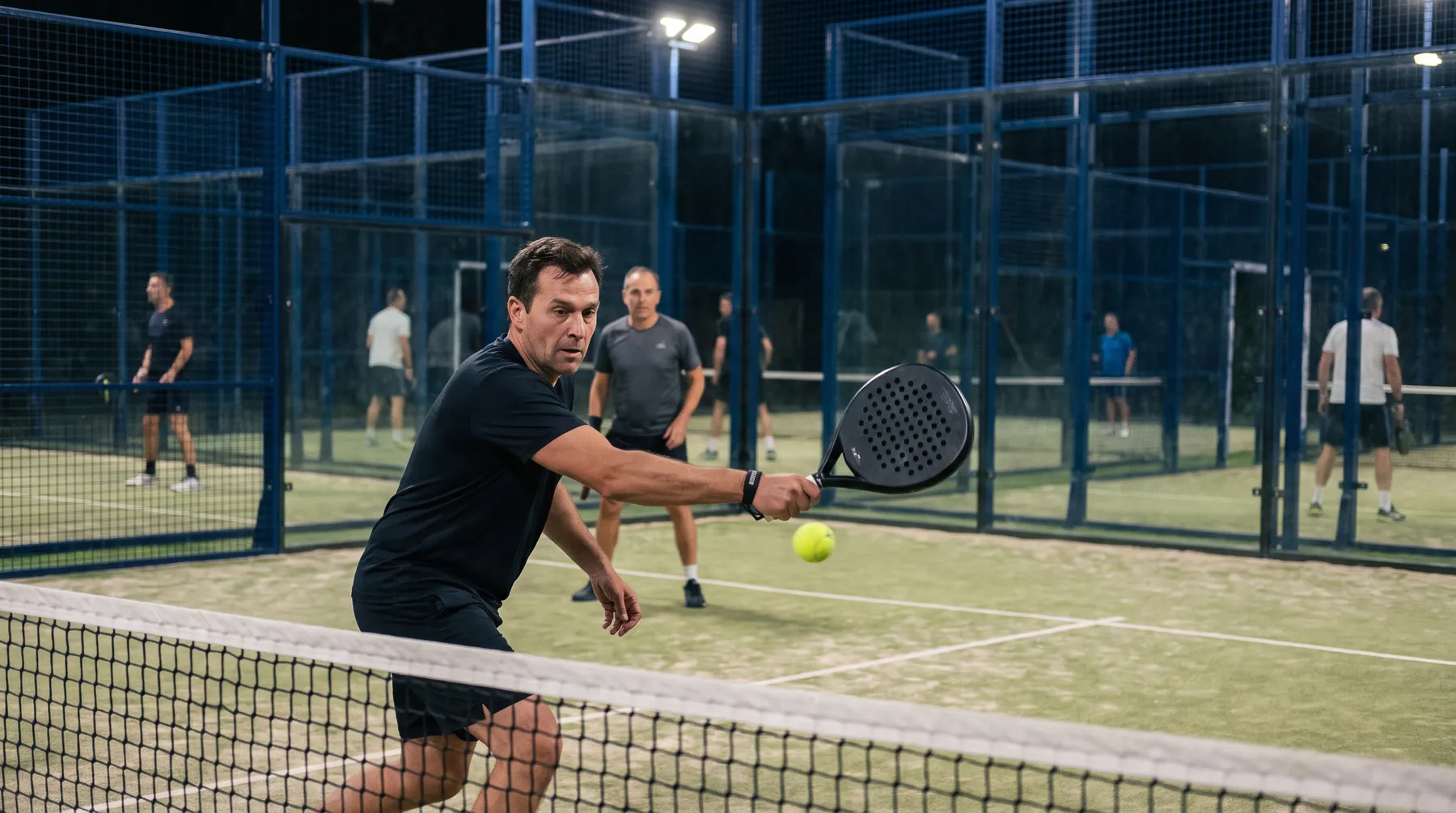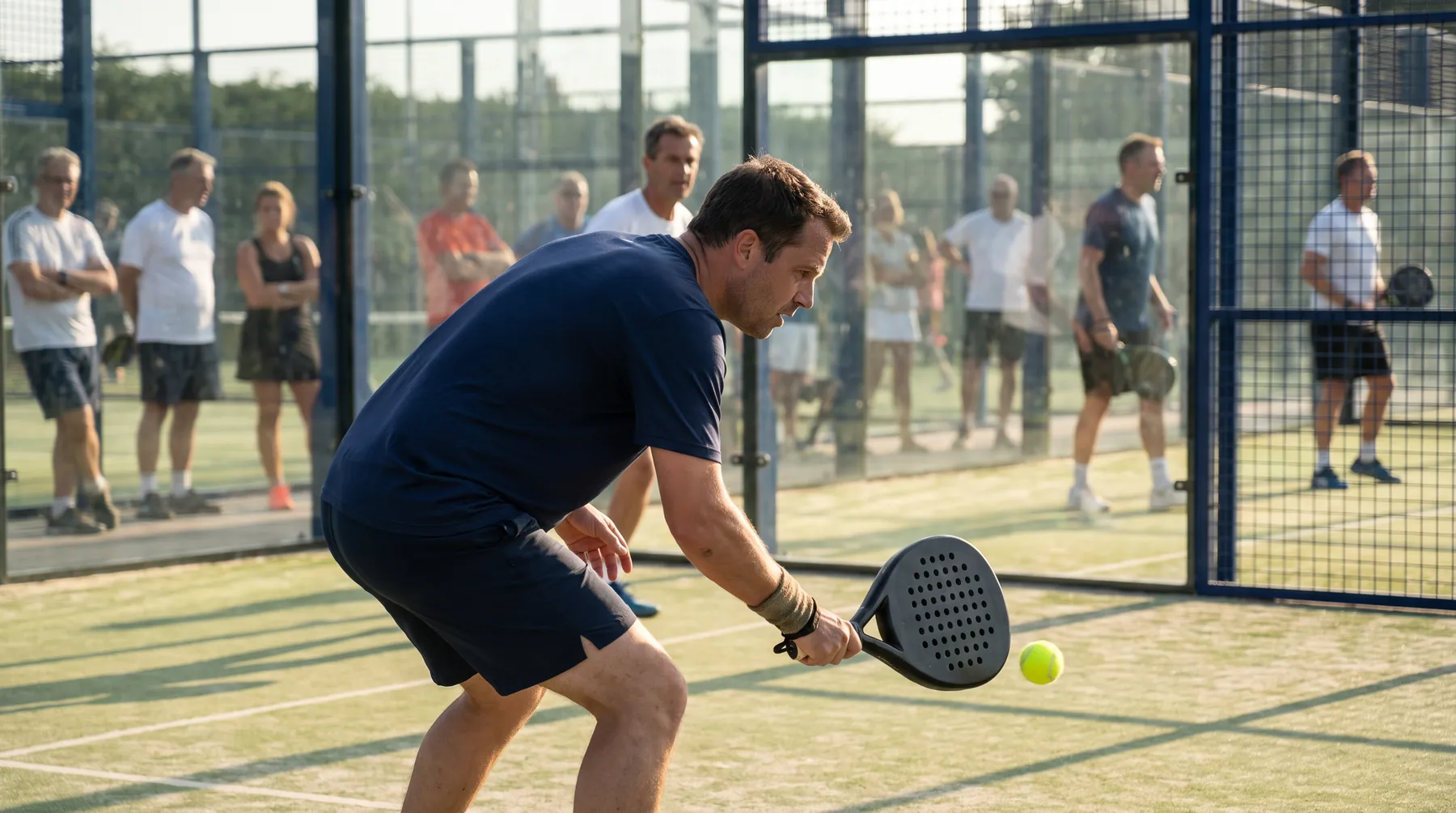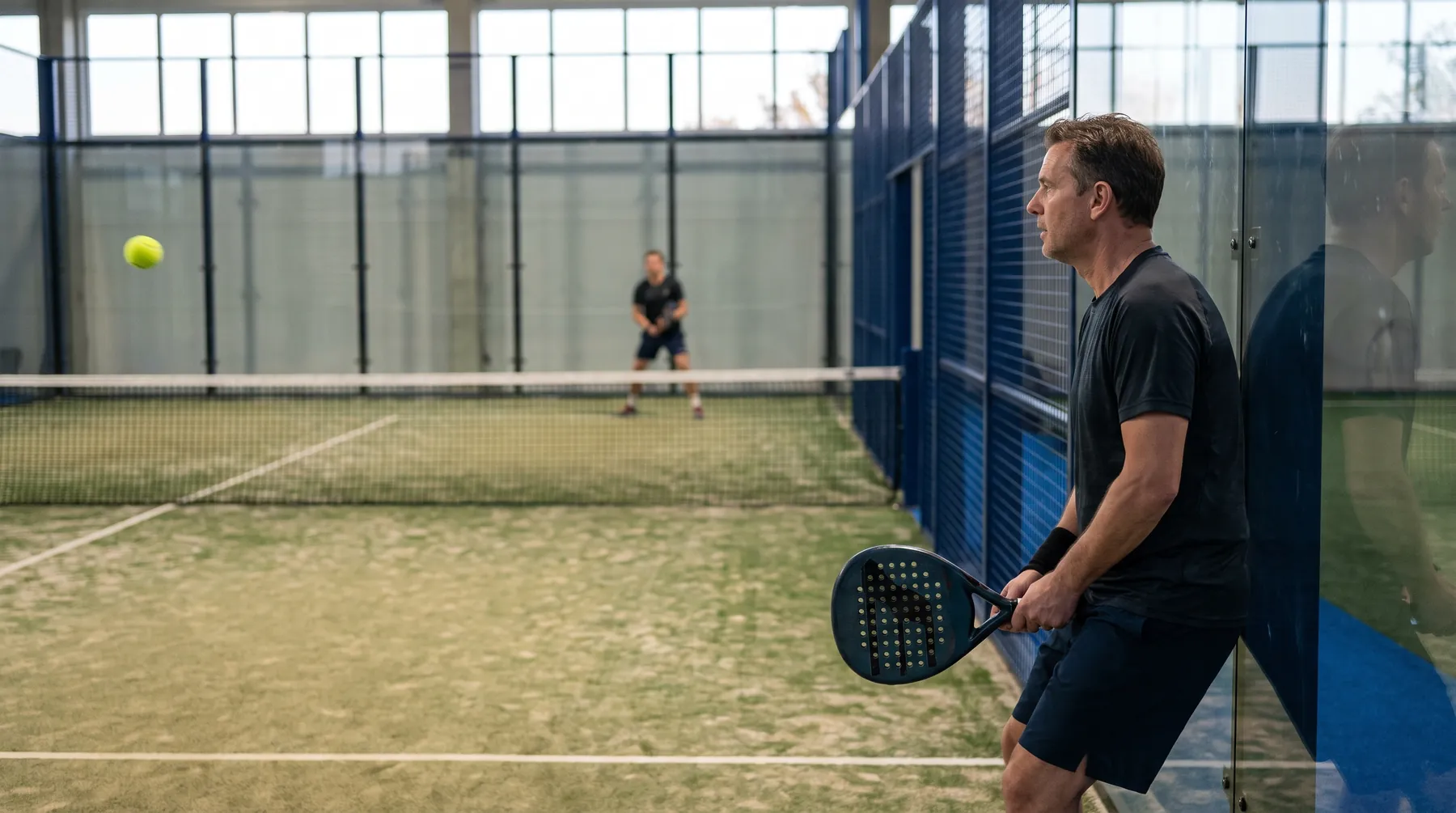
In tennis, a ball that gets past you is a lost point. In padel it bounces off the glass behind you and comes back into the court, slower than it went in, and you get another go.
Taking that second chance is the biggest step up a new player makes. It’s also where most beginners get tangled, because the ball never seems to come back quite where they expected. Below: what the rules let you do with the walls, how to read a rebound, and where to stand so the ball comes to you.
What the rules allow
The walls follow one principle: the floor comes first. Every shot has to bounce on the floor of the other side before it touches anything else. Once it has bounced on your side, the walls are part of the court. You can let the ball rebound and still play it, as long as you hit it before it bounces a second time.
| What happens | Result |
|---|---|
| Ball bounces on your side, hits your back or side glass, and you return it | Fine, play on |
| Ball bounces on your side and comes off the metal mesh | Still in play, though the bounce is less predictable |
| You hit the ball into your own glass and it carries over the net | Legal, and a recognised shot |
| You hit the ball into your own mesh | You lose the point |
| Your shot hits the other side’s glass or mesh before their floor | You lose the point |
All five come straight from the FIP Rules of Padel. Learn them before you start using the walls on purpose; the rules and scoring guide has the full set if you want to check anything else.
Why the glass is on your side
A ball that has bounced and then hit the back glass has lost a good deal of its speed. That gives you time. A fast drive that would rush you if you took it early is slower and more comfortable once it has come off the wall, and those extra moments let you set your feet and choose a shot.
It also means you can stop chasing everything. Beginners tend to sprint at every ball and hit it before it reaches the wall, often from an awkward position. Letting a deep ball go through to the glass is usually the calmer, safer choice.
As you improve, the same rebounds give you attacking chances too. The bajada (from the Spanish for “coming down”) is the obvious one: you hit a high rebound firmly back down into the court.
Reading the rebound
Good wall play starts the moment the opponent hits the ball, well before it reaches the glass. Three things decide where it will come out, and you can read all of them early:
- Pace matters most. A hard ball springs a long way back off the glass, so you need more space. A soft, looping ball drops close to the wall, so you have to move in nearer to it.
- Then the angle. A ball travelling straight down the court comes straight back out. A ball arriving at an angle leaves at a similar angle, heading across the court.
- Spin changes the height. Topspin makes the ball kick up and come out further. Slice makes it sit down and stay low near the glass.
Spin is the hardest to read, and it’s why the walls feel unpredictable for the first few months. Only repetition fixes it. Every rebound you watch teaches your eyes a little more.
Where to stand
The most common mistake is running straight to the point where the ball will hit the glass. It feels logical, but the ball doesn’t stay there. It bounces back out into the court, often straight into your body, and you end up jammed with no room to swing. Backing right up to the wall is one of the classic beginner mistakes.
Move instead to where the ball will be after the rebound. Go back early, as soon as you can see the ball is deep, and leave a gap between you and the wall. For a firm ball that’s around a metre or a bit more; for a soft one that will die near the glass, less.
Coaches quote slightly different distances, so don’t get hung up on the number. If you have to err, err on the side of space. A step forward at the last moment is easy. Being cramped against the wall leaves you with nothing.
Turn side-on as you go back, so you can see the ball over your shoulder and keep an eye on the court. Use small, quick steps, and get the racket back early so the only thing left to judge is the timing. Then let the ball come off the glass into the space in front of you, and step forward into the shot.
Going back for a deep ball, aim to arrive beside the rebound, not behind it. If the ball is going to come out on your forehand side, set up with it passing just in front of your hitting arm. Your footwork should finish moving towards the net, not falling back into the glass.
The back glass shot
When the ball comes off the back glass, it’s already travelling towards the net, so you hardly need to add pace. Bend your knees, swing gently from low to high, and guide the ball back over. It’s the same compact forehand and backhand you’d play from the back anyway, just with softer hands.
From there you have two sensible options. A lob over the net pair sends them back and might let you take the net. A low ball to their feet makes them volley up. Avoid the firm, mid-height ball that they can volley away from the service line.
Side glass and corners
A ball hit across the court often bounces, hits the side glass and comes across in front of you. Follow its line with your body and let it run, instead of lunging at it as it hits the wall. It will usually come out towards the middle, so take a step towards where it’s going.
Corners are trickier. A double-wall ball hits two walls before you play it, side then back or back then side. Watch which wall it hits first and the angle it arrives at, then wait. Once it has finished with both walls, it’s far easier to predict.
Save the ambition for another ball. Lifting this one back to a safe place and rebuilding the point is a good result. The playing off the glass guide goes through double-wall balls in more detail.
Using your own walls as a last resort
Sometimes a ball gets so far past you that there’s no way to play it forward. You can still turn and hit it into your own back or side glass so that it rebounds over the net. That shot is called a contrapared, Spanish for “against the wall”.
It’s an emergency shot and needs care. Hit up, with enough pace to clear the net, but not so hard that the ball hits the opponents’ glass before their floor, which loses you the point. And make sure you’re hitting glass, because mesh ends the rally against you. Hear a Spanish shot name on court you don’t recognise? The padel glossary will have it.
How to practise
You can start on your own, with nothing but a ball.
Try this on court
Stand around the service line facing the net, with the back glass behind you.
- Throw the ball high into your back glass so it bounces first, then rebounds.
- Move to where it’s coming out and catch it in your free hand. Catching takes the swing away, so all you’re learning is where to stand.
- Once you’re catching most of them comfortably, hit them back over the net instead.
With a partner, have them stand at the net and feed slow, deep balls past you. Start gently and only to your forehand, then mix sides so you don’t know which is coming. Keep the pace low for a good while, since you’re training footwork and spacing here. Winners can wait. When that starts to feel easy, the drills and practice library has more glass work for two and four players.
Next on the blogSetting padel goals that actually help