Four people, one glass box, an hour on the clock and nobody in the umpire’s chair. That’s almost all the padel you’ll ever play. You call your own shots and keep your own score, which only works if everyone has roughly the same idea of how to behave, and most of those ideas aren’t in the rulebook.
None of it is complicated. Knowing it saves awkward moments, and it makes people keen to play with you again.
Before you get on court
Turn up a few minutes early. Courts are booked by the hour, the next group will want theirs on time, and every minute spent changing shoes after the slot starts comes out of everyone’s game.
Wear proper court shoes, because running shoes slide about on sandy turf, and take off rings, watches and anything that dangles. If this is all new, your first padel session goes through what to wear and bring.
Sort out the small stuff before you start. If someone has booked and paid for the court, send them your share promptly. In a regular group, take turns bringing a new tube of balls, so it isn’t always the same person opening theirs.
Getting on and off the court
Padel venues often have several courts side by side, and the entrances are the gaps at the sides near the net. If you have to walk past a court where a point is being played, wait for the rally to end. The same goes if your ball rolls onto the next court: wait until their point is over, then ask for it back or let them send it over.
If a ball from the next court comes onto yours mid-rally, stop and replay the point. Nobody should have to play around a stray ball, and it’s a safety risk if someone steps on it.
When you change ends, walk round the net post. Don’t step over the net or lean on it. At the end of your slot, gather your bottles, towels and balls and leave promptly, so the next group gets their full hour.
The warm-up
The first few minutes are for getting loose, not for winning. Hit the ball to your opponents at a height they can play, and keep the rally going. In competition the FIP rules set aside three minutes for this, and club bookings tend to follow the same idea: a few minutes of gentle hitting before anyone keeps score.
Make sure all four of you get some volleys at the net and some balls off the back glass before the scoring starts. A couple of overheads are fine if you’re both happy, but drilling smashes at someone who’s still finding their feet isn’t.
Use the end of the warm-up to agree the format. Advantage or golden point at 40-40? How many sets? What happens at one set all? If those questions mean nothing yet, read up on how padel scoring works first.
Calling your own shots
Without an umpire, you call the things you’re best placed to see, and you call them against yourself:
- If the ball bounces twice before you hit it, say so.
- If the ball touches you or your clothing, you lose the point, so own up.
- If you touch the net with your body or racket while the ball is in play, that’s the point gone.
- If your racket slips from your hand or your wrist cord breaks, you lose the point. Make the call yourself.
The serve is the only shot where lines really matter, and the receiving pair usually call it, since they’re watching it land. If a call is close, the benefit of the doubt goes to the other side. If nobody can agree, replay the point. The rules and scoring guide settles most other disputes.
The serving pair calls the score before each point. If it gets muddled, go back to the last score all four of you agree on.
Between points
Send the balls back to whoever is serving next, in a way they can catch or pick up without chasing.
Before you serve, check the receiver is ready. A quick look is enough. Equally, don’t keep the server waiting while you have a long chat with your partner. In competition the FIP rules give you 20 seconds between points and 90 seconds at a change of ends, with no break after the first game of a set. Nobody brings a stopwatch to a social game, but those numbers give you a sense of the pace.
Keep chatter during a rally for your own partner. Calls like “mine”, “yours” and “switch” are part of the game. Shouting or waving while an opponent is about to hit the ball isn’t, and under the rules deliberate interference loses you the point.
If a ball you hit catches an opponent, raise a hand and apologise straight away, even when it was a perfectly fair shot. It keeps the game friendly. At social level, avoid aiming hard at someone standing close at the net.
Celebrations and partners
Enjoy your winners. A clenched fist or a “vamos” is part of the fun. What crosses the line is cheering when the other pair make an error, or making a show of a winner at them. When they hit a good one, tell them.
Look after your partner too. Everyone misses easy balls. If your partner gets one wrong, a “next one” does more good than a sigh or a lecture between points. If you’ve got a tactical idea, save it for the change of ends and keep it short.
At socials and mixed-level games
When you sign up for a social or a level-based game, be honest about your level. Overrating yourself spoils the game for the three people you’re paired with, and underrating yourself to win a few more points does the same.
If you’re the stronger player on court, play to keep rallies going. Hit to people’s strengths now and then, and save the shots they can’t reach for the occasional big point. If you’re the newest player, don’t apologise for every miss. Everyone on that court was new once.
Finishing the match
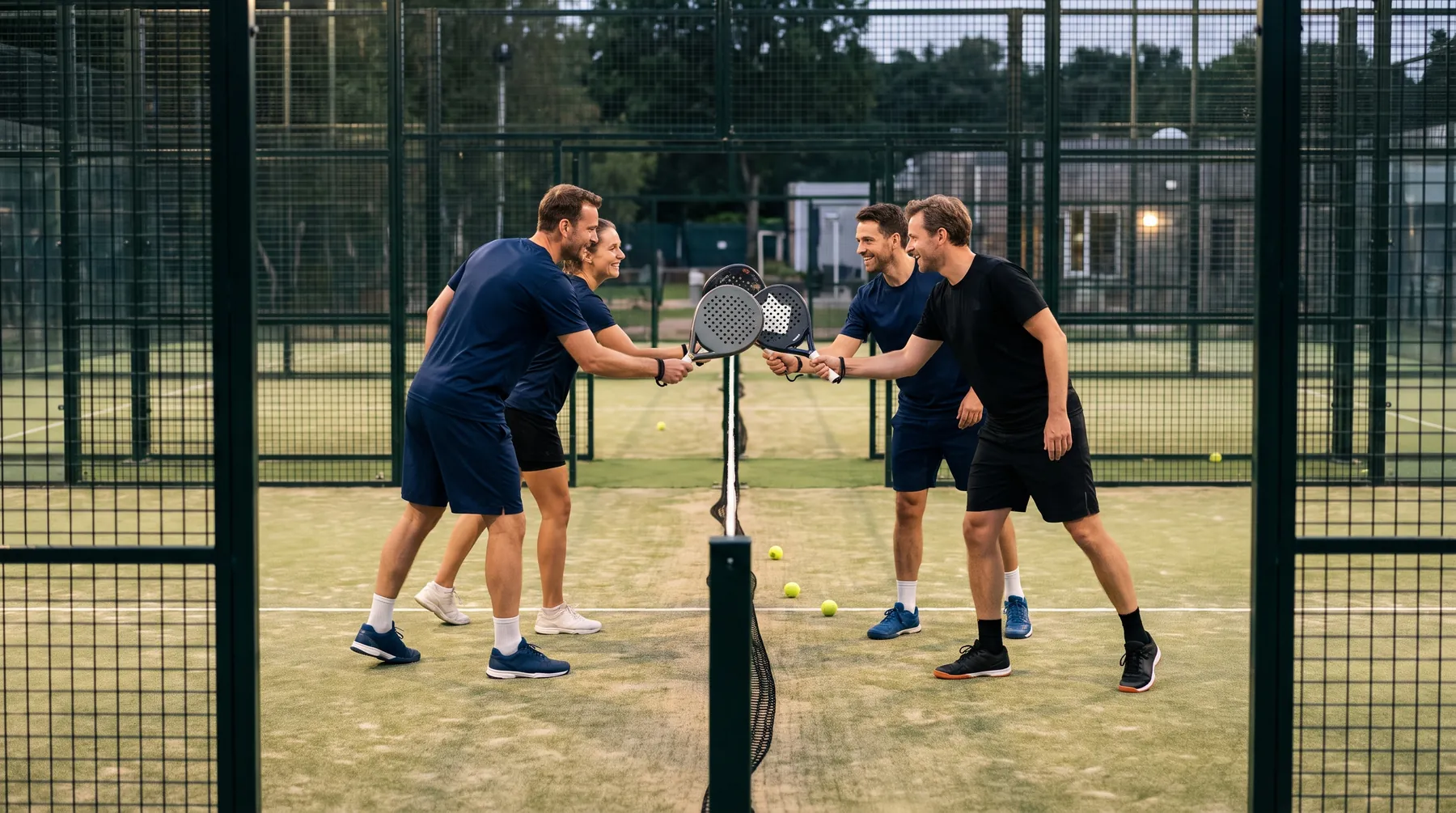
When the last point is played, meet at the net for a racket tap or a handshake with everyone, and thank them for the game. If someone else did the booking and chased everyone for their share, thank them too.
Then clear the court on time, and if the four of you got on, sort the next booking before you leave the car park. Regular groups grow out of exactly that. Our etiquette and what to wear guide keeps the short version of all this on one page, handy to send to a friend before their first game.
Next on the blogChoosing your first padel racket: shape, weight and what to ignore for now