The padel serve looks like the easiest shot in the game. You drop the ball, it bounces, you hit it underarm into a box. Then you watch a club match and count the double faults, and the arguments about whether that one “definitely hit the glass, not the mesh”. Below is every rule that applies to the serve, taken from the FIP Rules of Padel, followed by the faults club players make again and again.
The serve at a glance
Stand behind the service line on the correct side, bounce the ball behind that line, and hit it at or below waist height with at least one foot on the ground. It has to cross the net diagonally and land in the receiver’s service box.
After it lands, it can hit the glass and stay in play, but not the metal mesh. You get two attempts, and the receiver must let it bounce before hitting it. That covers most points. The details below cover the rest, and they’re the ones that cause the rows.
Where you stand
The server starts behind the service line, between the side wall and an imaginary line running back from the centre service line. You stay in that area until you’ve hit the ball. Your feet can’t touch the service line or that imaginary centre line, so standing with your toes on the paint is a fault before you’ve even swung.
The first serve of every game goes from the right-hand side of the court. After each point you switch to the left, then back to the right, and so on until the game ends.
Your partner can stand anywhere on your side of the court. Most stand near the net, which carries a small risk we’ll come back to.
The bounce and the contact
You must bounce the ball on the ground before you hit it, and the bounce has to happen in your own serving area, behind the service line. If the ball crosses the line before you strike it, that’s a fault.
At the moment of contact, the ball has to be at or below your waist and at least one of your feet has to be touching the ground. That rules out the jump serve. It also rules out slamming the ball down so it kicks up to chest height and then hitting it on the way down.
One rule surprises people: if you drop the ball and swing at it, the swing counts as a serve. Miss it completely and that’s a fault, even if you only meant to have a practice go.
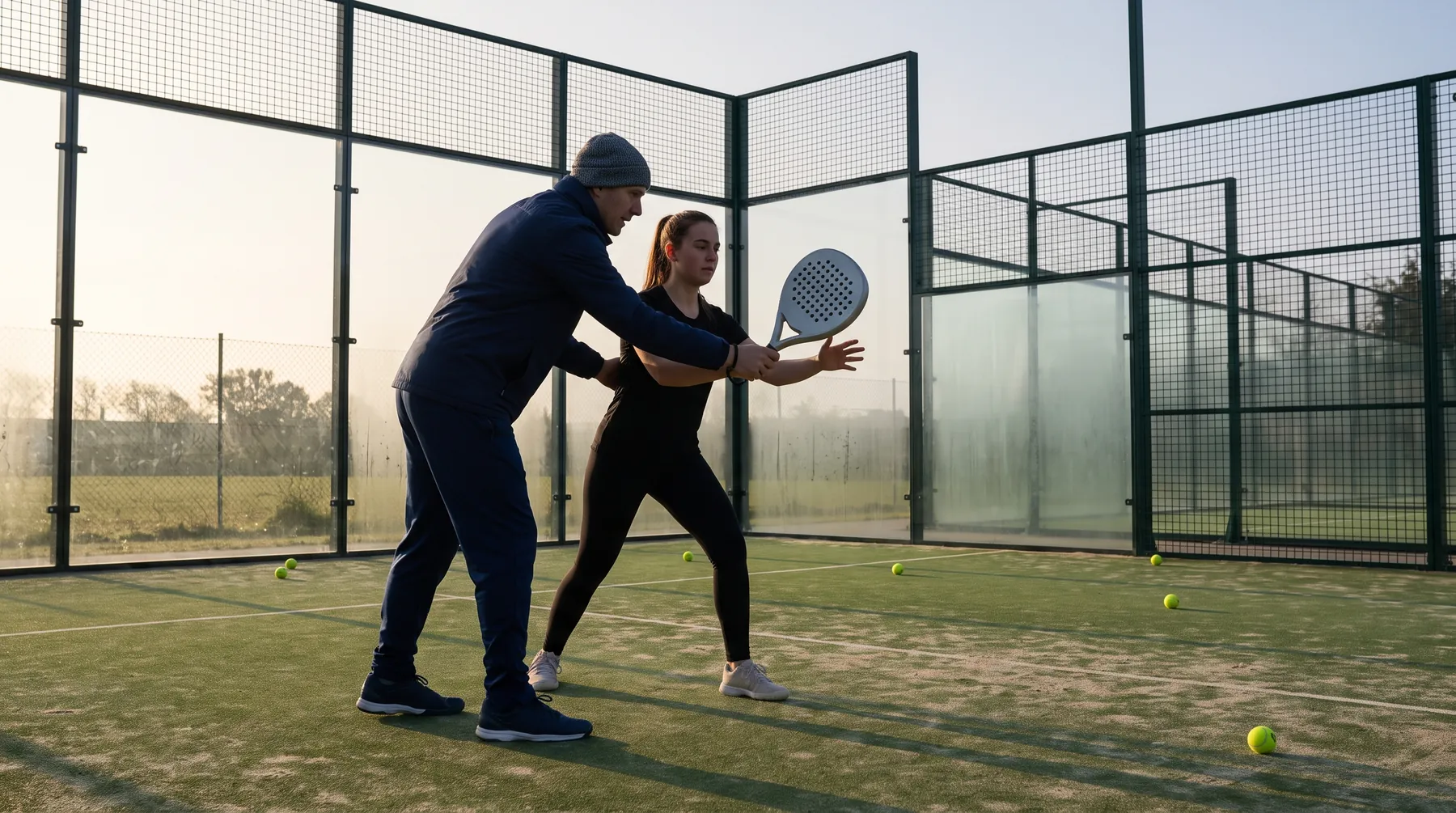
Drop the ball from about hip height and let it fall in front of your leading foot. A gentle drop gives a gentle, predictable bounce. The harder you throw it down, the higher it comes up, and the more likely you are to hit it above the waist.
Where the ball has to land
The serve goes diagonally over the net into the receiver’s service box. The lines count as in. After it lands, what it touches next decides whether it’s good.
| What the ball does | Result |
|---|---|
| Lands in the box, then hits the back or side glass | Good serve, play on |
| Lands in the box, then touches the metal mesh before bouncing again | Fault |
| Clips the net, lands in the box and stays clear of the mesh | Replay that serve |
| Clips the net, then hits a player before landing | Replay that serve |
| Clips the net and lands outside the box | Fault |
| Lands outside the box | Fault |
| Lands in the box, then goes out through a door on a court where out-of-court play isn’t allowed | Fault |
| Hits the server or the server’s partner | Fault |
The mesh rule makes more sense once you picture the court. On most courts the side glass only runs for the last few metres before the back wall, and further forward the side is mesh. A wide serve that lands in the front half of the box and skids sideways will usually find the mesh, and that’s a fault. One that lands deep and runs into the side glass near the back corner is fine.
Lets and second serves
A replayed serve doesn’t cost you anything, but how many attempts you get afterwards depends on when it happened. If the let comes on your first serve, you start again with two serves. If it comes on your second serve, you only replay the second serve.
The same applies if you serve before the receiver is ready: the serve is replayed. That only works if the receiver genuinely wasn’t ready. If they’ve had a swing at the ball, they can’t then claim they weren’t.
Two faults in a row lose the point, exactly as in tennis.
Rules for the receiving pair
The rule
The FIP Rules of Padel say the receiver must let the serve bounce in their box and return it before a second bounce. If the serve hits the receiver or their partner before it bounces, the point goes to the server.
In practice that means you can’t volley a serve, however tempting a slow one looks. Once the ball has bounced, the receiver can play it straight away or let it come off the glass first. Both are legal, and letting a fast serve come off the back wall is often the sensible choice (the guide to playing off the glass shows how to read the rebound).
Receivers also keep to one side for the whole set. Whoever receives on the right in the first game receives every serve to the right until the set ends. Who serves when, and how the golden point changes things at 40-40, is all in how padel scoring works.
The faults club players make most
Lost serves at club level tend to come from a short list:
- Hitting above the waist. The usual cause is a ball dropped too hard, so it bounces up past the hip before the racket arrives.
- Standing on the line. Players line up right behind it, and the front foot drifts onto the paint during the swing.
- Bouncing the ball on or over the service line. The bounce has to be behind it.
- Serving wide into the mesh. Aiming for the side of the box is fine until the ball runs into the fence instead of the glass.
- Hitting your own partner. A partner standing close to the centre at the net can get clipped by a low serve, and that’s a fault.
- Over-hitting. Pace without control finds the net, and even a fast serve that goes in tends to rebound off the back glass into the receiver’s hitting zone.
The last one matters most once you can serve legally. A padel serve isn’t meant to win the point outright. Its job is to start the rally on your terms so you and your partner can get to the net. A steady serve that lands deep and stays low does that far better than a big one that only goes in half the time.
Calling it without an umpire
Almost all club and social padel is played without an umpire, so the players call the serve themselves. The usual habit is that the receiving pair call serves on their side, because they have the best view, and they call it straight away. If nobody’s sure, give the server the benefit of the doubt.
Foot faults and waist height are harder, because the receivers are looking at the ball, not the server’s feet. In a friendly game most people let small things go. In a league match, if you think someone is consistently serving above the waist, mention it calmly between points, not straight after they’ve won one.
If you’ve served out of turn or from the wrong side, fix it as soon as someone notices. Points already played still count. For anything else that comes up mid-match, the rules and scoring guide is a quick check on your phone.
Getting it in before getting clever
A reliable serve comes from repetition more than technique, and ten minutes with a bucket of balls does more than a whole match.
Try this on court
Take a handful of balls to one side of an empty court, ideally in the first few minutes of a booking. Quiet off-peak slots at a venue near you (the court finder has them) are cheap enough for this.
- Serve ten from the right, aiming only to land in the box.
- Serve ten from the left the same way.
- Now aim for the back third of the box and count how many land there.
- Finish with ten second serves at three-quarter pace, keeping your feet still.
Once most of them land deep, start thinking about where in the box to aim and how to follow the serve to the net. The serve and return guide deals with both. A serve into the receiver’s body, or one that runs into the side glass at the back, is a good first target.
Next on the blogYour first padel session: what to wear, bring, book and pay