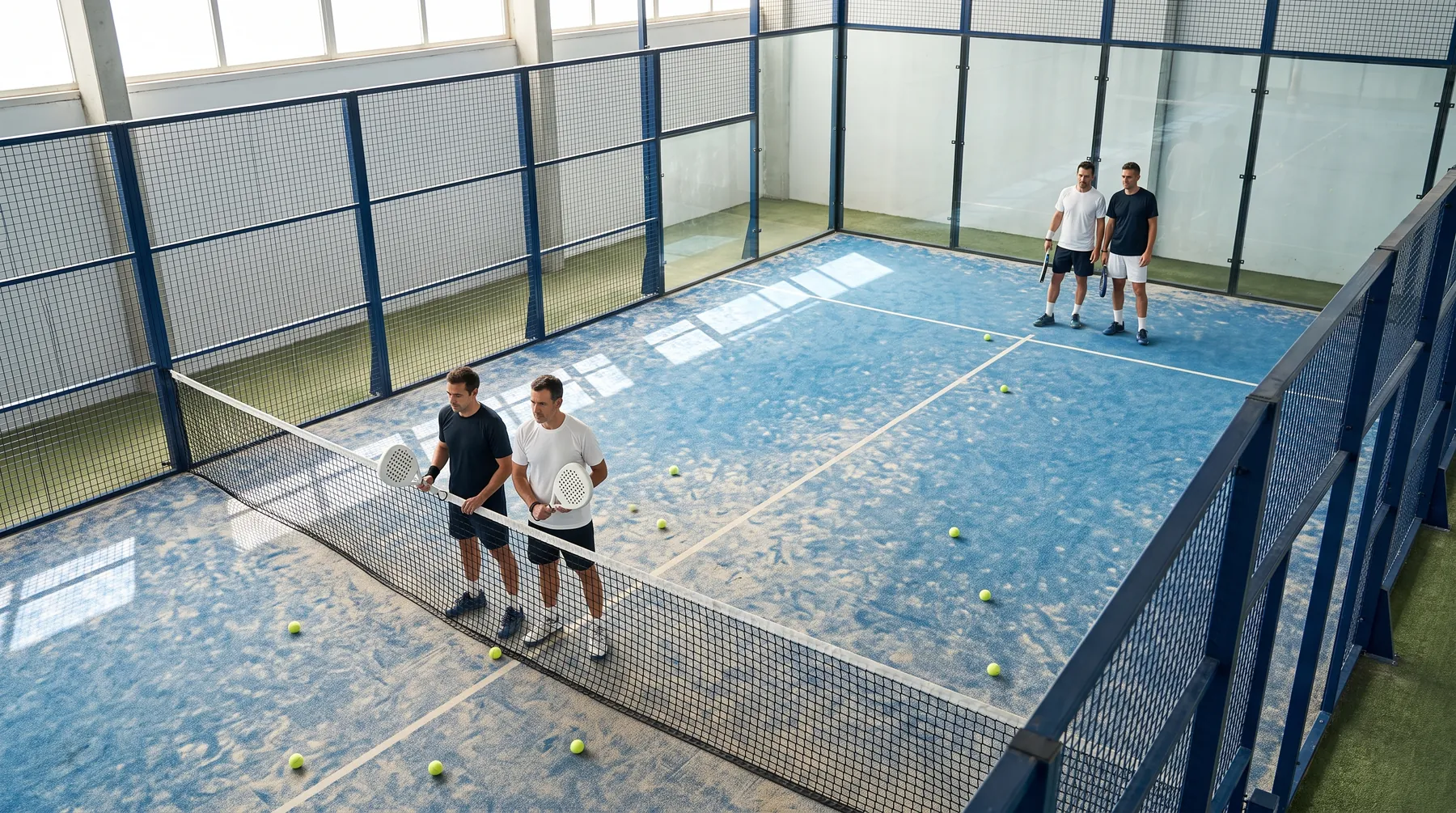
Padel has no rule about whose ball is whose. Either of you can play any shot, as long as you don’t both hit the same one, and that freedom is lovely right up until a ball comes down the middle and you each decide, at the same moment, that it belongs to the other person.
Two rackets clashing, or two players watching the ball fly between them: neither is a technique problem. Both are fixed by a few words said early enough.
Why padel needs more talking than tennis
You stand closer together than tennis doubles players do, and balls come off the glass at angles that make it hard to tell whose they are until late.
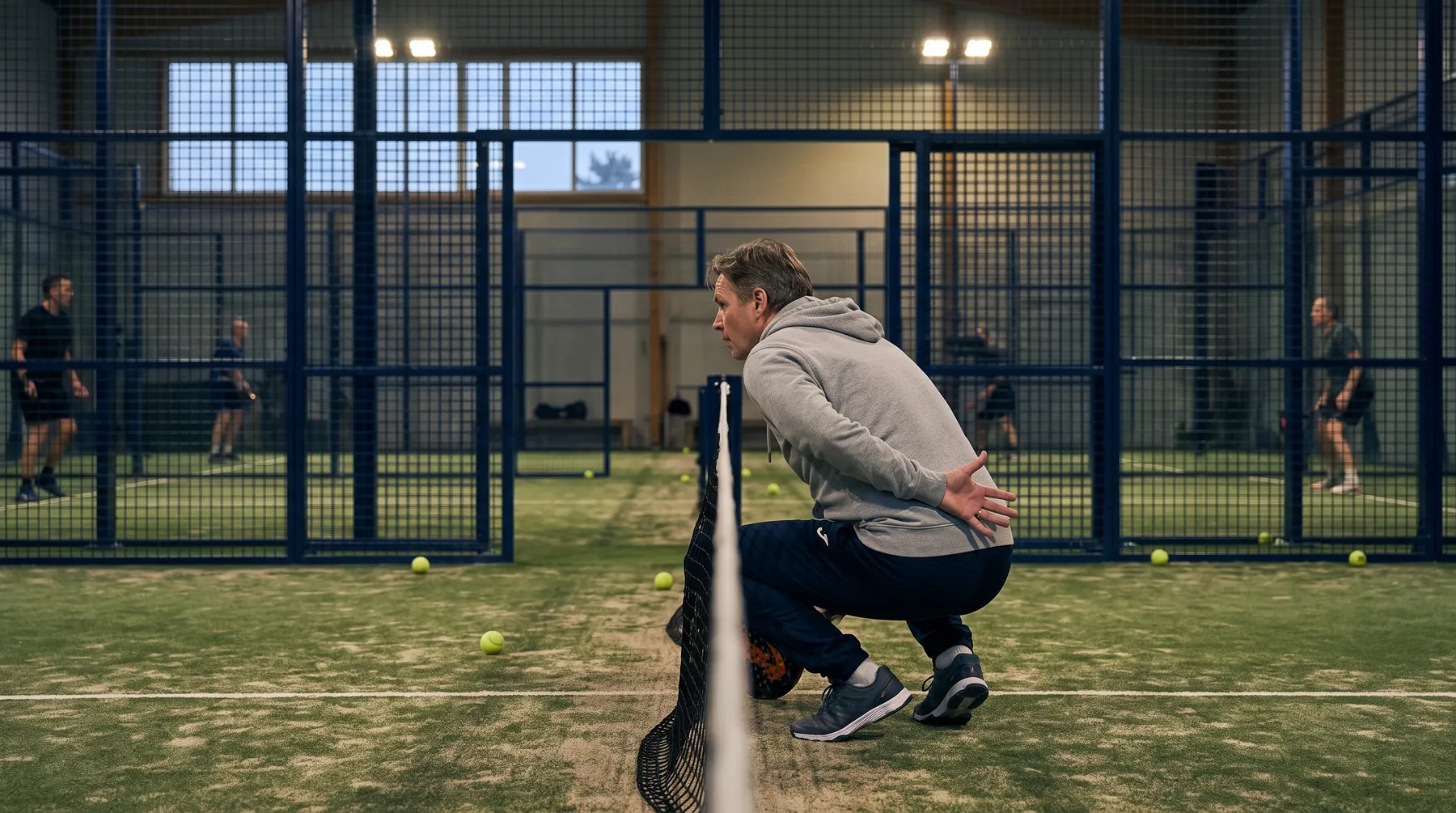
And one of you will often have your back to the opponents, chasing a lob or waiting for a ball to come off the back wall, with no idea what’s happening at the other end. Your partner can see it. That’s useful information, if they say it out loud.
The few calls you actually need
Forget building a vocabulary. A handful of short words you both understand will do, said early and loud enough to carry over the next court.
- “Mine” means you’re taking it. Say it as soon as you’ve decided, not as you swing.
- “Yours” hands the ball to your partner, and tells them you’re moving to cover the space they’re leaving.
- “Switch” is for a lob that has gone over your partner’s head. You run across behind them to play it, and they cross to your side, so both halves of the court are covered again.
- “Leave” or “out” tells your partner that the opponents’ shot is going to hit the glass or the fence before it bounces, which means it’s out and they shouldn’t touch it.
Two habits make these work. Whoever calls first gets the ball, and nobody argues with a call during the point. A confident call that turns out wrong costs you one point. Hesitating on every middle ball costs you far more over a match.
A warning for newer players: only call “leave” when you’re sure the ball will hit the wall before the floor. A ball that bounces first and then comes off your glass is still in play, and plenty of balls that look as if they’re flying long do exactly that. If you’re not sure, let your partner play it.
Who takes the ball down the middle
Calls handle the close ones, but you’ll have fewer close ones if you agree a default before you start. For two right-handers, the usual arrangement is that the player on the left takes middle balls, because they’ll be on that player’s forehand. If one of you is left-handed, both forehands may point at the middle, so you’ll need to talk it through. The next post deals with that.
The default is only a starting point. If your partner is clearly moving towards the ball and you aren’t, it’s theirs. Pairs who move together settle most of these before anyone needs to speak, and the positioning and tactics guide shows who covers what when one of you is pulled wide.
Telling your partner where the opponents are
Most club players never make this call, and it’s one of the most useful. When your partner is going back for a lob, or setting up to play a ball off the back glass, they’re looking at the ball and the wall. They can’t see whether the opponents have charged the net or dropped back. You can.
A one-word update lets them pick the right shot. Coaches use slightly different words, so agree your own, but something like this works:
- “Up” means the opponents are at the net, so a lob is the safer reply.
- “Back” means they’ve dropped deep, so your partner can play a calmer ball and the two of you can think about moving forward.
- “Coming” means they’re moving in, and there’s space at their feet.
Say it while the ball is still in the air, not after your partner has hit it. And keep it to the one word. A running commentary is harder to listen to than silence.
Hand signals before the serve
From around intermediate level, many pairs use signals on serve, borrowed from tennis doubles. The partner at the net puts a hand behind their back, where the server can see it and the receivers can’t, and shows a simple code. Usually it says two things: where the serve should go, and what the net player will do once it’s been hit.
A common set is one finger for a serve down the middle, two for a serve out wide towards the side glass, a closed fist for “I’m staying on my side”, and an open hand for a poach.
A poach is when the net player cuts across into their partner’s half to volley the return. It’s a lovely way to win a point, and a terrible way to lose one if the server doesn’t know it’s coming, because their side of the court is left empty.
There’s no official set of signals. Pairs make up their own, and some flip the meanings, so agree yours in the warm-up. The server should give a small nod so the net player knows the plan has landed. If the serve itself still feels shaky, get the serve rules straight before adding codes on top.
Talking during the point, and where the line is
Calls to your partner are a normal part of padel. The rules draw the line at the opponents.
The rule
The FIP Rules of Padel call it interference when a player puts an opponent off while they’re playing a shot. If it’s deliberate, the point goes to the other pair. If it’s accidental, the point is replayed, but a second accidental interference by the same pair costs them the point.
So your calls are for your partner. A shout timed for the moment an opponent is hitting, or noise made to distract them, isn’t communication. It’s also the quickest way to stop being invited back to a regular game, one of several unwritten rules that matter as much as the written ones.
What to say between points
The few seconds between points matter as much as the calls during them. Good pairs check in after almost every rally, win or lose. It doesn’t need to be a team talk. Catch each other’s eye and agree what you’re doing next.
Pass on information, not feelings. “Why did you go for that?” helps nobody. “Their left player is struggling with lobs, let’s keep going there” gives you both something to do. The same goes for your own mistakes: say what you’ll do differently and move on.
If your partner has just missed an easy ball, they know. The most useful thing you can say is something about the next point, said in a normal voice. Save the analysis for the drink afterwards.
Some people find chat on court distracting, and that’s fair. If you’re playing with someone new, ask before the match how much talking suits them, and at least settle the essentials: the middle ball, “switch” and “mine”.
A two-minute chat before you play
Most of this can be agreed while you’re walking on court. Run through:
- who takes balls down the middle, and who takes lobs over the middle;
- which words you’ll use, especially for “switch” and for where the opponents are;
- whether you’re using serve signals, and what each one means;
- how you’d like to hear about mistakes, if at all.
Try this on court
In the warm-up or a friendly game, play a few points where every ball has to be called.
- Every shot gets “mine” or “yours” before it’s hit, even the obvious ones.
- A ball hit without a call loses the point.
- Add “up” or “back” once the first two feel natural.
It feels silly for about five minutes. After that the calls start coming out on their own, and on a tight golden point that’s exactly when you’ll be glad of them. Our drills library has a few more for moving and talking as a pair.
Next on the blogLeft side or right side: choosing where you play in padel