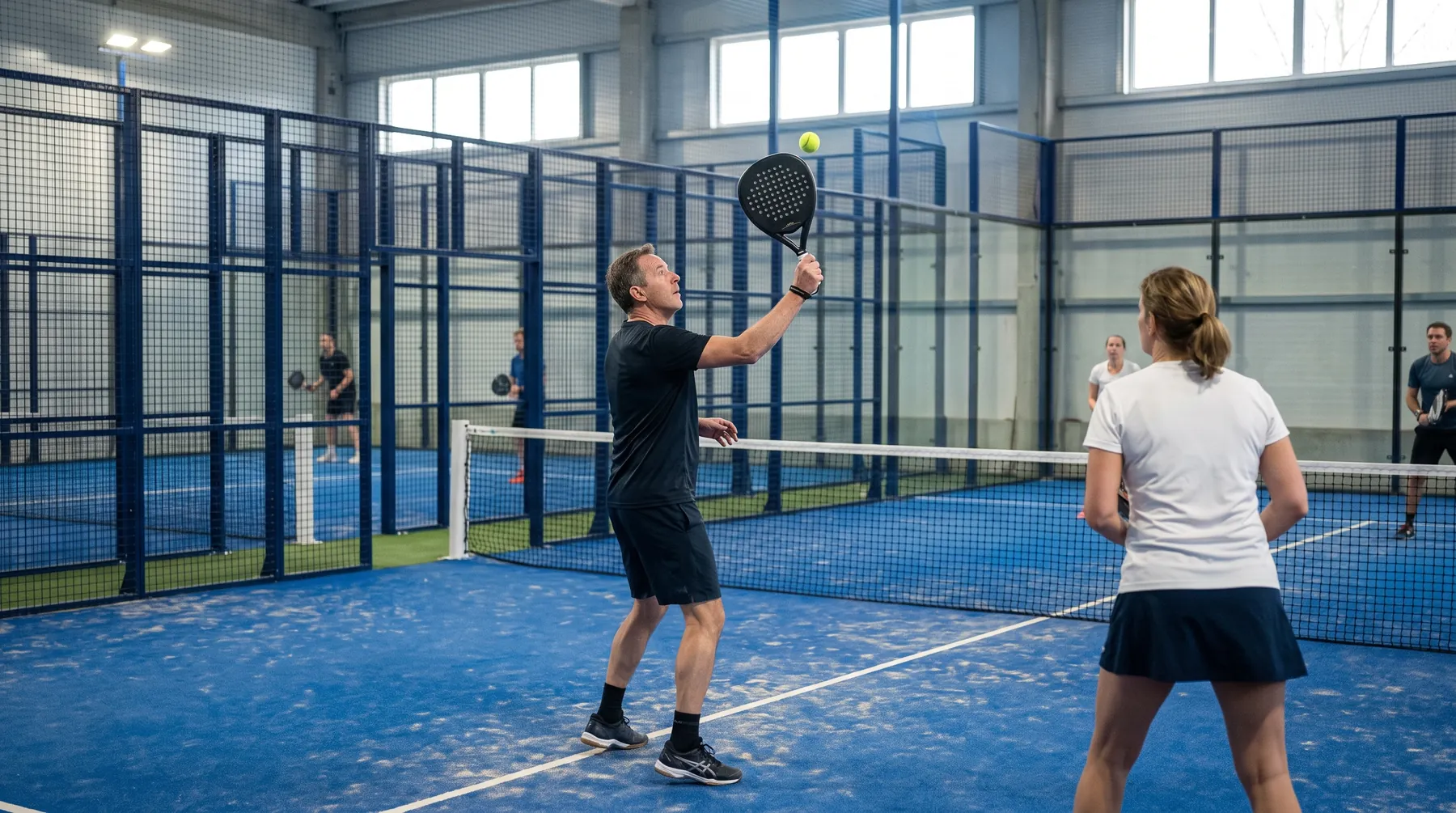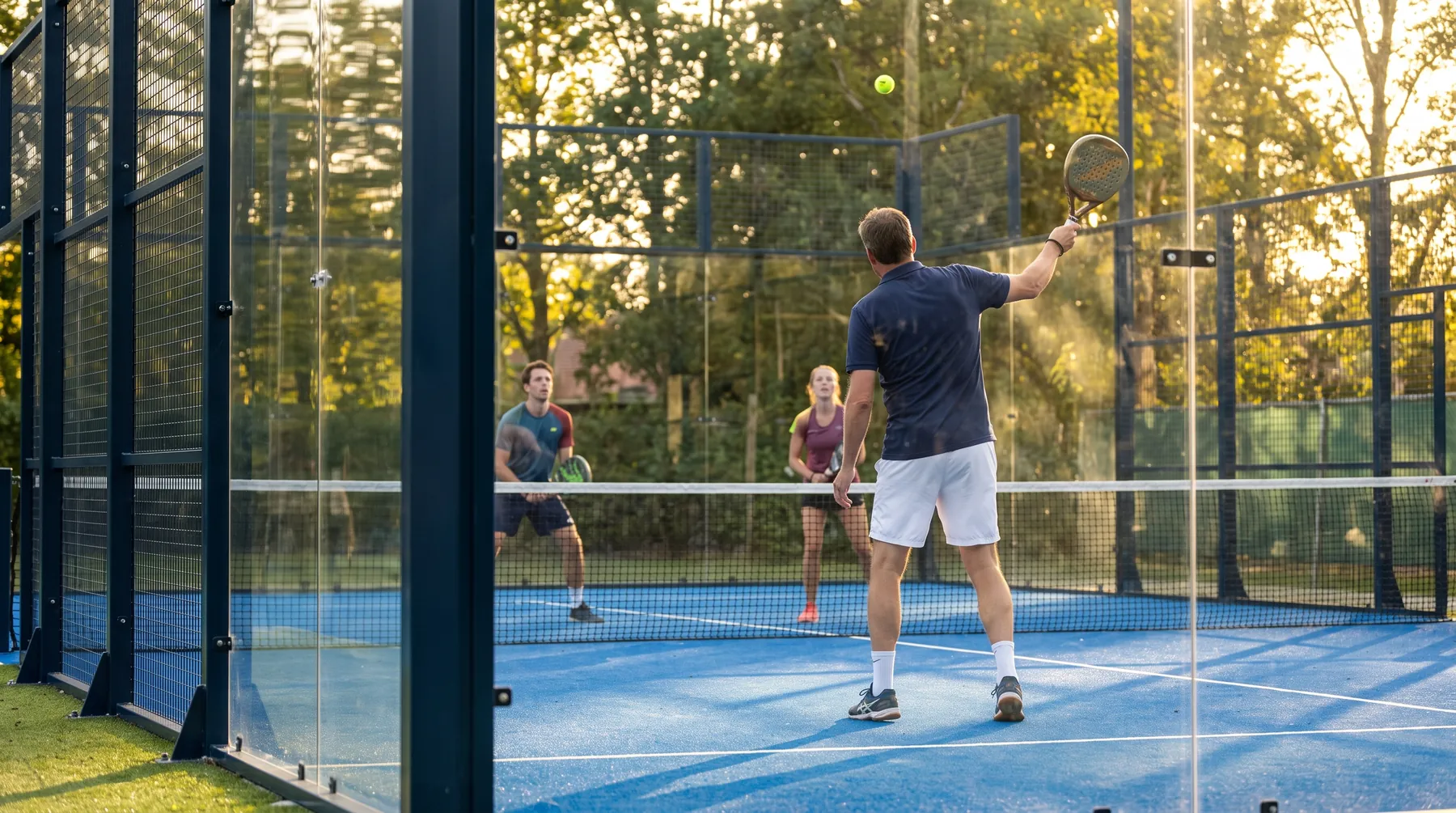
When a shot goes wrong, the racket usually gets the blame. Watch it back, though, and the problem was often there a second earlier: you were flat-footed when the ball was hit, or still moving when you hit it.
The Padel School makes the point that matches are lost less because of how players hit the ball than because of where they hit it from. Where you hit it from is down to your feet.
Why footwork matters more in padel
The court is small and the ball comes back off the walls, so most exchanges at the net are quick. You have less time to react than on a tennis court, and the ball can arrive from more directions, including off the side and back glass. Good feet buy you that time back.
There’s a health reason too. Padel is full of stops, lunges and changes of direction, and the lower limbs, taken as a region, account for more padel injuries than any other part of the body. Moving with bent knees and balanced landings puts less strain on knees and ankles than lunging at balls from a standstill. Shoes play their part, and the padel shoes post covers grip and support.
The ready position
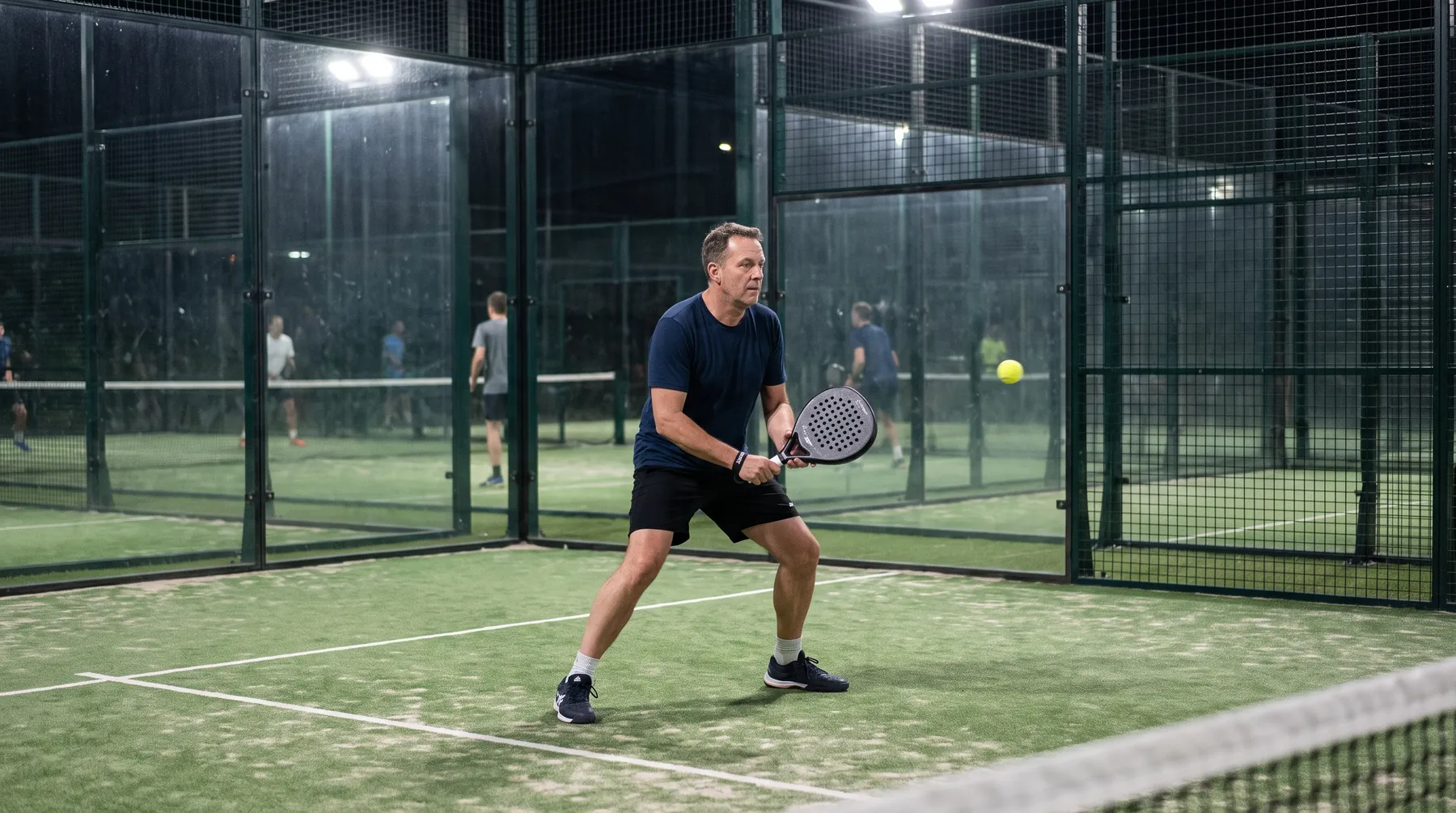
Everything starts from a base you can push off in any direction:
- Feet about shoulder-width apart.
- Knees slightly bent, weight forward on the balls of your feet.
- Heels light. Once they’re planted on the turf you’re slower to move.
- Racket up in front of you, so you don’t have to lift it before every shot.
It should feel springy, not crouched. If your thighs are burning after a few points, you’re too low.
The split step
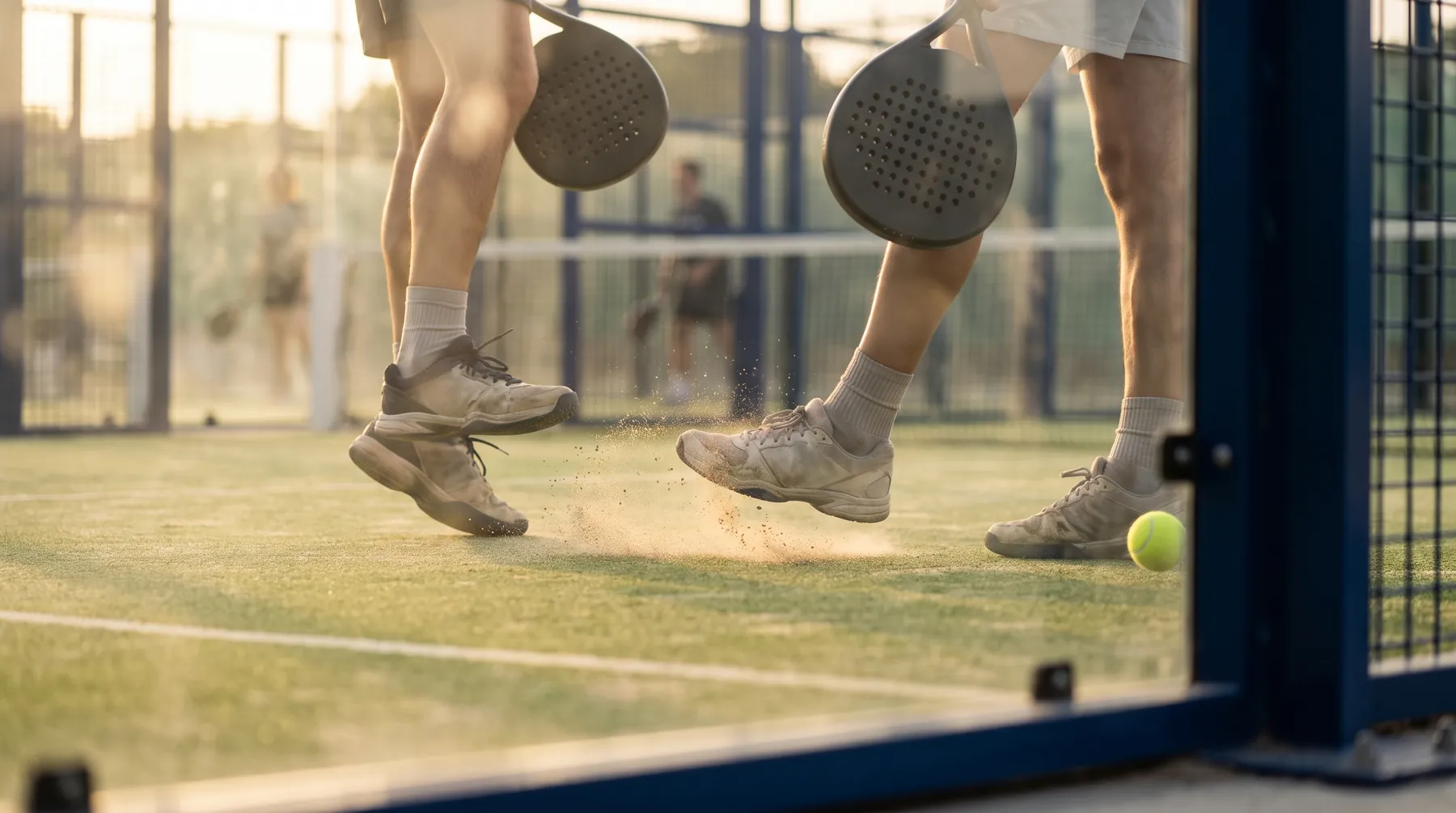
The split step is a small hop that lands you on both feet, slightly apart, just as the opponent hits the ball. Landing at that moment loads your legs so you can push off straight away in whichever direction the ball goes.
Timing is the whole skill. Hop too early and you’ve landed and gone flat before they hit. Hop too late and you’re in the air when you need to move. Aim to land just as their racket meets the ball.
The Padel School points out a difference from tennis here. With less reaction time, a padel split step should be lighter, quicker and a bit higher than the deep, low one many tennis players learn. Stay on your toes and keep it small.
Do it before every opponent’s shot, and not only when you’re waiting to return a serve. It applies when you’re moving forward too. Coming in to the net, stop and split step as the opponent is about to hit, then react. Running through their shot is how you get passed.
If you’re new and can’t yet read where the ball is going, forget that part for now. Concentrate on landing the split step at the right moment. Reading the direction comes with time, and you’ll already be balanced to move once it does.
Getting to the ball
Once you know where the ball is going, you have three kinds of step to choose from:
- Side steps (a shuffle, feet not crossing) for short moves along the net or the baseline. They keep you facing the play.
- Crossover steps, where one leg crosses in front of the other, when you need to cover ground quickly, such as going back for a lob or chasing a wide ball.
- Small adjustment steps as you arrive, to set the distance between you and the ball.
Beginners usually take too few steps, arriving with one big lunge and hitting off balance. The Padel School tells new players to do the opposite and take plenty of small steps on the approach. Good players look as if they barely move because they read the ball early and need fewer steps. You get there by starting with more of them.
Move diagonally when the ball is diagonal. A ball dropping towards the back corner needs you to go back and across in one line, not back first and then sideways.
Above all, try to be still when you hit. Set your feet, then swing. Hitting while you’re still running or leaning is behind a lot of unforced errors.
Going back for lobs and glass balls
Two situations go wrong so often that they need their own mention.
When a lob goes over you at the net, turn side-on straight away and move back with crossover steps, eyes on the ball. Backpedalling while facing the net is slow and is how people end up on the floor. Go far enough back that the ball drops in front of you, ready for a bandeja.
When a deep ball is heading for the back glass, make the same turn, but now you’re moving to where the ball will be after it rebounds, leaving a gap between you and the wall. How big that gap should be, and how to read the bounce, is the subject of the post on playing off the glass.
Recovering after every shot
The shot isn’t finished when the ball leaves your racket. A very common club habit is hitting a decent ball and then standing to admire it. By the time it comes back, you’re out of position.
Make recovery part of the shot. After a volley, take a step back into your ready position. After a bandeja, carry the momentum forward and get back to the net. After a ball off the glass, move up to your defensive spot. Then split step again as the opponent hits.
Moving as a pair
Doubles footwork isn’t only about your own feet. Coaches boil it down to one rule: go forward together and drop back together. If one of you goes to the net while the other stays back, a big diagonal gap opens through the middle, and decent opponents will find it.
Imagine the two of you joined by a short rope. When one moves forward, the other follows. When one is pulled wide towards the side glass, the other slides towards the middle to cover the gap. When a good lob sends one of you all the way back, the other drops back too.
That last one feels wrong at first, because it means giving up the net. But two players defending together at the back are far better placed than one at the net and one stranded behind. The positioning and tactics guide shows where each of you should stand in each case.
Practising footwork
Some of this works without a court. Shadow footwork at home or in your warm-up (split step, shuffle two steps, back to the middle, split step again) builds the habit. Agility ladders, cones and short shuttle runs help with quick feet if you enjoy that sort of thing. A few minutes of this on a spare evening is one of the easiest ways to practise between games.
Try this on court
A partner feeds from the other side at a gentle pace.
- They alternate balls to your left and right.
- Split step as they hit, move with small steps, and be still at contact.
- After each shot, recover to the middle before the next feed.
- Ten balls, rest, repeat. Ignore where your shots land.
If you can, film a game as well. Footwork problems you can’t feel while playing are obvious on video, and a phone on the bench is all it takes.
Next on the blogTalking to your partner: padel calls and hand signals