You’ve won the net, the other pair can’t get a ball past you, so they start lobbing. The ball climbs over your head and you have about a second to decide what to do with it.
Smash it, and unless you’re close to the net and well set, it comes back off the glass and you’ve lost your position. Let it go, and you’re back on the baseline defending. The bandeja is the third option, and it’s the one good players reach for most often.
What the bandeja is for
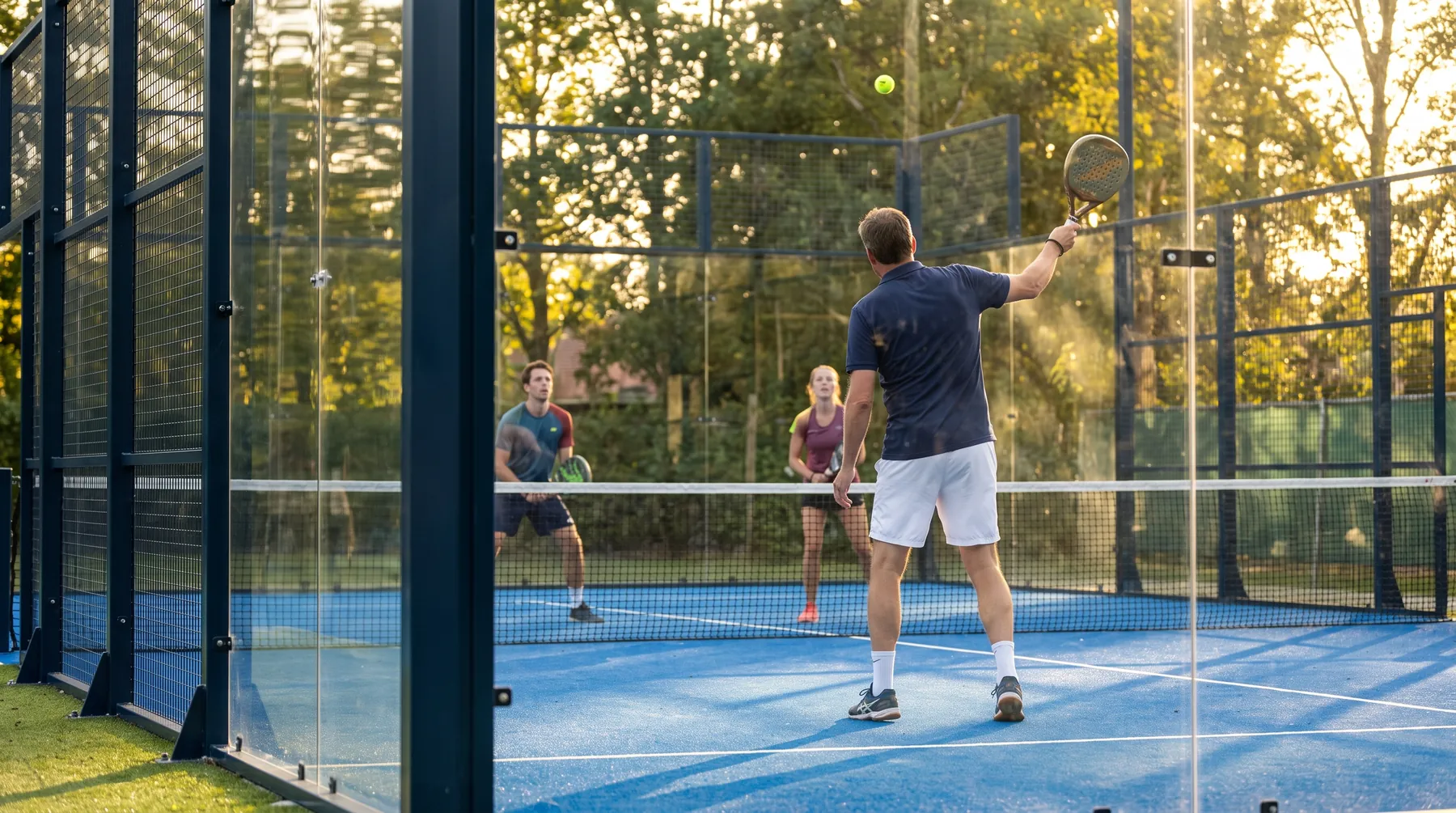
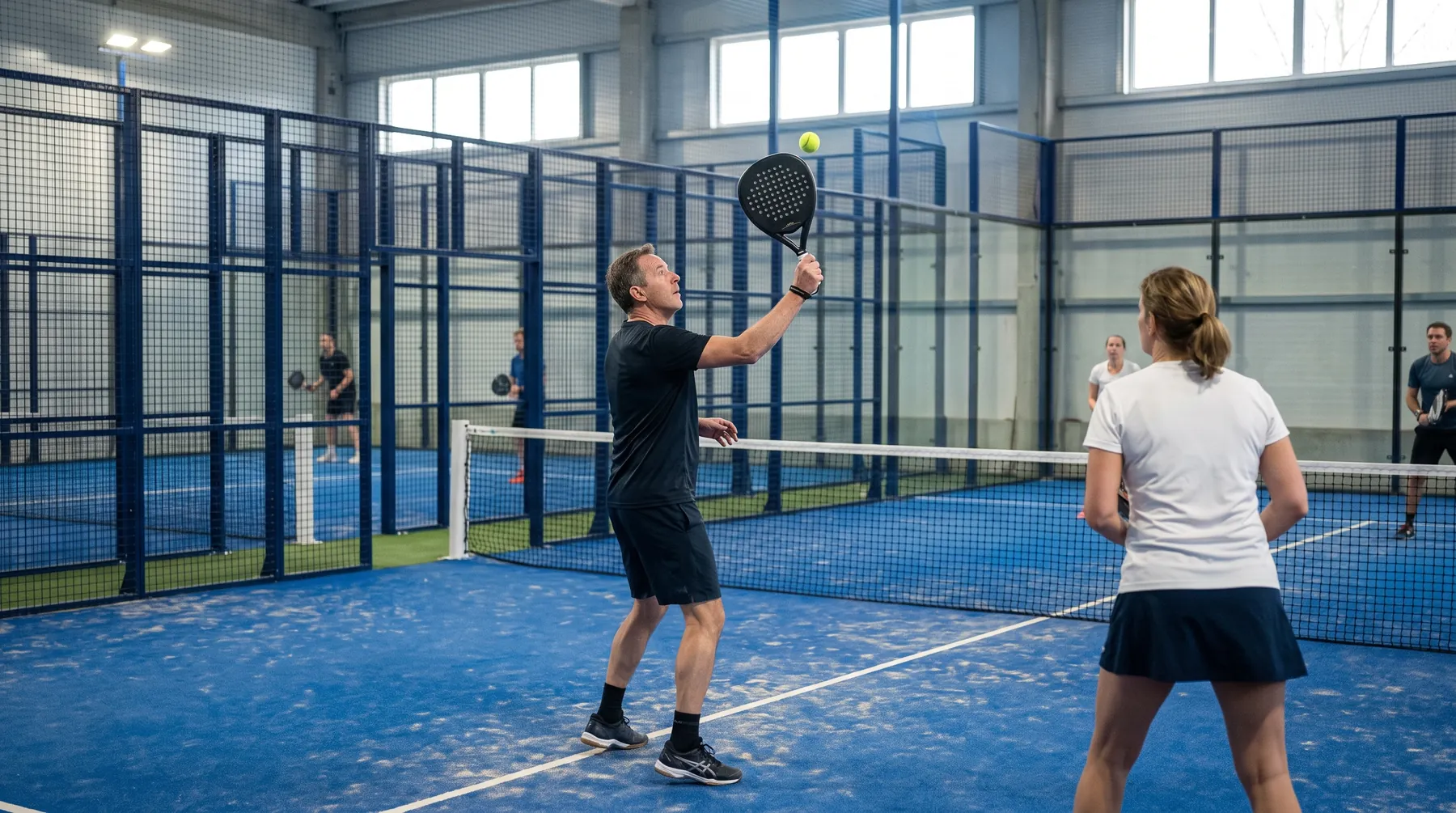
Bandeja is Spanish for “tray”, after the way the racket is held flat and open above your shoulder, like a waiter carrying drinks. It’s an overhead hit with slice and without much pace, and its job is to deal with a lob and keep you at the net.
So it holds on to the point; it rarely wins it. The LTA calls it the most common overhead in padel and says it accounts for 69% of overheads in the women’s game. What a good one does is land deep and come off the back glass low, so the other pair can’t attack you while you and your partner keep the net.
Think of it as the reply to a good lob. The lob forces you to hit an overhead from an awkward spot; the bandeja lets you answer without handing the net back.
Get there early
Almost every bad bandeja starts with late footwork. The moment you see an opponent getting under the ball to lob, start moving.
- Turn side-on. Point your shoulders at the side wall, not the net.
- Move back sideways. Use side steps or crossover steps. Backpedalling while facing the net is slow and leaves you off balance.
- Racket up. Lift it above your head as you move, hitting elbow high and the face open.
- Point at the ball. Your free hand tracks the drop and keeps your shoulders turned.
Go back a little further than seems necessary. You want the ball to drop in front of you, not over your head or behind you, because stepping forward into the shot is far easier than leaning back for it. The Padel School suggests filming yourself, since a phone propped on the bench shows straight away whether you’re getting back in time.
Hold the racket in the continental grip, the same one you use at the net. If you’re not sure you have it, check your grip first.
Contact and swing
Let the ball drop. Coaches differ a little on the exact height. The LTA and The Padel School both say about eye or forehead level, while others put it nearer the shoulder. Either way it’s lower than a smash, which you hit at full stretch, and it’s in front of your body, not above or behind your head.
The LTA describes the bandeja as a cross between an overhead and a forehand volley, which is a useful picture. The swing goes like this:
- Start with the racket above the contact point, face slightly open.
- Swing from high to low, cutting slightly under and through the ball. That’s the slice that keeps the bounce low.
- Instead of letting the racket finish down by your legs like a tennis smash, bring it across your body. The LTA’s image is wrapping your arm round you like a scarf.
Keep both feet on the ground while you’re learning. Professionals often hit it in the air, but staying grounded gives you a much steadier base.
Think “placement, not pace”. A bandeja that’s too hard gets to the opponents before you’ve recovered your position. Take pace off and aim for depth.
Where to aim
A good bandeja lands deep, past the service line, and comes off the back glass low enough that the opponents have to dig it out. You have two main targets.
Cross-court towards the side glass gives you the most court to hit into. If the opponent has drifted towards the middle, it sends them back into the corner and buys you time.
Down the middle, between the two of them, narrows their angles and can cause a moment’s confusion over who takes it.
Whichever you pick, the slice is what keeps the ball low. A flat bandeja tends to sit up off the glass and give the other pair an easy chance to attack.
Recover to the net
LTA coaches say the recovery matters almost as much as the shot. As you finish the swing, let the momentum carry you forward and get back to the net, level with your partner. Stand and admire it, and you’re stuck in no man’s land (the awkward middle of the court) with the opponents playing at your feet.
Your partner has a job too: stay level with you, so the two of you move back and forward together, the way pairs are meant to hold their positions through a rally.
Bandeja, víbora or smash?
The bandeja is one of a family of overheads, and choosing between them is half the skill.
- A short lob, close to the net, when you’re well set: smash it.
- A lob around the service line, with time to set up: bandeja, or a víbora (Spanish for “viper”, a faster overhead with sidespin) if you’re comfortable attacking.
- A deep lob that gets well past you: don’t force an overhead. Let it come off the back glass and play it off the wall instead.
When in doubt, play the bandeja. It’s the safe answer, and a deep, low one keeps you in the point.
The faults that make it bounce
If your bandeja keeps sitting up for the other pair, it’s usually one of these:
- Late preparation, so you hit the ball behind your head and push it up.
- A low elbow on the take-back, which flattens the swing and loses the slice.
- Hitting too hard, which makes it fly off the glass and leaves you no time to recover.
- Watching your last shot instead of moving back the moment the lob goes up.
- Squaring up to the net, which takes away the turn and the cross-court angle.
A drill for two pairs
This one is adapted from an LTA drill, and it needs all four of you.
Try this on court
One pair at the net, one pair at the back.
- The back pair starts each rally with a lob.
- The net pair must play a bandeja that lands beyond the service line before the point goes live.
- Then play it out: the net pair tries to keep the net and win the point.
- Swap ends every two points.
Keep a tally of how many bandejas let you get back level with your partner, and ignore the points score. If the number is low, the fault is nearly always in the first two steps of the footwork. Once it climbs, the bandeja and víbora guide shows where the faster víbora fits in.
Next on the blogPadel footwork: the split step, small steps and moving as a pair