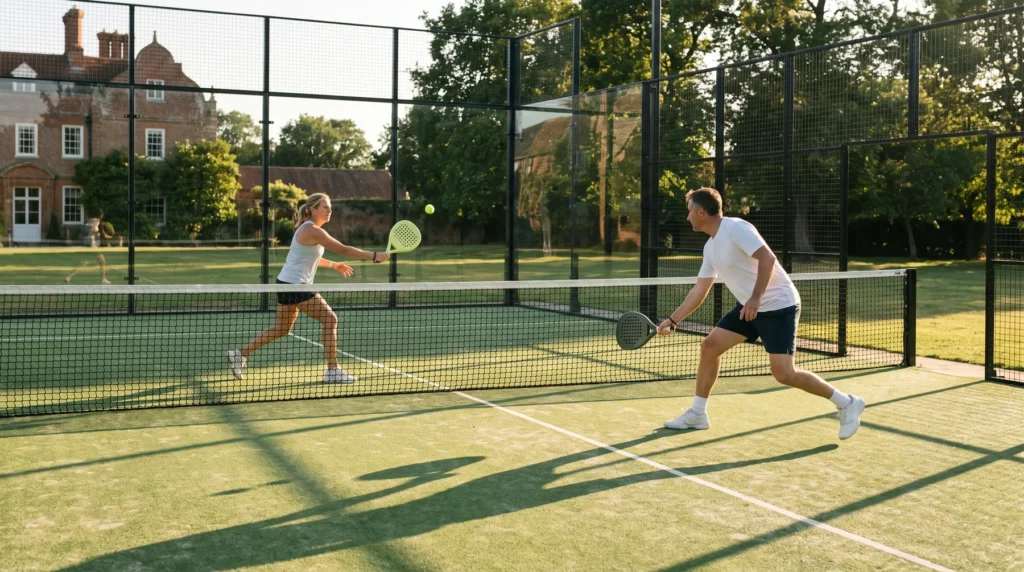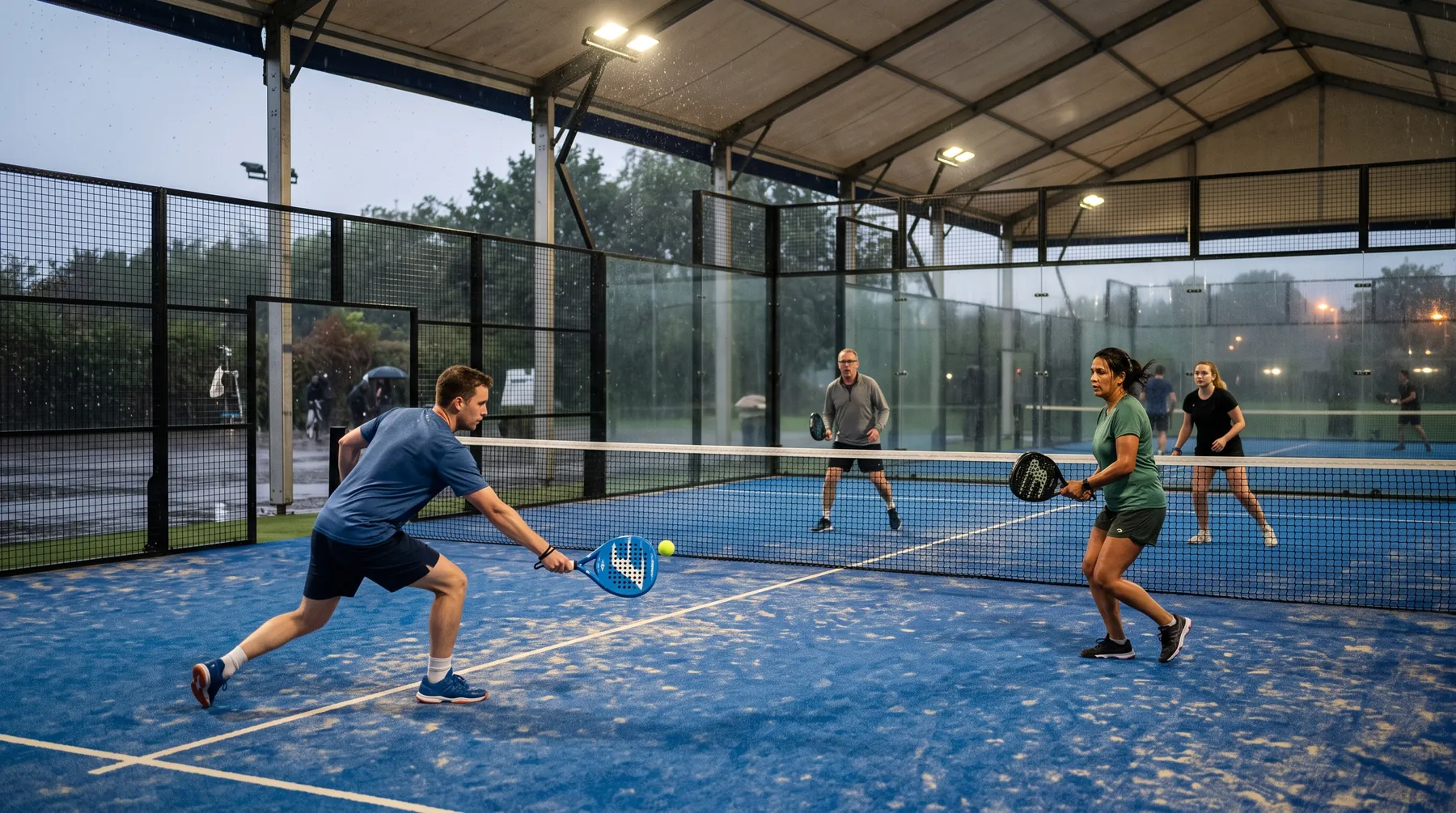
Book padel in Britain and you’ll meet three kinds of court: ones inside a proper building, ones under a canopy roof with open or half-open sides, and ones with nothing over them but sky.
The court inside the walls is identical in all three. Everything around it differs, and that changes how the ball behaves, what you should wear and what you pay.
The court itself doesn’t change
Under the FIP Rules of Padel, every court is 20 metres by 10 metres inside the walls, with the same net, the same service lines and the same glass and mesh enclosure. A point played indoors follows exactly the same rules as one played outside.
The building specs do differ slightly. LTA guidance for venues allows 10mm toughened glass on indoor courts and asks for 12mm outdoors, where the panels have to stand up to the weather. You won’t notice that from the service line. What you will notice is the air, the light, the temperature and whatever is above your head.
What counts as indoor
The word gets stretched. A fully enclosed hall keeps out wind, rain and most of the cold. A canopy keeps the rain off but often leaves the sides open, so you still get a breeze and a chilly evening. The LTA’s venue guidance describes both: some covered structures have a closed roof and walls, others are canopies with open sides, sometimes with mesh panels added to cut down wind and driving rain.
So when a listing says “covered”, look at the photos before you book, especially in winter. A canopy is not a heated hall, and you’ll want to dress for whichever one you’re getting. Venues choose between the three on cost and planning grounds, which our guide to building a padel court in the UK goes into.
Wind and sun outdoors
Wind is the biggest single difference on an open court. A lob that would drop neatly into the back corner indoors can be carried long by a following breeze or held up short by a headwind, and a short lob in padel usually gets smashed.
On gusty days, give your lobs more margin and keep more of the rally low and flat. Expect a few odd bounces off the glass too, because a ball that’s been pushed about in the air doesn’t come off the wall where you think it will.
The sun causes a different problem. Looking up into it for an overhead is miserable, and it turns a routine bandeja (padel’s controlled overhead) into guesswork. FIP recommends that outdoor courts run roughly north to south, which keeps the rising and setting sun off the ends, but a low winter sun still finds its way in.
Turn it to your advantage when you can. A ball that makes the net player look into the sun is much harder for them to attack, which is one more reason to lob well on a bright day.
Outdoors, check the wind and sun in the warm-up. Hit a few lobs from each end and see where they land, then agree with your partner which end is the hard one. You change ends after the first game and every two games after that, so you’ll both get a turn.
Temperature, damp and the glass
Ball pressure goes up in the warmth and down in the cold. On a hot day the ball flies and comes off the walls quickly. On a cold one it feels heavier, travels less and dies sooner off the glass, for reasons the post on padel balls goes into.
The glass changes too. An adidas padel coach, interviewed by the retailer All For Padel, says that on cold, damp days condensation forms on the walls and balls can drop almost straight down after hitting them. On those days, stand closer to the glass than usual and get your racket down early.
When it’s warm and dry the ball comes back out faster and further, so you need more room. The guide to playing off the glass has the basic movement.
Indoor halls take the edge off all of this, though not completely. An unheated hall in January is still cold, and the same coach warns that a hall without decent air conditioning can turn into an oven in summer. An open court never has that problem.
Looking up: roofs and lights
Outdoors there’s no ceiling, so you can throw up the highest defensive lob you like. Indoors, the roof sets a limit. The FIP rules ask for at least six metres of clear height over the whole court with nothing hanging into that space, and suggest eight metres for new venues. Older or converted buildings can feel lower, particularly near the ends.
The rule
If your shot bounces in the opponents’ court and then flies up into the ceiling, the lights or anything else that isn’t part of the court, it’s a good shot and you win the point (FIP Rules of Padel). A ball that hits the roof before it bounces is lost by whoever hit it.
Venues with a low roof sometimes add house rules for awkward cases, so ask at the desk if the beams look close.
Light matters on both kinds of court. FIP wants lighting that’s even across the court and doesn’t dazzle, with the fittings at least six metres up. Indoors you get the same light all day. Outdoors, evening games in autumn and winter rely on floodlights, so check they’re included in the booking.
Playing outside the court
In competitions with space around the court, players run out through the side openings to chase a ball that has bounced and left the court. Whether you can do that has nothing to do with the roof.
The FIP rules only allow it where each side has two openings and a clear area outside, at least three metres wide and four metres long, with no obstacles. Plenty of indoor halls pack their courts too close together for that, and so do many outdoor sites.
Where out-of-court play isn’t allowed, a ball that bounces and then leaves the court over the walls or through an opening is simply a winner for whoever hit it. Agree which applies before you start, so nobody sprints into the next court.
What it costs
A roof costs money to build, light and maintain, and booking prices reflect it. LTA Padel’s guide figures for venues put average pay-and-play court hire higher indoors than outdoors in every region it lists:
| Region | Indoor court, per hour | Outdoor court, per hour |
|---|---|---|
| London | £37 | £27 |
| South of England | £28 | £23 |
| Midlands | £27 | £20 |
| North of England | £20 | £17 |
| Scotland | £27 | £25 |
These are guide figures for a whole court, not quotes, so split them four ways and expect peak times to cost more. Per person the gap is small: in London it works out at about £2.50 each for the hour. Peak and off-peak pricing, and the apps that show it, are covered in booking a court in the UK.
Which should you book?
If you’re learning, we’d lean indoors when you can. The ball does the same thing every time, so you can work on your swing and your wall play without the weather setting you a second puzzle. A well-built outdoor court on a calm day is just as good, though, and if it’s cheaper or closer, the extra games will do more for you than the roof would.
Outdoor padel has its own case. It teaches you to read the conditions and play with more margin, and a warm evening outside with the floodlights coming on is hard to beat. The LTA notes that covered courts are used fairly evenly through the year while uncovered ones drop off in winter, so that’s when outdoor slots are easiest to get.
Plenty of players split the year: outside while the evenings are light, under cover once it turns grim. If you’re hunting for a venue with a roof before the clocks go back, the map of UK courts lets you check what each one has.
Next on the blogPlaying padel through a British winter